
Rust vs Ruby
Rust
The overprotective friend who's always right. Rust won't let you make mistakes, and you'll resent it until you realize every error it caught would have been a 3am production incident.
Ruby
The poet who became a startup founder. Matz designed Ruby explicitly to maximize programmer happiness, and it shows. Everything is an object, every expression returns a value, and blocks let you express ideas with a rhythm that feels literary.
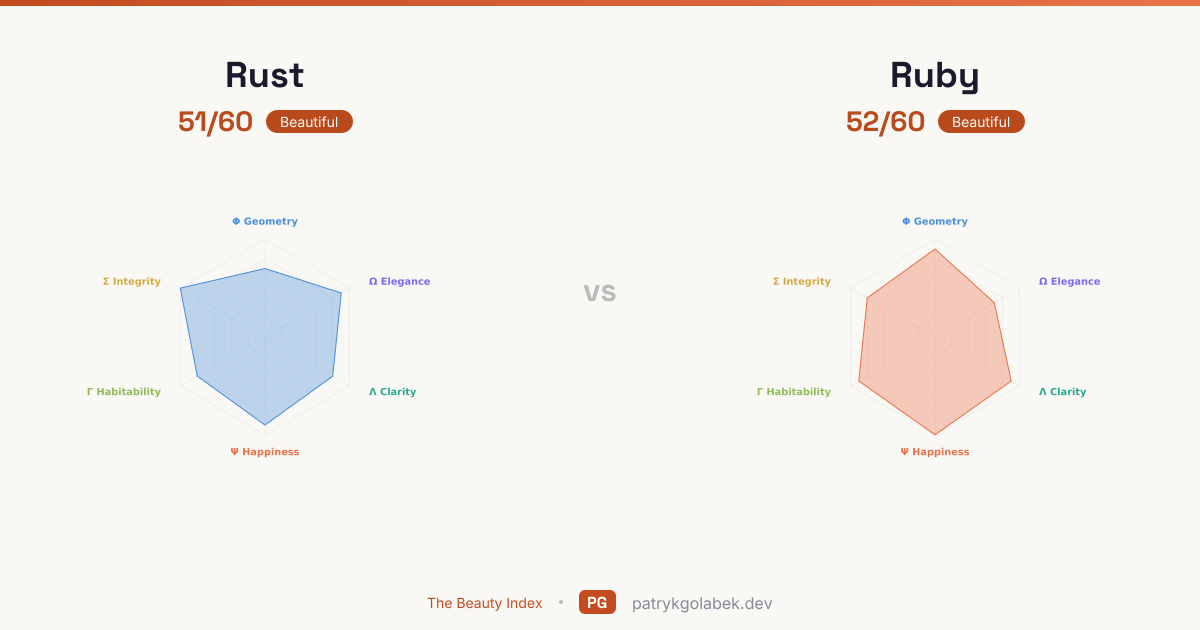
Ruby scores 52/60 against Rust's 51/60, leading in 4 of 6 dimensions. Rust owns mathematical and design while Ruby leads in aesthetic and human. Mathematical Elegance is where the pair separates most cleanly — Rust leads Ruby by 2 points and that gap colours everything else on the page.
See also: PHP vs Ruby , Rust .
Dimension-by-dimension analysis
Ω Mathematical Elegance
Rust wins Mathematical Elegance by 2 points — a decisive elegance advantage. Algebraic data types, pattern matching, and zero-cost abstractions let you write algorithms that feel close to mathematical proofs. Ownership annotations interrupt the flow slightly — the ceremony is justified but still ceremony. The gap on Elegance is real: Rust rewards precise thought, Ruby rewards precise bookkeeping. Everything is an object, every expression returns a value, and blocks enable higher-order patterns. Not a mathematical language per se, but its internal consistency gives algorithms a sense of inevitability. At the systems level elegance is rare and valuable — the winner earns it under real constraints.
Φ Aesthetic Geometry
Ruby wins Aesthetic Geometry by 2 points — a decisive visual advantage. Ruby's block syntax, do...end and { } conventions, and method chaining create a natural visual flow. Code reads top-to-bottom with a literary rhythm. Indentation feels organic rather than enforced. The visual gap between the two is not subtle — where Ruby prizes geometric calm, Rust trades that serenity for other commitments. rustfmt enforces strong visual consistency, and match arms, impl blocks, and module structure create clear visual architecture. Docked because lifetime annotations, turbofish (::<>), and trait bounds add visual noise that breaks geometric serenity. Designers of high-level code feel this difference the moment they open an unfamiliar module.
Σ Conceptual Integrity
Rust wins Conceptual Integrity by 2 points — a decisive philosophical edge. "Safety without sacrificing control." Every feature (ownership, borrowing, lifetimes, traits) follows from this single idea. Rust is the most opinionated systems language ever designed, and every opinion is justified by the core philosophy. Where Rust holds a line, Ruby has negotiated with history, ecosystems, and legacy users. "Optimize for programmer happiness" is a clear, singular vision. Ruby occasionally accumulates features (e.g., multiple ways to define lambdas), but the core philosophy holds. Docked slightly for the flexibility-creates-inconsistency tradeoff. Philosophical unity in a systems language is a rare and load-bearing virtue.
Γ Organic Habitability
Ruby edges Rust by a single point on Organic Habitability; the practical difference is slim but real. Monkey-patching, open classes, and convention-over-configuration make Ruby extremely habitable. Code accommodates change with minimal friction. The language invites you to extend it rather than fight it. The habitability edge is slim and often dominated by team culture rather than language choice. Ownership rules force you to think about structure upfront, which often produces code that ages well. Some modifications ("I just wanted to add a reference here") cascade more than expected, but the type system catches the fallout. For application codebases the habitability edge determines whether a project survives its second rewrite.
Λ Linguistic Clarity
Ruby edges Rust by a single point on Linguistic Clarity; the practical difference is slim but real. .reject(&:empty?), .each_with_index, File.readlines — Ruby reads aloud as English. Matz explicitly optimized for human communication over machine efficiency. Among the highest Knuthian "wit" in any language. On readability the edge is slim and disappears quickly as idioms are learned. Trait-based design, expressive enums, and the ? operator make intent clear. Rust rewards you with readable code once you know the idioms. Lifetime annotations are information for the compiler rather than the human reader, which docks it from 9. In high-level work, readable code is the difference between a 6-month onboarding and a 6-week one.
Ψ Practitioner Happiness
Ruby edges Rust by a single point on Practitioner Happiness; the practical difference is slim but real. Ruby was designed to maximize programmer happiness, it's the explicit, stated mission. Matz's philosophy permeates everything from the standard library API to the community culture. The canonical 10 on this dimension. Ruby noses ahead in surveys, but Rust retains a devoted following of its own. Topped Stack Overflow's "Most Admired" for 7+ consecutive years at 72%. The community is evangelical in its love. Compiler error messages are genuinely helpful. The "fighting the borrow checker" phase gives way to deep satisfaction. The winner here invites the next generation of contributors without asking them to earn it first.
Code comparison
The characteristic code snippet that best represents each language.
enum Shape {    Circle(f64),    Rectangle(f64, f64),    Triangle(f64, f64, f64),}
fn area(shape: &Shape) -> f64 { match shape { Shape::Circle(r) => std::f64::consts::PI * r * r, Shape::Rectangle(w, h) => w * h, Shape::Triangle(a, b, c) => { let s = (a + b + c) / 2.0; (s * (s - a) * (s - b) * (s - c)).sqrt() } }}class Array def histogram each_with_object(Hash.new(0)) { |item, counts| counts[item] += 1 } .sort_by { |_, count| -count } .map { |item, count| "#{item}: #{'*' * count}" } .join("\n") endendData structure definition using classes, structs, records, or equivalent.
#[derive(Debug, Clone)]struct User {    name: String,    email: String,    age: u32,}
impl User { fn new(name: &str, email: &str, age: u32) -> Self { Self { name: name.into(), email: email.into(), age } }}User = Struct.new(:name, :email, :age) do def greeting "Hello, #{name}!" endend
user = User.new("Alice", "alice@ex.com", 30)puts user.greetingFrequently asked questions
- Which is easier to learn, Rust or Ruby?
- Ruby scores 10 on Practitioner Happiness versus Rust's 9. Ruby was designed to maximize programmer happiness, it's the explicit, stated mission. Matz's philosophy permeates everything from the standard library API to the community culture. The canonical 10 on this dimension. For a developer adding a new language to their toolbelt, the happier one is the one you will still be writing in six months.
- Is Rust or Ruby better for algorithm-heavy code?
- For algorithm-heavy code, Rust has a clear edge — it scores 9/10 on Mathematical Elegance against Ruby's 7/10. Algebraic data types, pattern matching, and zero-cost abstractions let you write algorithms that feel close to mathematical proofs. Ownership annotations interrupt the flow slightly — the ceremony is justified but still ceremony.
- Should I pick Rust or Ruby in 2026?
- Rust lands in the beautiful tier at 51/60; Ruby in the beautiful tier at 52/60. With so little between them on raw score, choose on ecosystem: the library set, hiring market, and tooling you already own. The score difference reflects years of community use, tooling maturity, and the editorial judgment of the Beauty Index rubric.