
PHP vs Ruby
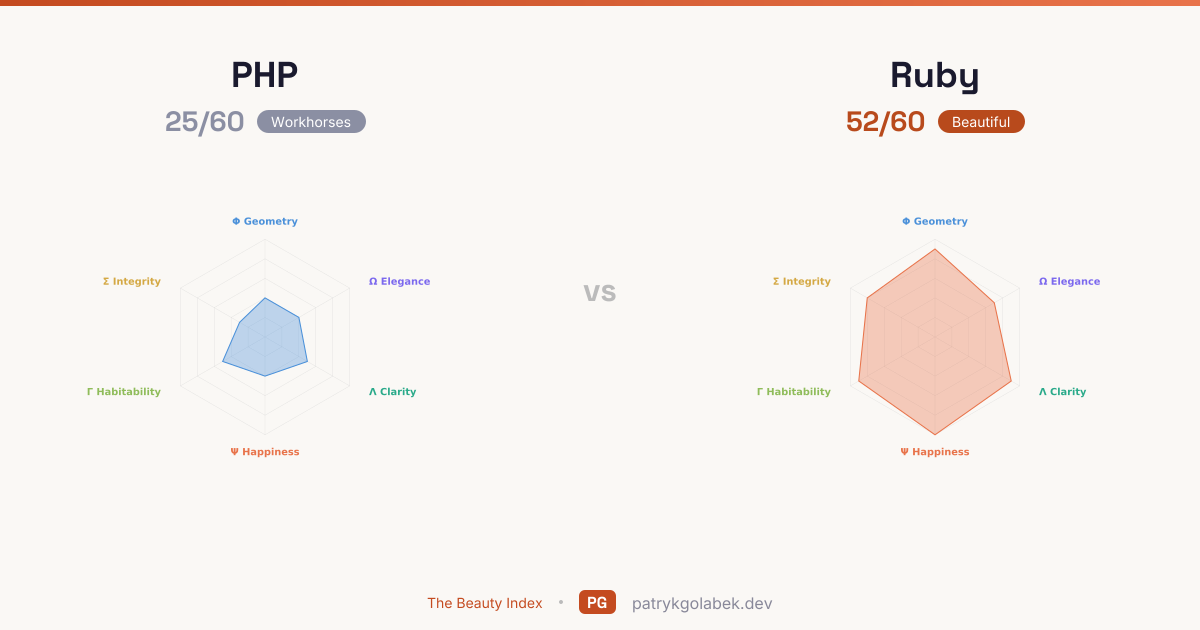
PHP
The duct tape that holds 40% of the web together while everyone pretends it doesn't exist. PHP is the cockroach of programming: ugly, everywhere, and absolutely unkillable.
Ruby
The poet who became a startup founder. Matz designed Ruby explicitly to maximize programmer happiness, and it shows. Everything is an object, every expression returns a value, and blocks let you express ideas with a rhythm that feels literary.
Ruby scores 52/60 against PHP's 25/60, leading in 6 of 6 dimensions. Ruby dominates the aesthetic, mathematical, human, and design axes. Read the comparison through Practitioner Happiness first: Ruby wins that axis by 6 points over PHP, and it is the single best lens on the pair.
See also: Elixir vs Ruby , PHP .
Dimension-by-dimension analysis
Ψ Practitioner Happiness
Ruby wins Practitioner Happiness by 6 points — a real happiness advantage. Ruby was designed to maximize programmer happiness, it's the explicit, stated mission. Matz's philosophy permeates everything from the standard library API to the community culture. The canonical 10 on this dimension. Where Ruby feels designed for the human, PHP feels designed for the machine first — the human catches up second. PHP developers themselves joke about PHP. The community is large and productive, but "most admired" it is not. Modern PHP (8.x with Laravel) has improved the experience significantly, but the reputation, and the daily reality of legacy code, weighs on happiness. For high-level work, developer happiness is the main driver of long-term retention.
Φ Aesthetic Geometry
Ruby wins Aesthetic Geometry by 5 points — a decisive visual advantage. Ruby's block syntax, do...end and { } conventions, and method chaining create a natural visual flow. Code reads top-to-bottom with a literary rhythm. Indentation feels organic rather than enforced. The visual gap between the two is not subtle — where Ruby prizes geometric calm, PHP trades that serenity for other commitments. $ on every variable, -> for method calls, inconsistent brace styles across frameworks, and <?php tags create visual clutter. Modern PHP (8.x) with named arguments and match expressions is cleaner, but the legacy visual debt remains. Designers of high-level code feel this difference the moment they open an unfamiliar module.
Σ Conceptual Integrity
Ruby wins Conceptual Integrity by 5 points — a decisive philosophical edge. "Optimize for programmer happiness" is a clear, singular vision. Ruby occasionally accumulates features (e.g., multiple ways to define lambdas), but the core philosophy holds. Docked slightly for the flexibility-creates-inconsistency tradeoff. Ruby speaks with a single design voice; PHP speaks with a committee. PHP was not designed; it was accumulated. Rasmus Lerdorf's personal homepage tools grew into a language without a coherent philosophy. Each version has improved quality, but there is no "soul", no single idea that all features follow from. The quintessential committee language. For application code the integrity edge means fewer "wait, why does it behave that way?" moments per week.
Γ Organic Habitability
Ruby wins Organic Habitability by 4 points — a meaningful extensibility gap. Monkey-patching, open classes, and convention-over-configuration make Ruby extremely habitable. Code accommodates change with minimal friction. The language invites you to extend it rather than fight it. Ruby invites modification; PHP rewards planning more than adjustment. PHP codebases survive, 77% of the web runs on PHP, and that code keeps working. The language is pragmatically habitable. But the inconsistent standard library and multiple paradigm shifts (procedural → OOP → modern PHP) make long-term evolution uneven. In high-level work, the language that welcomes modification wins the decade, not the quarter.
Λ Linguistic Clarity
Ruby wins Linguistic Clarity by 4 points — a meaningful clarity gap. .reject(&:empty?), .each_with_index, File.readlines — Ruby reads aloud as English. Matz explicitly optimized for human communication over machine efficiency. Among the highest Knuthian "wit" in any language. Ruby reads like a well-edited paragraph; PHP reads like a sentence that is still being translated. PHP can be readable in modern frameworks (Laravel's fluent syntax reads well). But str_replace vs. strpos vs. substr, inconsistent parameter ordering, and the legacy API are the antithesis of linguistic clarity. Two PHPs coexist: modern and legacy. The winner here treats readability as a core feature rather than a style preference.
Ω Mathematical Elegance
Ruby wins Mathematical Elegance by 3 points — a decisive elegance advantage. Everything is an object, every expression returns a value, and blocks enable higher-order patterns. Not a mathematical language per se, but its internal consistency gives algorithms a sense of inevitability. Ruby lets algorithms approach mathematical statement, while PHP asks more of the programmer when elegance is the goal. PHP is a templating language that grew into a general-purpose one. Array functions exist but lack the composability of functional languages. Mathematical elegance is not the design space PHP occupies. In application code the elegance edge shows up as less boilerplate per idea.
Code comparison
Data structure definition using classes, structs, records, or equivalent.
readonly class User {    public function __construct(        public string $name,        public string $email,        public int $age = 0,    ) {}
public function greeting(): string { return "Hello, {$this->name}!"; }}User = Struct.new(:name, :email, :age) do def greeting "Hello, #{name}!" endend
user = User.new("Alice", "alice@ex.com", 30)puts user.greetingThe characteristic code snippet that best represents each language.
$results = array_map( fn($user) => [ 'name' => $user['name'], 'email' => strtolower($user['email']), 'score' => array_sum($user['grades']) / count($user['grades']), ], array_filter( $users, fn($u) => $u['active'] && count($u['grades']) > 0 ));class Array def histogram each_with_object(Hash.new(0)) { |item, counts| counts[item] += 1 } .sort_by { |_, count| -count } .map { |item, count| "#{item}: #{'*' * count}" } .join("\n") endendFunction definition, parameters, return types, and closures.
function greet(string $name): string {    return "Hello, $name!";}
$apply = fn($f, $x) => $f($x);$double = fn($x) => $x * 2;
$makeAdder = fn($n) => fn($x) => $x + $n;def greet(name) "Hello, #{name}!"end
def apply(value, &block) block.call(value)end
double = ->(x) { x * 2 }triple = proc { |x| x * 3 }Frequently asked questions
- Which is easier to learn, PHP or Ruby?
- Ruby scores 10 on Practitioner Happiness versus PHP's 4. Ruby was designed to maximize programmer happiness, it's the explicit, stated mission. Matz's philosophy permeates everything from the standard library API to the community culture. The canonical 10 on this dimension. For a developer adding a new language to their toolbelt, the happier one is the one you will still be writing in six months.
- Is PHP or Ruby better for developer happiness?
- For developer happiness, Ruby has a clear edge — it scores 10/10 on Practitioner Happiness against PHP's 4/10. Ruby was designed to maximize programmer happiness, it's the explicit, stated mission. Matz's philosophy permeates everything from the standard library API to the community culture. The canonical 10 on this dimension.
- Should I pick PHP or Ruby in 2026?
- PHP lands in the workhorses tier at 25/60; Ruby in the beautiful tier at 52/60. On this score difference the answer is clear: the higher-ranked language wins unless you have an explicit reason to pay the cost of the other.