
Zig vs Elixir
Zig
The systems programmer who looked at C and said 'I can fix this without adding complexity.' Zig is the rare language that removes footguns by making the right thing the easy thing.
Elixir
The jazz musician who studied classical. Elixir takes Erlang's battle-tested concurrency and wraps it in syntax so pleasant you forget you're building distributed systems that never go down.
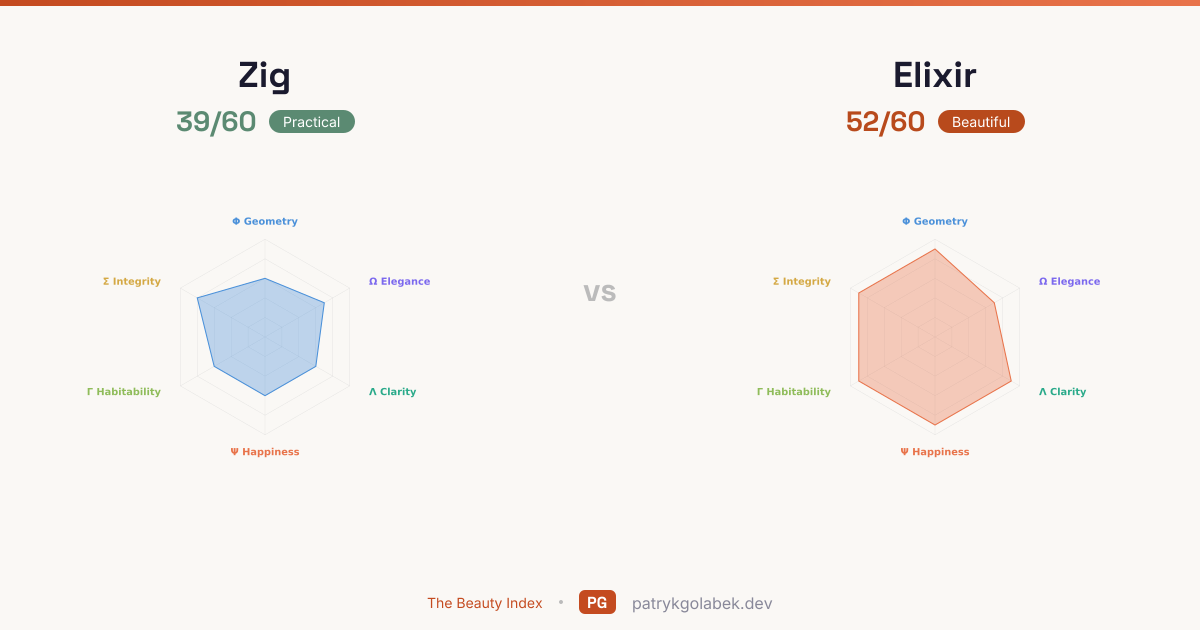
Elixir scores 52/60 against Zig's 39/60, leading in 5 of 6 dimensions. Elixir dominates the aesthetic, human, and design axes. The widest gap sits on Organic Habitability, where Elixir's 3-point lead over Zig shapes most of the pair's character.
See also: PHP vs Elixir , Zig .
Dimension-by-dimension analysis
Γ Organic Habitability
Elixir wins Organic Habitability by 3 points — a clear edge for long-lived code. Pipelines are growth-point idioms, insert a transformation step anywhere without restructuring. OTP's supervision trees are the embodiment of habitable architecture: systems designed to fail gracefully and be extended incrementally. Where Elixir accommodates change gracefully, Zig makes you earn each new direction. Zig's explicitness makes code predictable to modify but also verbose to evolve. The language removes footguns but doesn't actively create growth-point idioms. Habitable by being unsurprising rather than by being inviting. The winner here is the language you will still enjoy reading in five years.
Λ Linguistic Clarity
Elixir wins Linguistic Clarity by 3 points — an unmistakable prose-like flow. The pipe operator (|>) turns data transformation into a readable narrative. "hello" |> String.split() |> Enum.map(&String.capitalize/1) reads as a clear sequence of intentions. Among the most literate functional languages. Where Elixir favours plain intent, Zig trades clarity for control, capability, or history. Explicit by design, no hidden control flow, no hidden allocators. This makes code predictable but verbose. You always know what's happening, but you're reading more to know it. For application code the clarity advantage is the whole point of the language category.
Φ Aesthetic Geometry
Elixir wins Aesthetic Geometry by 3 points — an unmistakable aesthetic lead. Pipeline operators, pattern-matching clauses, and module structure create a visual flow that scans beautifully. Elixir code looks like a series of clean, evenly weighted transformation steps. Set the two side by side and the shape of each language announces itself before you read a single identifier. Clean and minimal but not visually distinctive. Zig code is functional and well-structured, but the syntax doesn't create the kind of visual rhythm that scores above 7. Workmanlike layout. For application code the geometry translates directly into readability for new contributors.
Ψ Practitioner Happiness
Elixir wins Practitioner Happiness by 3 points — a genuine community lead. Stack Overflow admiration at 66%. The Phoenix framework, LiveView, and OTP give practitioners a feeling of building something that "just works." The community is small but deeply enthusiastic and welcoming. Elixir has done the harder cultural work: tooling that delights, a community that welcomes, documentation that explains. Growing admiration in the systems programming community. The compiler's error messages are good, and the community is enthusiastic. Still young enough that tooling and ecosystem maturity lag behind established languages. For high-level work, developer happiness is the main driver of long-term retention.
Σ Conceptual Integrity
Elixir edges Zig by a single point on Conceptual Integrity; the practical difference is slim but real. "Erlang's power with modern syntax." José Valim had a clear vision: bring functional programming and fault-tolerant concurrency to a wider audience. The language feels designed by one mind with a singular purpose. Both Zig and Elixir have coherent design philosophies; Elixir merely holds to its centre with a firmer grip. "No hidden control flow, no hidden memory allocators." Andrew Kelley's vision is sharp and consistent. Every design choice follows from the principle that implicit behavior is the enemy. A focused, opinionated systems language. In high-level work a coherent philosophy is the frame that holds the language's features together.
Ω Mathematical Elegance
Both score 7 — this is one dimension where Zig and Elixir genuinely agree. comptime is genuinely clever, compile-time code generation without metaprogramming complexity. The approach to generics and allocators is elegant in a systems-programming context, though not mathematically abstract. When it comes to reaching "The Book," these two arrive together. Pattern matching, recursion, and immutable data structures support elegant algorithm expression. Not as abstract as Haskell or OCaml, but the BEAM VM's concurrency primitives give certain distributed algorithms an inevitable quality. When performance and precision matter, the language that expresses the algorithm most directly wins twice.
Code comparison
The characteristic code snippet that best represents each language.
fn fibonacci(comptime n: u32) u128 {    var a: u128 = 0;    var b: u128 = 1;    for (0..n) |_| {        const tmp = a;        a = b;        b = tmp + b;    }    return a;}
// Computed at compile time, zero runtime costconst fib_50 = fibonacci(50);def process_order(%Order{items: items, user: user}) do items |> Enum.filter(&(&1.in_stock)) |> Enum.map(&apply_discount(&1, user.tier)) |> Enum.reduce(0, &(&1.price + &2)) |> apply_tax(user.region) |> format_total()endException handling via try/catch or Result/Either patterns.
const ParseError = error{InvalidInput};
fn parseNumber(s: []const u8) ParseError!i32 {    return std.fmt.parseInt(i32, s, 10) catch {        return error.InvalidInput;    };}
const result = parseNumber("42") catch |err| { std.debug.print("Error: {}\n", .{err}); return;};with {:ok, user} <- fetch_user(id), {:ok, posts} <- fetch_posts(user.id), {:ok, _} <- validate(posts) do {:ok, format_response(user, posts)}else {:error, :not_found} -> {:error, "User not found"} {:error, reason} -> {:error, reason}endMap, filter, reduce and functional collection transformations.
const numbers = [_]i32{ 1, 2, 3, 4, 5, 6, 7, 8, 9, 10 };
var sum: i32 = 0;for (numbers) |n| {    sum += n;}
var evens: [5]i32 = undefined;var idx: usize = 0;for (numbers) |n| { if (@rem(n, 2) == 0) { evens[idx] = n; idx += 1; }}numbers = 1..10
doubled = Enum.map(numbers, &(&1 * 2))evens = Enum.filter(numbers, &(rem(&1, 2) == 0))total = Enum.reduce(numbers, 0, &+/2)
result = numbers|> Enum.filter(&(rem(&1, 2) == 0))|> Enum.map(&(&1 * &1))Frequently asked questions
- Which is easier to learn, Zig or Elixir?
- Elixir scores 9 on Practitioner Happiness versus Zig's 6. Stack Overflow admiration at 66%. The Phoenix framework, LiveView, and OTP give practitioners a feeling of building something that "just works." The community is small but deeply enthusiastic and welcoming. When ease of learning is the deciding factor, the happier community wins every time — mentors, docs, and examples are simply more abundant.
- Is Zig or Elixir better for long-lived codebases?
- For long-lived codebases, Elixir has a clear edge — it scores 9/10 on Organic Habitability against Zig's 6/10. Pipelines are growth-point idioms, insert a transformation step anywhere without restructuring. OTP's supervision trees are the embodiment of habitable architecture: systems designed to fail gracefully and be extended incrementally.
- Should I pick Zig or Elixir in 2026?
- Zig lands in the practical tier at 39/60; Elixir in the beautiful tier at 52/60. On this score difference the answer is clear: the higher-ranked language wins unless you have an explicit reason to pay the cost of the other.