
Python vs Elixir
Python
Everyone's first love and nobody's last. Python's beauty is the beauty of clarity, indentation is structure, the most readable way is the correct way, and a newcomer can read someone else's code without a tutorial.
Elixir
The jazz musician who studied classical. Elixir takes Erlang's battle-tested concurrency and wraps it in syntax so pleasant you forget you're building distributed systems that never go down.
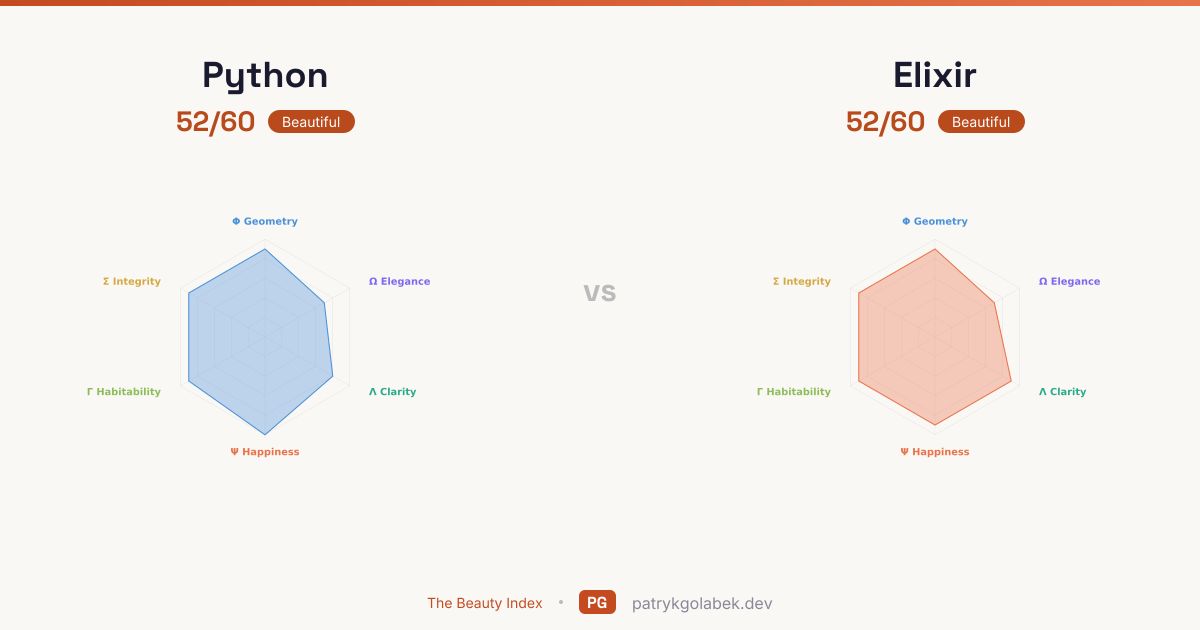
Python and Elixir finish level at 52/60, splitting the six dimensions 1-1 with 4 tied. Python owns human while Elixir leads in aesthetic. Linguistic Clarity is where the pair separates most cleanly — Elixir leads Python by 1 points and that gap colours everything else on the page.
See also: PHP vs Elixir , Python .
Dimension-by-dimension analysis
Λ Linguistic Clarity
Elixir edges Python by a single point on Linguistic Clarity; the practical difference is slim but real. The pipe operator (|>) turns data transformation into a readable narrative. "hello" |> String.split() |> Enum.map(&String.capitalize/1) reads as a clear sequence of intentions. Among the most literate functional languages. The difference is real but modest — pick either and a team will read fluently within weeks. The closest any general-purpose language gets to executable pseudocode. Variable naming conventions, keyword arguments, and minimal ceremony make intent self-evident to readers at nearly any experience level. For application code the clarity advantage is the whole point of the language category.
Ψ Practitioner Happiness
Python edges Elixir by a single point on Practitioner Happiness; the practical difference is slim but real. Universally liked, beginner-friendly, and the default choice across data science, web, scripting, and education. The community is enormous, warm, and productive. Packaging friction (pip vs. poetry vs. uv) is a real blemish, but the read-write experience remains unmatched in reach. On developer happiness the edge is modest — the two communities are both thriving. Stack Overflow admiration at 66%. The Phoenix framework, LiveView, and OTP give practitioners a feeling of building something that "just works." The community is small but deeply enthusiastic and welcoming. For high-level work, developer happiness is the main driver of long-term retention.
Γ Organic Habitability
Both score 9 — this is one dimension where Python and Elixir genuinely agree. Python codebases age well. Duck typing, simple module structure, and a culture of readability make modification and extension feel natural. The language bends to the domain rather than imposing rigid abstractions. For long-lived codebases the two languages sit on roughly equal ground. Pipelines are growth-point idioms, insert a transformation step anywhere without restructuring. OTP's supervision trees are the embodiment of habitable architecture: systems designed to fail gracefully and be extended incrementally. The winner here is the language you will still enjoy reading in five years.
Ω Mathematical Elegance
Both score 7 — this is one dimension where Python and Elixir genuinely agree. List comprehensions, generators, and first-class functions bring Python closer to mathematical notation than most dynamic languages. sum(x**2 for x in range(10)) reads like a formula. Not Haskell-tier, but a clear step above "workhorse" expressiveness. When it comes to reaching "The Book," these two arrive together. Pattern matching, recursion, and immutable data structures support elegant algorithm expression. Not as abstract as Haskell or OCaml, but the BEAM VM's concurrency primitives give certain distributed algorithms an inevitable quality. For high-level work, the gap compounds: fewer lines per algorithm means fewer bugs per feature.
Φ Aesthetic Geometry
Both score 9 — this is one dimension where Python and Elixir genuinely agree. Indentation is syntax. Python enforces geometric structure at the grammar level. A screenful of Python has natural visual rhythm with minimal punctuation noise. On geometry the two languages converge; whatever separates them must be found on another axis. Pipeline operators, pattern-matching clauses, and module structure create a visual flow that scans beautifully. Elixir code looks like a series of clean, evenly weighted transformation steps. Designers of high-level code feel this difference the moment they open an unfamiliar module.
Σ Conceptual Integrity
Both score 9 — this is one dimension where Python and Elixir genuinely agree. "There should be one, and preferably only one, obvious way to do it." The Zen of Python is a genuine design philosophy, not a marketing tagline. Guido's benevolent-dictator era gave the language a coherent soul that has mostly survived committee evolution. Both Python and Elixir feel designed by a single mind, even when they are not; on integrity they meet as equals. "Erlang's power with modern syntax." José Valim had a clear vision: bring functional programming and fault-tolerant concurrency to a wider audience. The language feels designed by one mind with a singular purpose. The winner's philosophical discipline is what keeps its idioms stable as the language evolves.
Code comparison
The characteristic code snippet that best represents each language.
from itertools import takewhile
def fibonacci():    a, b = 0, 1    while True:        yield a        a, b = b, a + b
squares = { n: n**2 for n in takewhile(lambda x: x < 100, fibonacci()) if n > 0}def process_order(%Order{items: items, user: user}) do items |> Enum.filter(&(&1.in_stock)) |> Enum.map(&apply_discount(&1, user.tier)) |> Enum.reduce(0, &(&1.price + &2)) |> apply_tax(user.region) |> format_total()endException handling via try/catch or Result/Either patterns.
def parse_number(s: str) -> int:    try:        return int(s)    except ValueError as e:        raise ValueError(f"Invalid: {s}") from e
try: result = parse_number(input_str)except ValueError: result = -1finally: cleanup()with {:ok, user} <- fetch_user(id), {:ok, posts} <- fetch_posts(user.id), {:ok, _} <- validate(posts) do {:ok, format_response(user, posts)}else {:error, :not_found} -> {:error, "User not found"} {:error, reason} -> {:error, reason}endNative pattern matching constructs for destructuring and control flow.
match command: case ["quit"]: quit() case ["go", direction]: move(direction) case ["get", item] if item in inventory: pick_up(item) case _: print("Unknown command")case list do [] -> "empty" [x] -> "just #{x}" [h | _] when h > 0 -> "starts positive" _ -> "other"end
# Function clause pattern matching (inside a module)# def handle({:ok, result}), do: result# def handle({:error, reason}), do: raise reason
{:ok, value} = {:ok, 42}Frequently asked questions
- Which is easier to learn, Python or Elixir?
- Python scores 10 on Practitioner Happiness versus Elixir's 9. Universally liked, beginner-friendly, and the default choice across data science, web, scripting, and education. The community is enormous, warm, and productive. Packaging friction (pip vs. poetry vs. uv) is a real blemish, but the read-write experience remains unmatched in reach. For a newcomer picking up their first serious language in 2026, the happiness-score winner is the more forgiving starting point.
- Is Python or Elixir better for readable code?
- For readable code, Elixir has a clear edge — it scores 9/10 on Linguistic Clarity against Python's 8/10. The pipe operator (|>) turns data transformation into a readable narrative. "hello" |> String.split() |> Enum.map(&String.capitalize/1) reads as a clear sequence of intentions. Among the most literate functional languages.
- Should I pick Python or Elixir in 2026?
- Python lands in the beautiful tier at 52/60; Elixir in the beautiful tier at 52/60. The gap is narrow enough that team familiarity and ecosystem fit should decide. Pick the one your hires already know. The score difference reflects years of community use, tooling maturity, and the editorial judgment of the Beauty Index rubric.