
Kotlin vs Ruby
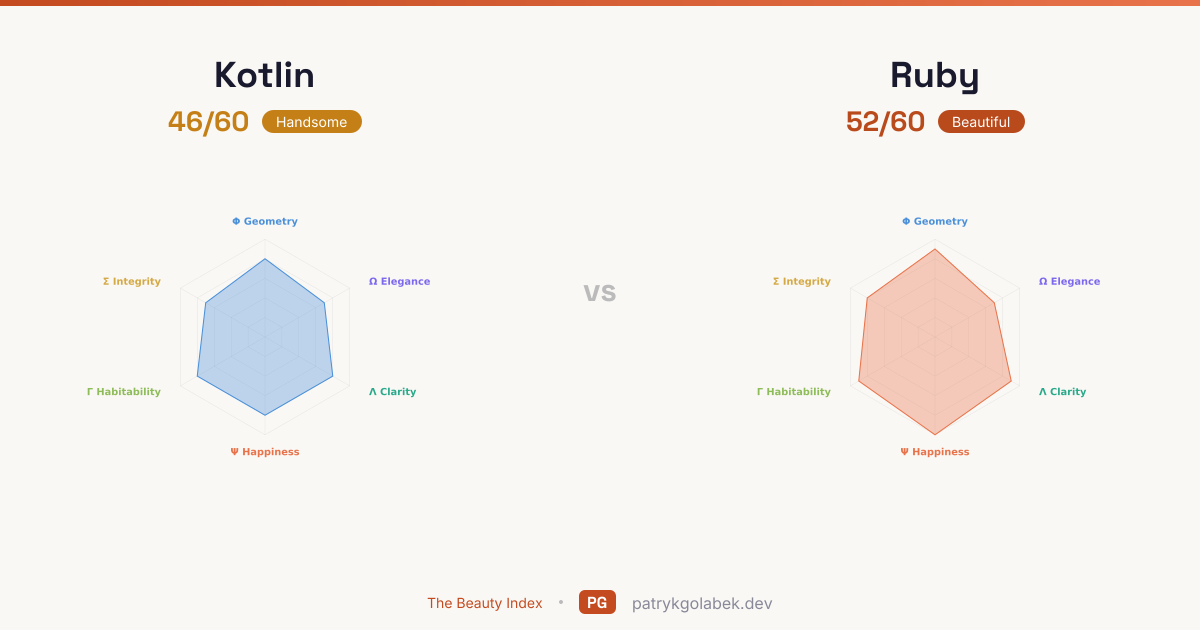
Kotlin
The diplomat who made peace between Java and good taste. Kotlin looked at decades of JVM pain and said 'what if we just... didn't do that?' and everyone agreed.
Ruby
The poet who became a startup founder. Matz designed Ruby explicitly to maximize programmer happiness, and it shows. Everything is an object, every expression returns a value, and blocks let you express ideas with a rhythm that feels literary.
Ruby scores 52/60 against Kotlin's 46/60, leading in 5 of 6 dimensions. Ruby dominates the aesthetic, human, and design axes. Read the comparison through Practitioner Happiness first: Ruby wins that axis by 2 points over Kotlin, and it is the single best lens on the pair.
See also: PHP vs Ruby , Kotlin .
Dimension-by-dimension analysis
Ψ Practitioner Happiness
Ruby wins Practitioner Happiness by 2 points — a genuine community lead. Ruby was designed to maximize programmer happiness, it's the explicit, stated mission. Matz's philosophy permeates everything from the standard library API to the community culture. The canonical 10 on this dimension. Where Ruby feels designed for the human, Kotlin feels designed for the machine first — the human catches up second. Strong admiration in the Android community and growing JVM adoption. JetBrains' tooling (IntelliJ integration) is best-in-class. Developers who switch from Java rarely want to go back. The winner here invites the next generation of contributors without asking them to earn it first.
Γ Organic Habitability
Ruby edges Kotlin by a single point on Organic Habitability; the practical difference is slim but real. Monkey-patching, open classes, and convention-over-configuration make Ruby extremely habitable. Code accommodates change with minimal friction. The language invites you to extend it rather than fight it. The habitability edge is slim and often dominated by team culture rather than language choice. Interoperability with Java means Kotlin codebases can grow incrementally. Null-safety, sealed classes, and coroutines provide guardrails that help code age well without over-constraining structure. In high-level work, the language that welcomes modification wins the decade, not the quarter.
Λ Linguistic Clarity
Ruby edges Kotlin by a single point on Linguistic Clarity; the practical difference is slim but real. .reject(&:empty?), .each_with_index, File.readlines — Ruby reads aloud as English. Matz explicitly optimized for human communication over machine efficiency. Among the highest Knuthian "wit" in any language. On readability the edge is slim and disappears quickly as idioms are learned. Kotlin reads clearly, listOf, when, ?.let { } communicate intent without requiring deep language knowledge. Scope functions (let, run, apply) can slightly obscure control flow when overused, preventing a 9. In high-level work, readable code is the difference between a 6-month onboarding and a 6-week one.
Φ Aesthetic Geometry
Ruby edges Kotlin by a single point on Aesthetic Geometry; the practical difference is slim but real. Ruby's block syntax, do...end and { } conventions, and method chaining create a natural visual flow. Code reads top-to-bottom with a literary rhythm. Indentation feels organic rather than enforced. Both Kotlin and Ruby care about how code looks — they simply draw the line in slightly different places. Data classes, named arguments, and concise lambda syntax produce clean, well-proportioned code. The visual improvement over Java is immediately obvious, less ceremony, more signal. Designers of high-level code feel this difference the moment they open an unfamiliar module.
Σ Conceptual Integrity
Ruby edges Kotlin by a single point on Conceptual Integrity; the practical difference is slim but real. "Optimize for programmer happiness" is a clear, singular vision. Ruby occasionally accumulates features (e.g., multiple ways to define lambdas), but the core philosophy holds. Docked slightly for the flexibility-creates-inconsistency tradeoff. The integrity gap is narrow and more visible in edge cases than in everyday code. "What if Java, but good?" is a clear mission, but it's defined in opposition to something else rather than from first principles. The pragmatic "fix everything" approach is coherent but doesn't have the singular philosophical punch of Rust or Clojure. In high-level work a coherent philosophy is the frame that holds the language's features together.
Ω Mathematical Elegance
Both score 7 — this is one dimension where Kotlin and Ruby genuinely agree. Extension functions, sealed classes, and functional collection operations (map, filter, fold) support elegant algorithm expression within a pragmatic framework. Not pushing mathematical frontiers, but consistently economical. Both Kotlin and Ruby support the same class of elegant patterns — the decision lives on another axis. Everything is an object, every expression returns a value, and blocks enable higher-order patterns. Not a mathematical language per se, but its internal consistency gives algorithms a sense of inevitability. In application code the elegance edge shows up as less boilerplate per idea.
Code comparison
Native pattern matching constructs for destructuring and control flow.
fun describe(shape: Shape): String = when (shape) {    is Circle -> "circle r=${shape.radius}"    is Rectangle -> "rect ${shape.w}x${shape.h}"    is Triangle -> "triangle"}
val (name, age) = personwhen { age < 18 -> "minor" else -> "adult"}case datain { name: String => name, age: (18..) => age } puts "Adult: #{name}, #{age}"in { name: String => name, age: Integer => age } puts "Minor: #{name}, #{age}"in [Integer => x, Integer => y] puts "Point: #{x}, #{y}"endException handling via try/catch or Result/Either patterns.
fun parseNumber(s: String): Result<Int> =    runCatching { s.toInt() }
val result = parseNumber("42")    .map { it * 2 }    .getOrElse { -1 }
val value = try { riskyOperation()} catch (e: IOException) { fallbackValue}def parse_number(str) Integer(str)rescue ArgumentError => e raise "Invalid input: #{str}"end
begin result = parse_number(input)rescue => e puts "Error: #{e.message}" result = -1ensure cleanupendFor/while iteration patterns and loop constructs.
Frequently asked questions
- Which is easier to learn, Kotlin or Ruby?
- Ruby scores 10 on Practitioner Happiness versus Kotlin's 8. Ruby was designed to maximize programmer happiness, it's the explicit, stated mission. Matz's philosophy permeates everything from the standard library API to the community culture. The canonical 10 on this dimension. When ease of learning is the deciding factor, the happier community wins every time — mentors, docs, and examples are simply more abundant.
- Is Kotlin or Ruby better for developer happiness?
- For developer happiness, Ruby has a clear edge — it scores 10/10 on Practitioner Happiness against Kotlin's 8/10. Ruby was designed to maximize programmer happiness, it's the explicit, stated mission. Matz's philosophy permeates everything from the standard library API to the community culture. The canonical 10 on this dimension.
- Should I pick Kotlin or Ruby in 2026?
- Kotlin lands in the handsome tier at 46/60; Ruby in the beautiful tier at 52/60. The gap is wide enough to matter in day-to-day experience. Pick the higher scorer unless a hard constraint pushes otherwise. The score difference reflects years of community use, tooling maturity, and the editorial judgment of the Beauty Index rubric.