
Kotlin vs Clojure
Kotlin
The diplomat who made peace between Java and good taste. Kotlin looked at decades of JVM pain and said 'what if we just... didn't do that?' and everyone agreed.
Clojure
The Zen master who sees through your abstractions. Clojure distills programming to data, functions, and immutability, then watches smugly as your mutable-state codebase catches fire.
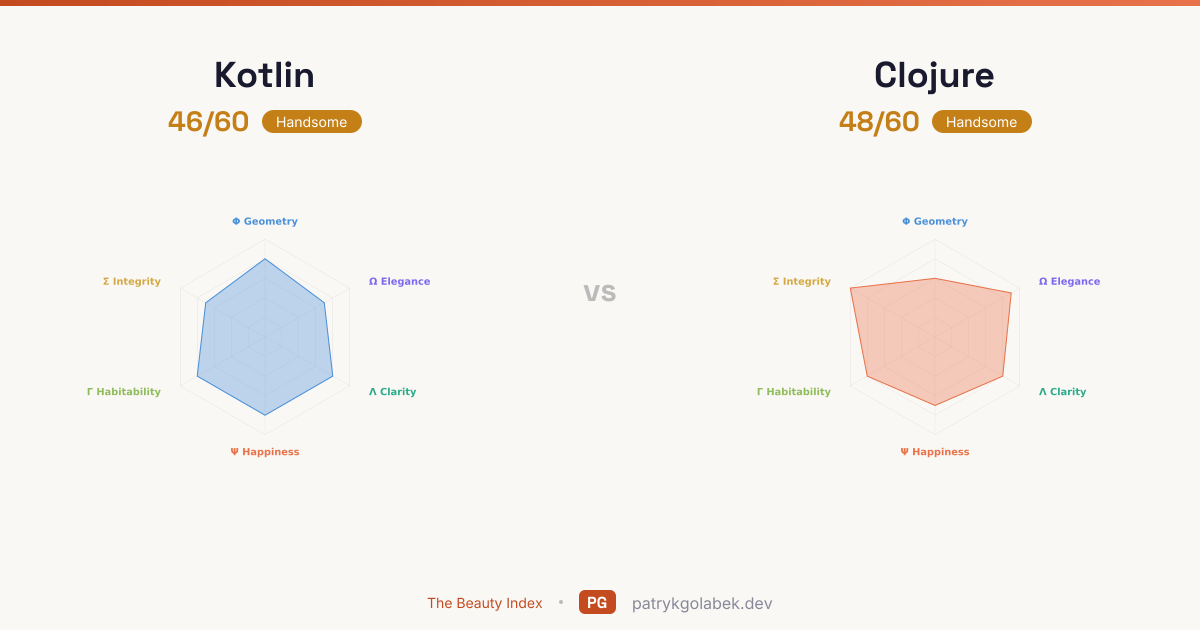
Clojure scores 48/60 against Kotlin's 46/60, leading in 2 of 6 dimensions. Kotlin owns aesthetic and human while Clojure leads in mathematical and design. Read the comparison through Conceptual Integrity first: Clojure wins that axis by 3 points over Kotlin, and it is the single best lens on the pair.
See also: PHP vs Clojure , Kotlin .
Dimension-by-dimension analysis
Σ Conceptual Integrity
Clojure wins Conceptual Integrity by 3 points — an unmistakable unity of purpose. "Code is data. Data is code. Everything is immutable." Clojure is distilled philosophy, every design choice follows from a handful of axioms. Rich Hickey's talks are effectively the language's specification, and the language is the talks made concrete. Where Clojure holds a line, Kotlin has negotiated with history, ecosystems, and legacy users. "What if Java, but good?" is a clear mission, but it's defined in opposition to something else rather than from first principles. The pragmatic "fix everything" approach is coherent but doesn't have the singular philosophical punch of Rust or Clojure. The winner's philosophical discipline is what keeps its idioms stable as the language evolves.
Ω Mathematical Elegance
Clojure wins Mathematical Elegance by 2 points — a substantive reach beyond idiom. Homoiconicity (code is data) enables metaprogramming that feels mathematical. Persistent data structures, lazy sequences, and transducers let you express algorithms with remarkable economy. Among the most "Book", like in practice. The gap on Elegance is real: Clojure rewards precise thought, Kotlin rewards precise bookkeeping. Extension functions, sealed classes, and functional collection operations (map, filter, fold) support elegant algorithm expression within a pragmatic framework. Not pushing mathematical frontiers, but consistently economical. In application code the elegance edge shows up as less boilerplate per idea.
Φ Aesthetic Geometry
Kotlin wins Aesthetic Geometry by 2 points — an unmistakable aesthetic lead. Data classes, named arguments, and concise lambda syntax produce clean, well-proportioned code. The visual improvement over Java is immediately obvious, less ceremony, more signal. Set the two side by side and the shape of each language announces itself before you read a single identifier. Clojure's parentheses-heavy syntax is unconventional, but it's regular and tree-like. The uniform (verb noun noun) structure has its own geometric coherence once you internalize the visual grammar. Not chaotic, just non-traditional. For application code the geometry translates directly into readability for new contributors.
Ψ Practitioner Happiness
Kotlin edges Clojure by a single point on Practitioner Happiness; the practical difference is slim but real. Strong admiration in the Android community and growing JVM adoption. JetBrains' tooling (IntelliJ integration) is best-in-class. Developers who switch from Java rarely want to go back. Kotlin noses ahead in surveys, but Clojure retains a devoted following of its own. A devoted, intellectually engaged community. The REPL-driven workflow induces genuine flow states. The ecosystem is mature (for its size). Docked because the community is small and Lisp-family syntax creates a real adoption barrier. For high-level work, developer happiness is the main driver of long-term retention.
Γ Organic Habitability
Both score 8 — this is one dimension where Kotlin and Clojure genuinely agree. Interoperability with Java means Kotlin codebases can grow incrementally. Null-safety, sealed classes, and coroutines provide guardrails that help code age well without over-constraining structure. On habitability the outcome is even; what tips the scale is elsewhere. Immutable data and pure functions produce code that is inherently easy to extend and modify, no hidden state to trip over. Rich Hickey's "simple made easy" philosophy is the definition of habitable design. For application codebases the habitability edge determines whether a project survives its second rewrite.
Λ Linguistic Clarity
Both score 8 — this is one dimension where Kotlin and Clojure genuinely agree. Kotlin reads clearly, listOf, when, ?.let { } communicate intent without requiring deep language knowledge. Scope functions (let, run, apply) can slightly obscure control flow when overused, preventing a 9. On linguistic clarity the two converge; what separates them is elsewhere. Threading macros (->, ->>) transform nested Lisp into readable pipelines. The data-oriented philosophy, plain maps and vectors over custom types, makes intent transparent. Prefix notation is a barrier for newcomers, but the idioms are clear once learned. For application code the clarity advantage is the whole point of the language category.
Code comparison
For/while iteration patterns and loop constructs.
Native pattern matching constructs for destructuring and control flow.
fun describe(shape: Shape): String = when (shape) {    is Circle -> "circle r=${shape.radius}"    is Rectangle -> "rect ${shape.w}x${shape.h}"    is Triangle -> "triangle"}
val (name, age) = personwhen { age < 18 -> "minor" else -> "adult"}(require '[clojure.core.match :refer [match]])
(match [x y] [_ 0] "y is zero" [0 _] "x is zero" [a b] (str "both non-zero: " a ", " b))
(let [{:keys [name age]} person] (str name " is " age))The characteristic code snippet that best represents each language.
data class User(val name: String, val email: String?)
fun greet(users: List<User>): List<String> = users .filter { it.email != null } .sortedBy { it.name } .map { user -> "Hello, ${user.name} (${user.email!!})" }(defn process-users [users] (->> users (filter :active) (map :email) (map clojure.string/lower-case) (sort) (dedupe) (into [])))Frequently asked questions
- Which is easier to learn, Kotlin or Clojure?
- Kotlin scores 8 on Practitioner Happiness versus Clojure's 7. Strong admiration in the Android community and growing JVM adoption. JetBrains' tooling (IntelliJ integration) is best-in-class. Developers who switch from Java rarely want to go back. When ease of learning is the deciding factor, the happier community wins every time — mentors, docs, and examples are simply more abundant.
- Is Kotlin or Clojure better for principled design?
- For principled design, Clojure has a clear edge — it scores 10/10 on Conceptual Integrity against Kotlin's 7/10. "Code is data. Data is code. Everything is immutable." Clojure is distilled philosophy, every design choice follows from a handful of axioms. Rich Hickey's talks are effectively the language's specification, and the language is the talks made concrete.
- Should I pick Kotlin or Clojure in 2026?
- Kotlin lands in the handsome tier at 46/60; Clojure in the handsome tier at 48/60. The gap is narrow enough that team familiarity and ecosystem fit should decide. Pick the one your hires already know. The score difference reflects years of community use, tooling maturity, and the editorial judgment of the Beauty Index rubric.