
PHP vs Clojure
PHP
The duct tape that holds 40% of the web together while everyone pretends it doesn't exist. PHP is the cockroach of programming: ugly, everywhere, and absolutely unkillable.
Clojure
The Zen master who sees through your abstractions. Clojure distills programming to data, functions, and immutability, then watches smugly as your mutable-state codebase catches fire.
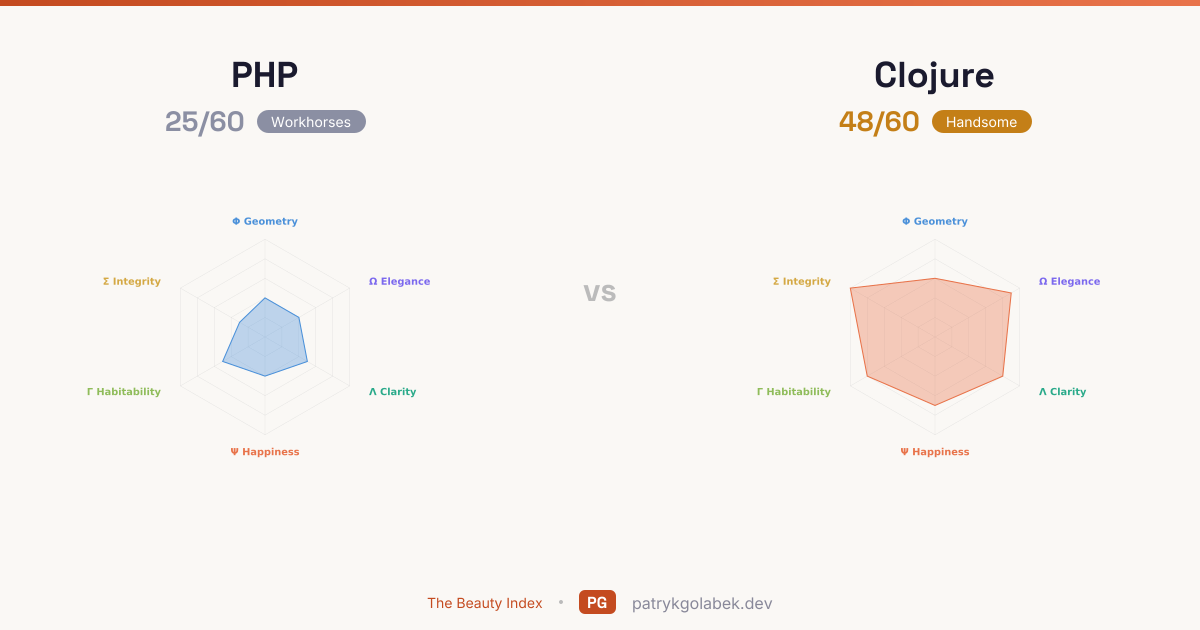
Clojure scores 48/60 against PHP's 25/60, leading in 6 of 6 dimensions. Clojure dominates the aesthetic, mathematical, human, and design axes. Conceptual Integrity is where the pair separates most cleanly — Clojure leads PHP by 7 points and that gap colours everything else on the page.
See also: Haskell vs Clojure , PHP .
Dimension-by-dimension analysis
Σ Conceptual Integrity
Clojure wins Conceptual Integrity by 7 points — a genuine lead in design coherence. "Code is data. Data is code. Everything is immutable." Clojure is distilled philosophy, every design choice follows from a handful of axioms. Rich Hickey's talks are effectively the language's specification, and the language is the talks made concrete. The design philosophy of Clojure feels inevitable, each feature a consequence of one idea — PHP feels assembled from several good ideas instead of from one great one. PHP was not designed; it was accumulated. Rasmus Lerdorf's personal homepage tools grew into a language without a coherent philosophy. Each version has improved quality, but there is no "soul", no single idea that all features follow from. The quintessential committee language. For application code the integrity edge means fewer "wait, why does it behave that way?" moments per week.
Ω Mathematical Elegance
Clojure wins Mathematical Elegance by 5 points — a clear algorithmic edge. Homoiconicity (code is data) enables metaprogramming that feels mathematical. Persistent data structures, lazy sequences, and transducers let you express algorithms with remarkable economy. Among the most "Book", like in practice. Clojure lets algorithms approach mathematical statement, while PHP asks more of the programmer when elegance is the goal. PHP is a templating language that grew into a general-purpose one. Array functions exist but lack the composability of functional languages. Mathematical elegance is not the design space PHP occupies. The winner lets the author think in algorithms rather than in ceremony.
Γ Organic Habitability
Clojure wins Organic Habitability by 3 points — a real habitability advantage. Immutable data and pure functions produce code that is inherently easy to extend and modify, no hidden state to trip over. Rich Hickey's "simple made easy" philosophy is the definition of habitable design. Where Clojure accommodates change gracefully, PHP makes you earn each new direction. PHP codebases survive, 77% of the web runs on PHP, and that code keeps working. The language is pragmatically habitable. But the inconsistent standard library and multiple paradigm shifts (procedural → OOP → modern PHP) make long-term evolution uneven. For application codebases the habitability edge determines whether a project survives its second rewrite.
Λ Linguistic Clarity
Clojure wins Linguistic Clarity by 3 points — a real readability advantage. Threading macros (->, ->>) transform nested Lisp into readable pipelines. The data-oriented philosophy, plain maps and vectors over custom types, makes intent transparent. Prefix notation is a barrier for newcomers, but the idioms are clear once learned. The clarity gap is felt on first contact — Clojure invites, PHP introduces friction before trust is earned. PHP can be readable in modern frameworks (Laravel's fluent syntax reads well). But str_replace vs. strpos vs. substr, inconsistent parameter ordering, and the legacy API are the antithesis of linguistic clarity. Two PHPs coexist: modern and legacy. For application code the clarity advantage is the whole point of the language category.
Ψ Practitioner Happiness
Clojure wins Practitioner Happiness by 3 points — an unmistakable experiential gap. A devoted, intellectually engaged community. The REPL-driven workflow induces genuine flow states. The ecosystem is mature (for its size). Docked because the community is small and Lisp-family syntax creates a real adoption barrier. Clojure has done the harder cultural work: tooling that delights, a community that welcomes, documentation that explains. PHP developers themselves joke about PHP. The community is large and productive, but "most admired" it is not. Modern PHP (8.x with Laravel) has improved the experience significantly, but the reputation, and the daily reality of legacy code, weighs on happiness. For high-level work, developer happiness is the main driver of long-term retention.
Φ Aesthetic Geometry
Clojure wins Aesthetic Geometry by 2 points — a meaningful cleanliness gap. Clojure's parentheses-heavy syntax is unconventional, but it's regular and tree-like. The uniform (verb noun noun) structure has its own geometric coherence once you internalize the visual grammar. Not chaotic, just non-traditional. The difference is not cosmetic: Clojure rewards the eye, while PHP asks the reader to absorb more punctuation and more ceremony. $ on every variable, -> for method calls, inconsistent brace styles across frameworks, and <?php tags create visual clutter. Modern PHP (8.x) with named arguments and match expressions is cleaner, but the legacy visual debt remains. In a language where expressiveness is the selling point, visual calm amplifies the advantage.
Code comparison
For/while iteration patterns and loop constructs.
The characteristic code snippet that best represents each language.
$results = array_map( fn($user) => [ 'name' => $user['name'], 'email' => strtolower($user['email']), 'score' => array_sum($user['grades']) / count($user['grades']), ], array_filter( $users, fn($u) => $u['active'] && count($u['grades']) > 0 ));(defn process-users [users] (->> users (filter :active) (map :email) (map clojure.string/lower-case) (sort) (dedupe) (into [])))Embedding expressions and variables within string literals.
$name = 'PHP';$version = 8.3;
$msg = "Hello, $name! Version: $version";$expr = "Length: " . strlen($name) . ", Upper: " . strtoupper($name);$heredoc = <<<EOTWelcome to $name.Version: $versionEOT;
$formatted = sprintf("%-10s | %5.1f", $name, $version);(def name "Clojure")(def version 1.12)
(str "Hello, " name "! Version: " version)(format "Hello, %s! Version: %.1f" name version)
(println (str "Welcome to " name ". " "Version: " version))Frequently asked questions
- Which is easier to learn, PHP or Clojure?
- Clojure scores 7 on Practitioner Happiness versus PHP's 4. A devoted, intellectually engaged community. The REPL-driven workflow induces genuine flow states. The ecosystem is mature (for its size). Docked because the community is small and Lisp-family syntax creates a real adoption barrier. For classroom or self-directed study, the practitioner-happiness winner almost always has better learning materials and kinder error messages.
- Is PHP or Clojure better for principled design?
- For principled design, Clojure has a clear edge — it scores 10/10 on Conceptual Integrity against PHP's 3/10. "Code is data. Data is code. Everything is immutable." Clojure is distilled philosophy, every design choice follows from a handful of axioms. Rich Hickey's talks are effectively the language's specification, and the language is the talks made concrete.
- Should I pick PHP or Clojure in 2026?
- PHP lands in the workhorses tier at 25/60; Clojure in the handsome tier at 48/60. With this much daylight between them, the higher scorer is the default and the lower scorer needs a business case. The score difference reflects years of community use, tooling maturity, and the editorial judgment of the Beauty Index rubric.