
JavaScript vs TypeScript
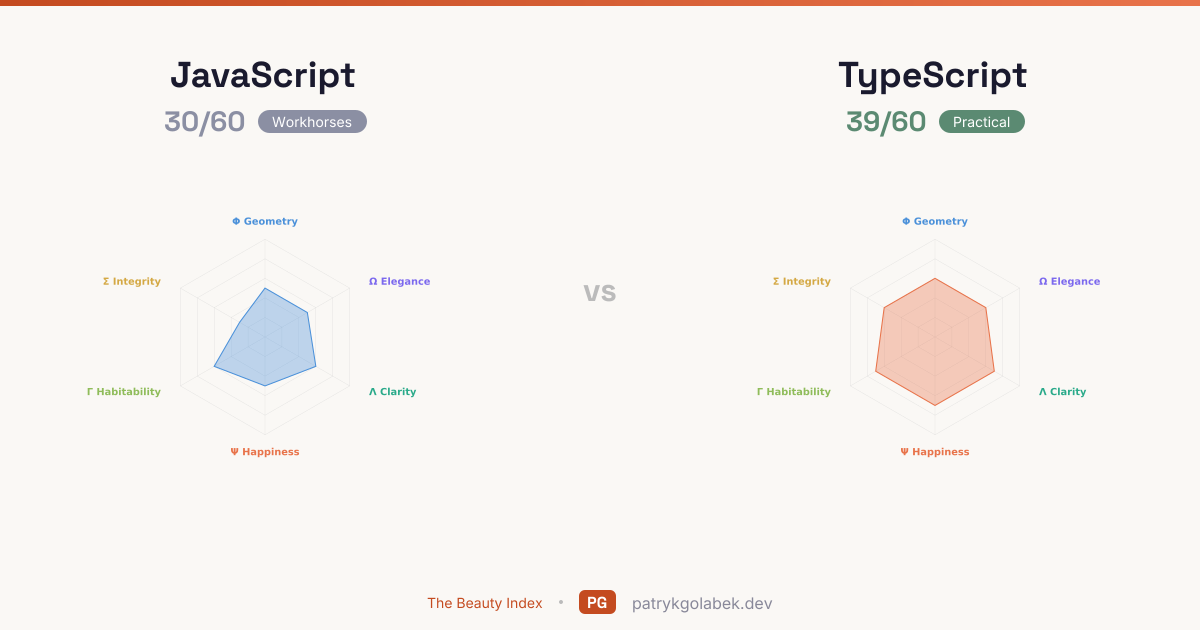
JavaScript
The accidental emperor who conquered the world in 10 days. JavaScript was built as a toy, became the backbone of the internet, and still thinks '0' == 0 is reasonable.
TypeScript
The responsible older sibling who cleans up JavaScript's messes. TypeScript proves that the best way to fix a language is to build a better one on top and pretend the old one doesn't exist.
TypeScript scores 39/60 against JavaScript's 30/60, leading in 6 of 6 dimensions. TypeScript dominates the aesthetic, mathematical, human, and design axes. Read the comparison through Conceptual Integrity first: TypeScript wins that axis by 3 points over JavaScript, and it is the single best lens on the pair.
See also: JavaScript vs Elixir , JavaScript .
Dimension-by-dimension analysis
Σ Conceptual Integrity
TypeScript wins Conceptual Integrity by 3 points — a decisive philosophical edge. TypeScript has evolved beyond "typed JavaScript" into its own identity. The type system is a language-within-a-language with a coherent mission: add sound typing to JS without breaking compatibility. Still inherits some of JavaScript's conceptual chaos, but the mission itself is clear and focused. TypeScript speaks with a single design voice; JavaScript speaks with a committee. Famously designed in 10 days with no unified vision. Decades of backward-compatible additions have layered prototypal OOP, functional patterns, class syntax, modules, and async models on top of each other. JavaScript is the archetypal "accumulated rather than designed" language. For application code the integrity edge means fewer "wait, why does it behave that way?" moments per week.
Ψ Practitioner Happiness
TypeScript wins Practitioner Happiness by 2 points — a real happiness advantage. Consistently scores ~73% admired in Stack Overflow surveys. The VS Code integration is best-in-class, and catching bugs at compile time is genuinely satisfying. Developers actively choose TypeScript over JavaScript. The practitioner experience on TypeScript is simply more fun, day in and day out, than on JavaScript. JavaScript is everywhere, and many developers use it because they must, not because they love it. The ecosystem's churn (framework fatigue) creates constant friction. Individual tools (React, Node) are liked; the language itself gets mixed reviews. The winner here invites the next generation of contributors without asking them to earn it first.
Γ Organic Habitability
TypeScript edges JavaScript by a single point on Organic Habitability; the practical difference is slim but real. Gradual typing means you can introduce TypeScript incrementally. Codebases grow naturally from loose to strict. The any escape hatch is ugly but pragmatically habitable, you can always tighten later. Both JavaScript and TypeScript age reasonably well; TypeScript is merely a little kinder to the future reader. JavaScript's flexibility means codebases can be extended organically. The ecosystem's dynamism keeps things evolving. But the same flexibility produces wildly inconsistent patterns, and the lack of guardrails makes long-term maintenance unpredictable. In high-level work, the language that welcomes modification wins the decade, not the quarter.
Λ Linguistic Clarity
TypeScript edges JavaScript by a single point on Linguistic Clarity; the practical difference is slim but real. TypeScript improves on JavaScript's readability significantly, type annotations as documentation, discriminated unions for intent, and strong IDE support make code self-explanatory. A clear upgrade in linguistic clarity. Both JavaScript and TypeScript communicate their intent without heroic effort; TypeScript is only a little more forgiving. Modern JavaScript (ES6+) reads reasonably well — arrow functions, destructuring, and template literals improve clarity. Docked because typeof null === 'object', implicit coercion, and this binding make code that looks clear but behaves surprisingly. For application code the clarity advantage is the whole point of the language category.
Ω Mathematical Elegance
TypeScript edges JavaScript by a single point on Mathematical Elegance; the practical difference is slim but real. Conditional types, mapped types, and template literal types are genuinely innovative, the type system is more expressive than most mainstream languages. But the underlying JS runtime prevents the mathematical "economy" that Omega measures. Both JavaScript and TypeScript can express algorithms cleanly; TypeScript merely gets there with slightly less ceremony. First-class functions, closures, and prototype chains enable some elegant patterns. Array methods (.map, .reduce, .filter) are expressive. But the language provides too many ways to do everything, and none feel mathematically inevitable. In application code the elegance edge shows up as less boilerplate per idea.
Φ Aesthetic Geometry
TypeScript edges JavaScript by a single point on Aesthetic Geometry; the practical difference is slim but real. Inherits JavaScript's visual structure, which is functional but unremarkable. Generic type annotations and complex union types can create visual density. Not ugly, but not architecturally striking. Both JavaScript and TypeScript care about how code looks — they simply draw the line in slightly different places. JavaScript's visual style depends entirely on the developer and framework. The language itself imposes no visual discipline. Curly braces, callbacks, and framework-specific patterns create inconsistent visual texture across codebases. In a language where expressiveness is the selling point, visual calm amplifies the advantage.
Code comparison
Conditional branching and control flow expressions.
const label = score >= 90 ? "excellent" : score >= 70 ? "good" : score >= 50 ? "average" : "needs improvement";function describe(value: string | number): string { if (typeof value === "number") { return value > 0 ? "positive" : "non-positive"; } else { return value.length > 0 ? "non-empty" : "empty"; }}The characteristic code snippet that best represents each language.
async function fetchUserPosts(userId) {  const [user, posts] = await Promise.all([    fetch(`/api/users/${userId}`).then(r => r.json()),    fetch(`/api/users/${userId}/posts`).then(r => r.json()),  ]);
const { name, avatar } = user; return { name, avatar, posts: posts.slice(0, 5) };}type Result<T, E = Error> = | { ok: true; value: T } | { ok: false; error: E };
function parse(input: string): Result<number> { const n = Number(input); return isNaN(n) ? { ok: false, error: new Error(`Invalid: ${input}`) } : { ok: true, value: n };}Exception handling via try/catch or Result/Either patterns.
async function fetchData(url) { try { const response = await fetch(url); if (!response.ok) throw new Error(`HTTP ${response.status}`); return await response.json(); } catch (error) { console.error("Fetch failed:", error.message); return null; }}type Result<T> = { ok: true; value: T } | { ok: false; error: Error };
function safeParse(s: string): Result<number> { const n = Number(s); return isNaN(n) ? { ok: false, error: new Error(`Invalid: ${s}`) } : { ok: true, value: n };}
const result = safeParse("42");if (result.ok) console.log(result.value);Frequently asked questions
- Which is easier to learn, JavaScript or TypeScript?
- TypeScript scores 7 on Practitioner Happiness versus JavaScript's 5. Consistently scores ~73% admired in Stack Overflow surveys. The VS Code integration is best-in-class, and catching bugs at compile time is genuinely satisfying. Developers actively choose TypeScript over JavaScript. For a developer adding a new language to their toolbelt, the happier one is the one you will still be writing in six months.
- Is JavaScript or TypeScript better for principled design?
- For principled design, TypeScript has a clear edge — it scores 6/10 on Conceptual Integrity against JavaScript's 3/10. TypeScript has evolved beyond "typed JavaScript" into its own identity. The type system is a language-within-a-language with a coherent mission: add sound typing to JS without breaking compatibility. Still inherits some of JavaScript's conceptual chaos, but the mission itself is clear and focused.
- Should I pick JavaScript or TypeScript in 2026?
- JavaScript lands in the workhorses tier at 30/60; TypeScript in the practical tier at 39/60. With this much daylight between them, the higher scorer is the default and the lower scorer needs a business case. The score difference reflects years of community use, tooling maturity, and the editorial judgment of the Beauty Index rubric.