
JavaScript vs Elixir
JavaScript
The accidental emperor who conquered the world in 10 days. JavaScript was built as a toy, became the backbone of the internet, and still thinks '0' == 0 is reasonable.
Elixir
The jazz musician who studied classical. Elixir takes Erlang's battle-tested concurrency and wraps it in syntax so pleasant you forget you're building distributed systems that never go down.
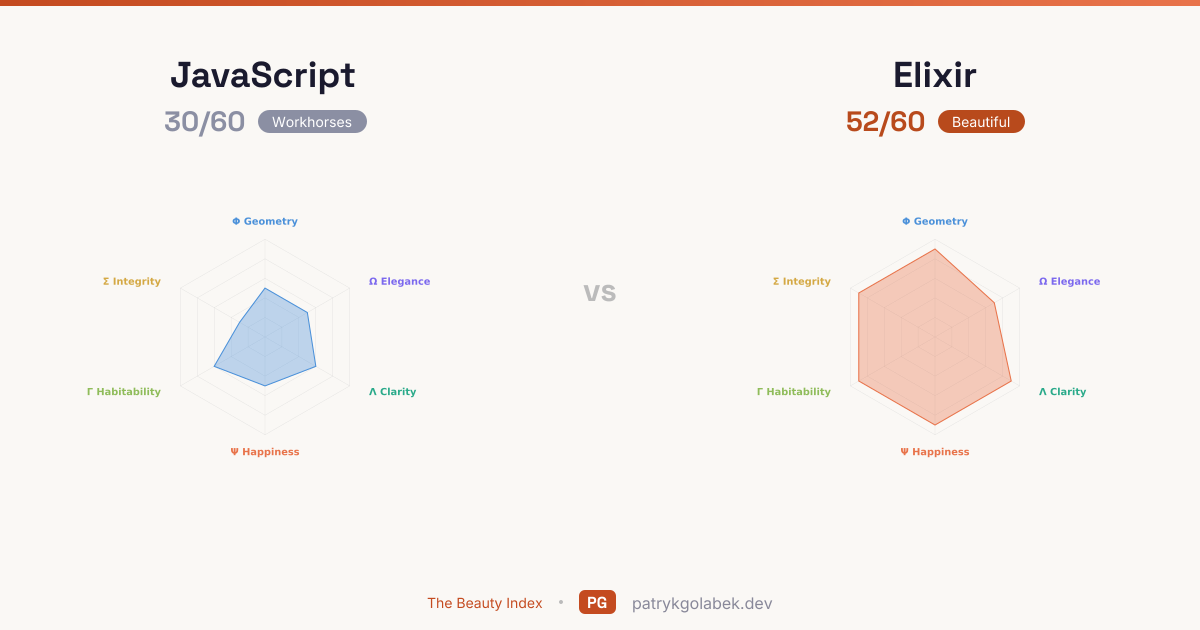
Elixir scores 52/60 against JavaScript's 30/60, leading in 6 of 6 dimensions. Elixir dominates the aesthetic, mathematical, human, and design axes. Read the comparison through Conceptual Integrity first: Elixir wins that axis by 6 points over JavaScript, and it is the single best lens on the pair.
See also: Python vs Elixir , JavaScript .
Dimension-by-dimension analysis
Σ Conceptual Integrity
Elixir wins Conceptual Integrity by 6 points — a decisive philosophical edge. "Erlang's power with modern syntax." José Valim had a clear vision: bring functional programming and fault-tolerant concurrency to a wider audience. The language feels designed by one mind with a singular purpose. Elixir speaks with a single design voice; JavaScript speaks with a committee. Famously designed in 10 days with no unified vision. Decades of backward-compatible additions have layered prototypal OOP, functional patterns, class syntax, modules, and async models on top of each other. JavaScript is the archetypal "accumulated rather than designed" language. In high-level work a coherent philosophy is the frame that holds the language's features together.
Φ Aesthetic Geometry
Elixir wins Aesthetic Geometry by 4 points — a decisive visual advantage. Pipeline operators, pattern-matching clauses, and module structure create a visual flow that scans beautifully. Elixir code looks like a series of clean, evenly weighted transformation steps. The visual gap between the two is not subtle — where Elixir prizes geometric calm, JavaScript trades that serenity for other commitments. JavaScript's visual style depends entirely on the developer and framework. The language itself imposes no visual discipline. Curly braces, callbacks, and framework-specific patterns create inconsistent visual texture across codebases. In a language where expressiveness is the selling point, visual calm amplifies the advantage.
Ψ Practitioner Happiness
Elixir wins Practitioner Happiness by 4 points — a real happiness advantage. Stack Overflow admiration at 66%. The Phoenix framework, LiveView, and OTP give practitioners a feeling of building something that "just works." The community is small but deeply enthusiastic and welcoming. Where Elixir feels designed for the human, JavaScript feels designed for the machine first — the human catches up second. JavaScript is everywhere, and many developers use it because they must, not because they love it. The ecosystem's churn (framework fatigue) creates constant friction. Individual tools (React, Node) are liked; the language itself gets mixed reviews. For high-level work, developer happiness is the main driver of long-term retention.
Γ Organic Habitability
Elixir wins Organic Habitability by 3 points — a meaningful extensibility gap. Pipelines are growth-point idioms, insert a transformation step anywhere without restructuring. OTP's supervision trees are the embodiment of habitable architecture: systems designed to fail gracefully and be extended incrementally. The habitability gap shows in long-lived codebases — Elixir ages, JavaScript calcifies without careful discipline. JavaScript's flexibility means codebases can be extended organically. The ecosystem's dynamism keeps things evolving. But the same flexibility produces wildly inconsistent patterns, and the lack of guardrails makes long-term maintenance unpredictable. The winner here is the language you will still enjoy reading in five years.
Λ Linguistic Clarity
Elixir wins Linguistic Clarity by 3 points — a meaningful clarity gap. The pipe operator (|>) turns data transformation into a readable narrative. "hello" |> String.split() |> Enum.map(&String.capitalize/1) reads as a clear sequence of intentions. Among the most literate functional languages. Elixir reads like a well-edited paragraph; JavaScript reads like a sentence that is still being translated. Modern JavaScript (ES6+) reads reasonably well — arrow functions, destructuring, and template literals improve clarity. Docked because typeof null === 'object', implicit coercion, and this binding make code that looks clear but behaves surprisingly. For application code the clarity advantage is the whole point of the language category.
Ω Mathematical Elegance
Elixir wins Mathematical Elegance by 2 points — a decisive elegance advantage. Pattern matching, recursion, and immutable data structures support elegant algorithm expression. Not as abstract as Haskell or OCaml, but the BEAM VM's concurrency primitives give certain distributed algorithms an inevitable quality. Where Elixir compresses an idea into a line or two, JavaScript tends to spread the same idea across a paragraph. First-class functions, closures, and prototype chains enable some elegant patterns. Array methods (.map, .reduce, .filter) are expressive. But the language provides too many ways to do everything, and none feel mathematically inevitable. The winner lets the author think in algorithms rather than in ceremony.
Code comparison
Exception handling via try/catch or Result/Either patterns.
async function fetchData(url) { try { const response = await fetch(url); if (!response.ok) throw new Error(`HTTP ${response.status}`); return await response.json(); } catch (error) { console.error("Fetch failed:", error.message); return null; }}with {:ok, user} <- fetch_user(id), {:ok, posts} <- fetch_posts(user.id), {:ok, _} <- validate(posts) do {:ok, format_response(user, posts)}else {:error, :not_found} -> {:error, "User not found"} {:error, reason} -> {:error, reason}endFor/while iteration patterns and loop constructs.
for (const item of items) {  console.log(item);}
items.forEach((item, index) => {  console.log(`${index}: ${item}`);});
for (let i = 0; i < 10; i++) { console.log(i);}Enum.each(1..10, fn i -> IO.puts(i)end)
for x <- 1..10, rem(x, 2) == 0, do: x * x
def sum_to(0), do: 0def sum_to(n), do: n + sum_to(n - 1)Basic variable syntax, type annotations, and initialization patterns.
const name = "JavaScript";let count = 0;const languages = ["JS", "TS"];
count++;
const [x, y] = [10, 20];const { age, ...rest } = { age: 30, name: "JS" };name = "Elixir"age = 12{status, message} = {:ok, "Connected"}
[head | tail] = [1, 2, 3, 4]%{name: lang} = %{name: "Elixir", year: 2011}Frequently asked questions
- Which is easier to learn, JavaScript or Elixir?
- Elixir scores 9 on Practitioner Happiness versus JavaScript's 5. Stack Overflow admiration at 66%. The Phoenix framework, LiveView, and OTP give practitioners a feeling of building something that "just works." The community is small but deeply enthusiastic and welcoming. For a developer adding a new language to their toolbelt, the happier one is the one you will still be writing in six months.
- Is JavaScript or Elixir better for principled design?
- For principled design, Elixir has a clear edge — it scores 9/10 on Conceptual Integrity against JavaScript's 3/10. "Erlang's power with modern syntax." José Valim had a clear vision: bring functional programming and fault-tolerant concurrency to a wider audience. The language feels designed by one mind with a singular purpose.
- Should I pick JavaScript or Elixir in 2026?
- JavaScript lands in the workhorses tier at 30/60; Elixir in the beautiful tier at 52/60. On this score difference the answer is clear: the higher-ranked language wins unless you have an explicit reason to pay the cost of the other.