
TypeScript vs Swift
TypeScript
The responsible older sibling who cleans up JavaScript's messes. TypeScript proves that the best way to fix a language is to build a better one on top and pretend the old one doesn't exist.
Swift
The architect who redesigned the entire house because the kitchen drawer was 2mm off. Swift pursues perfection with Apple-level obsession, and the result is a language that feels inevitable.
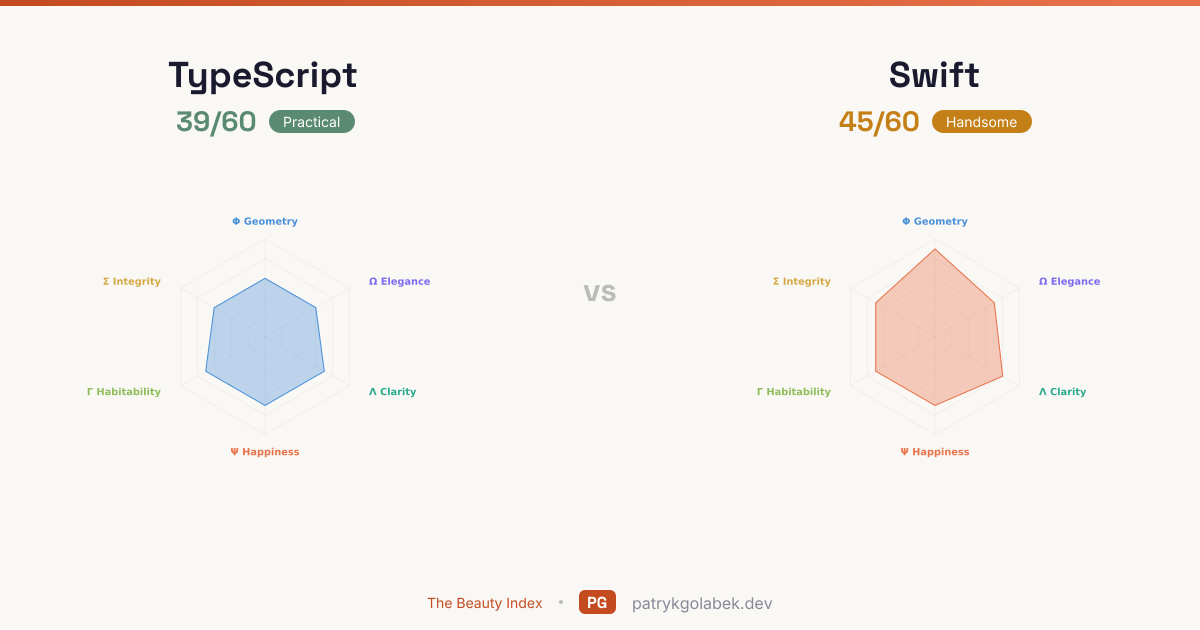
Swift scores 45/60 against TypeScript's 39/60, leading in 4 of 6 dimensions. Swift dominates the aesthetic, mathematical, and design axes. Aesthetic Geometry is where the pair separates most cleanly — Swift leads TypeScript by 3 points and that gap colours everything else on the page.
See also: PHP vs Swift , TypeScript .
Dimension-by-dimension analysis
Φ Aesthetic Geometry
Swift wins Aesthetic Geometry by 3 points — a decisive visual advantage. Swift's syntax is visually clean and well-proportioned, closures, guard statements, and trailing closure syntax create a natural reading flow. Apple's design obsession shows in the visual weight of the code. The visual gap between the two is not subtle — where Swift prizes geometric calm, TypeScript trades that serenity for other commitments. Inherits JavaScript's visual structure, which is functional but unremarkable. Generic type annotations and complex union types can create visual density. Not ugly, but not architecturally striking. In a language where expressiveness is the selling point, visual calm amplifies the advantage.
Λ Linguistic Clarity
Swift edges TypeScript by a single point on Linguistic Clarity; the practical difference is slim but real. Named parameters, guard clauses, and descriptive API naming conventions (inherited from Objective-C culture) make Swift code read clearly. array.filter { $0.isValid }.map { $0.name } communicates intent directly. The difference is real but modest — pick either and a team will read fluently within weeks. TypeScript improves on JavaScript's readability significantly, type annotations as documentation, discriminated unions for intent, and strong IDE support make code self-explanatory. A clear upgrade in linguistic clarity. For application code the clarity advantage is the whole point of the language category.
Ω Mathematical Elegance
Swift edges TypeScript by a single point on Mathematical Elegance; the practical difference is slim but real. Generics, protocol extensions, and enum-associated values support expressive algorithm design. Not in the functional-language Omega tier, but protocol-oriented programming enables elegant domain modeling. Both TypeScript and Swift can express algorithms cleanly; Swift merely gets there with slightly less ceremony. Conditional types, mapped types, and template literal types are genuinely innovative, the type system is more expressive than most mainstream languages. But the underlying JS runtime prevents the mathematical "economy" that Omega measures. In application code the elegance edge shows up as less boilerplate per idea.
Σ Conceptual Integrity
Swift edges TypeScript by a single point on Conceptual Integrity; the practical difference is slim but real. "Safe, fast, expressive" with protocol-oriented programming as a distinctive paradigm. The design is opinionated, but Apple's commercial interests and platform-specific priorities dilute the pure language-design vision. On conceptual unity the two are close enough that the decision turns on other factors. TypeScript has evolved beyond "typed JavaScript" into its own identity. The type system is a language-within-a-language with a coherent mission: add sound typing to JS without breaking compatibility. Still inherits some of JavaScript's conceptual chaos, but the mission itself is clear and focused. In high-level work a coherent philosophy is the frame that holds the language's features together.
Γ Organic Habitability
Both score 7 — this is one dimension where TypeScript and Swift genuinely agree. Gradual typing means you can introduce TypeScript incrementally. Codebases grow naturally from loose to strict. The any escape hatch is ugly but pragmatically habitable, you can always tighten later. Both TypeScript and Swift have proven they can carry code across decades — this is not where they differ. Protocol-oriented design encourages extensible architecture. Codebases can grow along protocol boundaries. Docked because Apple's rapid language evolution (Swift 1→6) has imposed migration costs, and the tight platform coupling limits organic growth beyond Apple's garden. In high-level work, the language that welcomes modification wins the decade, not the quarter.
Ψ Practitioner Happiness
Both score 7 — this is one dimension where TypeScript and Swift genuinely agree. Consistently scores ~73% admired in Stack Overflow surveys. The VS Code integration is best-in-class, and catching bugs at compile time is genuinely satisfying. Developers actively choose TypeScript over JavaScript. On happiness the verdict is a draw — choose based on what the work demands, not on what feels good. Strong satisfaction among iOS/macOS developers. Swift Playgrounds and Xcode integration create pleasant workflows. Docked because the ecosystem is Apple-locked, and build times plus ABI stability issues have caused real friction. In application languages the community culture compounds the language advantage.
Code comparison
The characteristic code snippet that best represents each language.
type Result<T, E = Error> =  | { ok: true; value: T }  | { ok: false; error: E };
function parse(input: string): Result<number> { const n = Number(input); return isNaN(n) ? { ok: false, error: new Error(`Invalid: ${input}`) } : { ok: true, value: n };}protocol Drawable { func draw() -> String}
extension Drawable { func debugDraw() -> String { "[(draw())]" }}
struct Circle: Drawable { let radius: Double func draw() -> String { "Circle(r=(radius))" }}Conditional branching and control flow expressions.
function describe(value: string | number): string { if (typeof value === "number") { return value > 0 ? "positive" : "non-positive"; } else { return value.length > 0 ? "non-empty" : "empty"; }}var label: Stringif score >= 90 { label = "excellent"} else if score >= 70 { label = "good"} else if score >= 50 { label = "average"} else { label = "needs improvement"}Data structure definition using classes, structs, records, or equivalent.
interface User {  readonly name: string;  readonly email: string;  age: number;}
class UserImpl implements User {  constructor(    public readonly name: string,    public readonly email: string,    public age: number  ) {}
greeting(): string { return `Hello, ${this.name}!`; }}struct User: Codable, Equatable { let name: String let email: String var age: Int
func greeting() -> String { "Hello, \(name)!" }}
let user = User(name: "Alice", email: "a@b.c", age: 30)Frequently asked questions
- Which is easier to learn, TypeScript or Swift?
- TypeScript and Swift are tied on Practitioner Happiness at 7/10 — both are broadly welcoming to newcomers. Consistently scores ~73% admired in Stack Overflow surveys. The VS Code integration is best-in-class, and catching bugs at compile time is genuinely satisfying. Developers actively choose TypeScript over JavaScript. For a developer adding a new language to their toolbelt, the happier one is the one you will still be writing in six months.
- Is TypeScript or Swift better for visually clean syntax?
- For visually clean syntax, Swift has a clear edge — it scores 9/10 on Aesthetic Geometry against TypeScript's 6/10. Swift's syntax is visually clean and well-proportioned, closures, guard statements, and trailing closure syntax create a natural reading flow. Apple's design obsession shows in the visual weight of the code.
- Should I pick TypeScript or Swift in 2026?
- TypeScript lands in the practical tier at 39/60; Swift in the handsome tier at 45/60. With this spread, default to the higher-ranked language and reserve the other for projects where its specific strengths matter. The score difference reflects years of community use, tooling maturity, and the editorial judgment of the Beauty Index rubric.