
TypeScript vs PHP
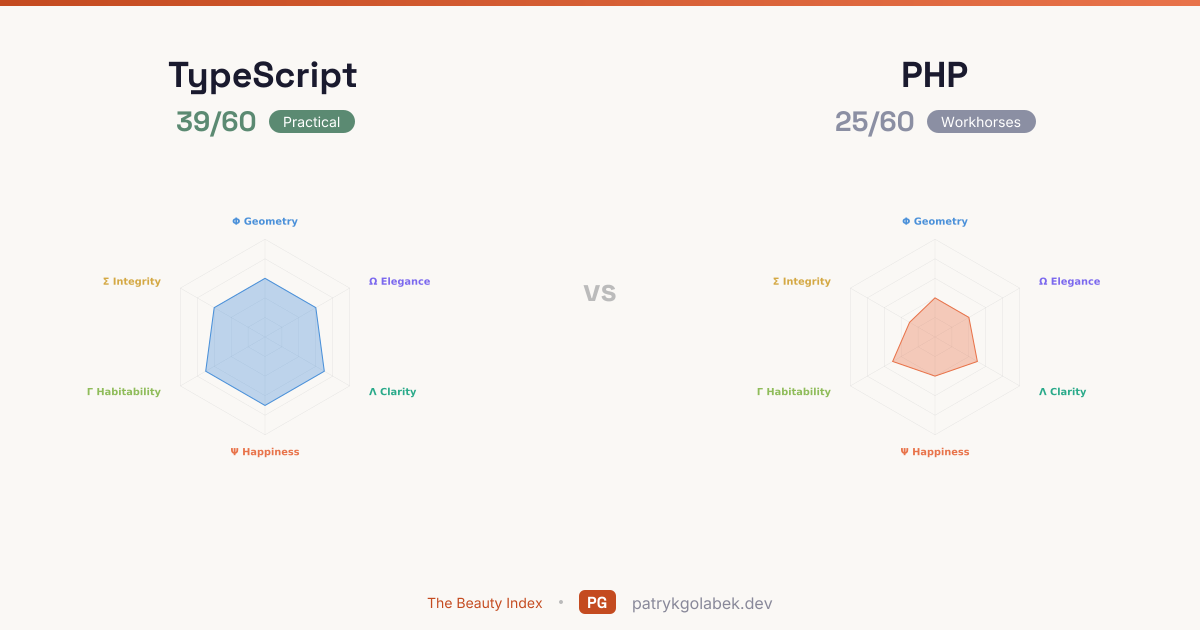
TypeScript
The responsible older sibling who cleans up JavaScript's messes. TypeScript proves that the best way to fix a language is to build a better one on top and pretend the old one doesn't exist.
PHP
The duct tape that holds 40% of the web together while everyone pretends it doesn't exist. PHP is the cockroach of programming: ugly, everywhere, and absolutely unkillable.
TypeScript scores 39/60 against PHP's 25/60, leading in 6 of 6 dimensions. TypeScript dominates the aesthetic, mathematical, human, and design axes. The widest gap sits on Practitioner Happiness, where TypeScript's 3-point lead over PHP shapes most of the pair's character.
See also: TypeScript vs Zig , TypeScript .
Dimension-by-dimension analysis
Ψ Practitioner Happiness
TypeScript wins Practitioner Happiness by 3 points — a decisive cultural edge. Consistently scores ~73% admired in Stack Overflow surveys. The VS Code integration is best-in-class, and catching bugs at compile time is genuinely satisfying. Developers actively choose TypeScript over JavaScript. Where TypeScript feels designed for the human, PHP feels designed for the machine first — the human catches up second. PHP developers themselves joke about PHP. The community is large and productive, but "most admired" it is not. Modern PHP (8.x with Laravel) has improved the experience significantly, but the reputation, and the daily reality of legacy code, weighs on happiness. In application languages the community culture compounds the language advantage.
Σ Conceptual Integrity
TypeScript wins Conceptual Integrity by 3 points — a clear integrity advantage. TypeScript has evolved beyond "typed JavaScript" into its own identity. The type system is a language-within-a-language with a coherent mission: add sound typing to JS without breaking compatibility. Still inherits some of JavaScript's conceptual chaos, but the mission itself is clear and focused. The design philosophy of TypeScript feels inevitable, each feature a consequence of one idea — PHP feels assembled from several good ideas instead of from one great one. PHP was not designed; it was accumulated. Rasmus Lerdorf's personal homepage tools grew into a language without a coherent philosophy. Each version has improved quality, but there is no "soul", no single idea that all features follow from. The quintessential committee language. For application code the integrity edge means fewer "wait, why does it behave that way?" moments per week.
Γ Organic Habitability
TypeScript wins Organic Habitability by 2 points — an unmistakable lead in how well code ages. Gradual typing means you can introduce TypeScript incrementally. Codebases grow naturally from loose to strict. The any escape hatch is ugly but pragmatically habitable, you can always tighten later. TypeScript invites modification; PHP rewards planning more than adjustment. PHP codebases survive, 77% of the web runs on PHP, and that code keeps working. The language is pragmatically habitable. But the inconsistent standard library and multiple paradigm shifts (procedural → OOP → modern PHP) make long-term evolution uneven. In high-level work, the language that welcomes modification wins the decade, not the quarter.
Λ Linguistic Clarity
TypeScript wins Linguistic Clarity by 2 points — a clear signal-to-noise edge. TypeScript improves on JavaScript's readability significantly, type annotations as documentation, discriminated unions for intent, and strong IDE support make code self-explanatory. A clear upgrade in linguistic clarity. The clarity gap is felt on first contact — TypeScript invites, PHP introduces friction before trust is earned. PHP can be readable in modern frameworks (Laravel's fluent syntax reads well). But str_replace vs. strpos vs. substr, inconsistent parameter ordering, and the legacy API are the antithesis of linguistic clarity. Two PHPs coexist: modern and legacy. The winner here treats readability as a core feature rather than a style preference.
Ω Mathematical Elegance
TypeScript wins Mathematical Elegance by 2 points — a genuine expressive lead. Conditional types, mapped types, and template literal types are genuinely innovative, the type system is more expressive than most mainstream languages. But the underlying JS runtime prevents the mathematical "economy" that Omega measures. TypeScript lets algorithms approach mathematical statement, while PHP asks more of the programmer when elegance is the goal. PHP is a templating language that grew into a general-purpose one. Array functions exist but lack the composability of functional languages. Mathematical elegance is not the design space PHP occupies. In application code the elegance edge shows up as less boilerplate per idea.
Φ Aesthetic Geometry
TypeScript wins Aesthetic Geometry by 2 points — a clear geometric edge. Inherits JavaScript's visual structure, which is functional but unremarkable. Generic type annotations and complex union types can create visual density. Not ugly, but not architecturally striking. PHP, by contrast, accepts visual density in exchange for other priorities. $ on every variable, -> for method calls, inconsistent brace styles across frameworks, and <?php tags create visual clutter. Modern PHP (8.x) with named arguments and match expressions is cleaner, but the legacy visual debt remains. For application code the geometry translates directly into readability for new contributors.
Code comparison
The characteristic code snippet that best represents each language.
type Result<T, E = Error> =  | { ok: true; value: T }  | { ok: false; error: E };
function parse(input: string): Result<number> { const n = Number(input); return isNaN(n) ? { ok: false, error: new Error(`Invalid: ${input}`) } : { ok: true, value: n };}$results = array_map( fn($user) => [ 'name' => $user['name'], 'email' => strtolower($user['email']), 'score' => array_sum($user['grades']) / count($user['grades']), ], array_filter( $users, fn($u) => $u['active'] && count($u['grades']) > 0 ));Conditional branching and control flow expressions.
function describe(value: string | number): string { if (typeof value === "number") { return value > 0 ? "positive" : "non-positive"; } else { return value.length > 0 ? "non-empty" : "empty"; }}$label = match(true) { $score >= 90 => 'excellent', $score >= 70 => 'good', $score >= 50 => 'average', default => 'needs improvement',};Embedding expressions and variables within string literals.
const name = "TypeScript";const version = 5.4;
const msg = `Hello, ${name}! Version: ${version}`;const expr = `Length: ${name.length}, Upper: ${name.toUpperCase()}`;const multi = `Welcome to ${name}.Version: ${version}`;$name = 'PHP';$version = 8.3;
$msg = "Hello, $name! Version: $version";$expr = "Length: " . strlen($name) . ", Upper: " . strtoupper($name);$heredoc = <<<EOTWelcome to $name.Version: $versionEOT;
$formatted = sprintf("%-10s | %5.1f", $name, $version);Frequently asked questions
- Which is easier to learn, TypeScript or PHP?
- TypeScript scores 7 on Practitioner Happiness versus PHP's 4. Consistently scores ~73% admired in Stack Overflow surveys. The VS Code integration is best-in-class, and catching bugs at compile time is genuinely satisfying. Developers actively choose TypeScript over JavaScript. For a newcomer picking up their first serious language in 2026, the happiness-score winner is the more forgiving starting point.
- Is TypeScript or PHP better for developer happiness?
- For developer happiness, TypeScript has a clear edge — it scores 7/10 on Practitioner Happiness against PHP's 4/10. Consistently scores ~73% admired in Stack Overflow surveys. The VS Code integration is best-in-class, and catching bugs at compile time is genuinely satisfying. Developers actively choose TypeScript over JavaScript.
- Should I pick TypeScript or PHP in 2026?
- TypeScript lands in the practical tier at 39/60; PHP in the workhorses tier at 25/60. On this score difference the answer is clear: the higher-ranked language wins unless you have an explicit reason to pay the cost of the other.