
Swift vs PHP
Swift
The architect who redesigned the entire house because the kitchen drawer was 2mm off. Swift pursues perfection with Apple-level obsession, and the result is a language that feels inevitable.
PHP
The duct tape that holds 40% of the web together while everyone pretends it doesn't exist. PHP is the cockroach of programming: ugly, everywhere, and absolutely unkillable.
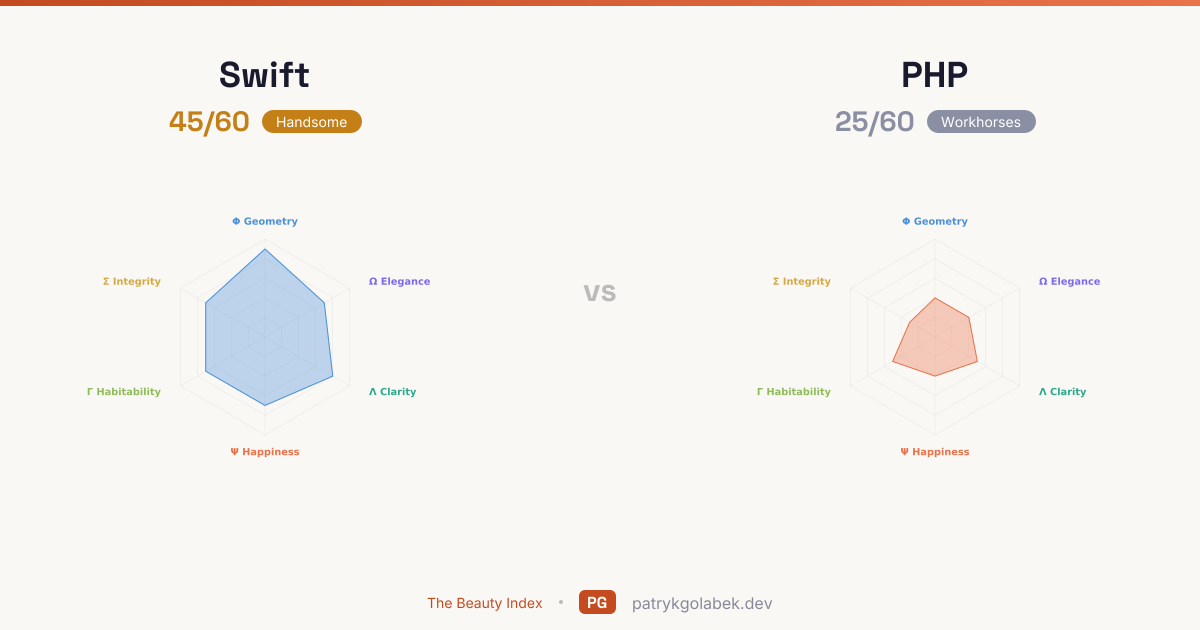
Swift scores 45/60 against PHP's 25/60, leading in 6 of 6 dimensions. Swift dominates the aesthetic, mathematical, human, and design axes. Aesthetic Geometry is where the pair separates most cleanly — Swift leads PHP by 5 points and that gap colours everything else on the page.
See also: Swift vs Kotlin , Swift .
Dimension-by-dimension analysis
Φ Aesthetic Geometry
Swift wins Aesthetic Geometry by 5 points — an unmistakable aesthetic lead. Swift's syntax is visually clean and well-proportioned, closures, guard statements, and trailing closure syntax create a natural reading flow. Apple's design obsession shows in the visual weight of the code. Set the two side by side and the shape of each language announces itself before you read a single identifier. $ on every variable, -> for method calls, inconsistent brace styles across frameworks, and <?php tags create visual clutter. Modern PHP (8.x) with named arguments and match expressions is cleaner, but the legacy visual debt remains. For application code the geometry translates directly into readability for new contributors.
Σ Conceptual Integrity
Swift wins Conceptual Integrity by 4 points — an unmistakable unity of purpose. "Safe, fast, expressive" with protocol-oriented programming as a distinctive paradigm. The design is opinionated, but Apple's commercial interests and platform-specific priorities dilute the pure language-design vision. The design philosophy of Swift feels inevitable, each feature a consequence of one idea — PHP feels assembled from several good ideas instead of from one great one. PHP was not designed; it was accumulated. Rasmus Lerdorf's personal homepage tools grew into a language without a coherent philosophy. Each version has improved quality, but there is no "soul", no single idea that all features follow from. The quintessential committee language. The winner's philosophical discipline is what keeps its idioms stable as the language evolves.
Λ Linguistic Clarity
Swift wins Linguistic Clarity by 3 points — an unmistakable prose-like flow. Named parameters, guard clauses, and descriptive API naming conventions (inherited from Objective-C culture) make Swift code read clearly. array.filter { $0.isValid }.map { $0.name } communicates intent directly. Where Swift favours plain intent, PHP trades clarity for control, capability, or history. PHP can be readable in modern frameworks (Laravel's fluent syntax reads well). But str_replace vs. strpos vs. substr, inconsistent parameter ordering, and the legacy API are the antithesis of linguistic clarity. Two PHPs coexist: modern and legacy. For application code the clarity advantage is the whole point of the language category.
Ω Mathematical Elegance
Swift wins Mathematical Elegance by 3 points — a substantive reach beyond idiom. Generics, protocol extensions, and enum-associated values support expressive algorithm design. Not in the functional-language Omega tier, but protocol-oriented programming enables elegant domain modeling. The gap on Elegance is real: Swift rewards precise thought, PHP rewards precise bookkeeping. PHP is a templating language that grew into a general-purpose one. Array functions exist but lack the composability of functional languages. Mathematical elegance is not the design space PHP occupies. For high-level work, the gap compounds: fewer lines per algorithm means fewer bugs per feature.
Ψ Practitioner Happiness
Swift wins Practitioner Happiness by 3 points — a genuine community lead. Strong satisfaction among iOS/macOS developers. Swift Playgrounds and Xcode integration create pleasant workflows. Docked because the ecosystem is Apple-locked, and build times plus ABI stability issues have caused real friction. The practitioner experience on Swift is simply more fun, day in and day out, than on PHP. PHP developers themselves joke about PHP. The community is large and productive, but "most admired" it is not. Modern PHP (8.x with Laravel) has improved the experience significantly, but the reputation, and the daily reality of legacy code, weighs on happiness. The winner here invites the next generation of contributors without asking them to earn it first.
Γ Organic Habitability
Swift wins Organic Habitability by 2 points — a clear edge for long-lived code. Protocol-oriented design encourages extensible architecture. Codebases can grow along protocol boundaries. Docked because Apple's rapid language evolution (Swift 1→6) has imposed migration costs, and the tight platform coupling limits organic growth beyond Apple's garden. Where Swift accommodates change gracefully, PHP makes you earn each new direction. PHP codebases survive, 77% of the web runs on PHP, and that code keeps working. The language is pragmatically habitable. But the inconsistent standard library and multiple paradigm shifts (procedural → OOP → modern PHP) make long-term evolution uneven. The winner here is the language you will still enjoy reading in five years.
Code comparison
The characteristic code snippet that best represents each language.
protocol Drawable {    func draw() -> String}
extension Drawable {    func debugDraw() -> String { "[(draw())]" }}
struct Circle: Drawable { let radius: Double func draw() -> String { "Circle(r=(radius))" }}$results = array_map( fn($user) => [ 'name' => $user['name'], 'email' => strtolower($user['email']), 'score' => array_sum($user['grades']) / count($user['grades']), ], array_filter( $users, fn($u) => $u['active'] && count($u['grades']) > 0 ));Basic variable syntax, type annotations, and initialization patterns.
For/while iteration patterns and loop constructs.
for i in 1...10 {    print(i)}
for (index, value) in list.enumerated() {    print("\(index): \(value)")}
for i in stride(from: 0, to: 100, by: 5) { print(i)}foreach ($items as $index => $item) { echo "$index: $item\n";}
for ($i = 0; $i < 10; $i++) { echo "$i\n";}
$sum = 0;while ($sum < 100) { $sum += 10; }Frequently asked questions
- Which is easier to learn, Swift or PHP?
- Swift scores 7 on Practitioner Happiness versus PHP's 4. Strong satisfaction among iOS/macOS developers. Swift Playgrounds and Xcode integration create pleasant workflows. Docked because the ecosystem is Apple-locked, and build times plus ABI stability issues have caused real friction. When ease of learning is the deciding factor, the happier community wins every time — mentors, docs, and examples are simply more abundant.
- Is Swift or PHP better for visually clean syntax?
- For visually clean syntax, Swift has a clear edge — it scores 9/10 on Aesthetic Geometry against PHP's 4/10. Swift's syntax is visually clean and well-proportioned, closures, guard statements, and trailing closure syntax create a natural reading flow. Apple's design obsession shows in the visual weight of the code.
- Should I pick Swift or PHP in 2026?
- Swift lands in the handsome tier at 45/60; PHP in the workhorses tier at 25/60. With this much daylight between them, the higher scorer is the default and the lower scorer needs a business case. The score difference reflects years of community use, tooling maturity, and the editorial judgment of the Beauty Index rubric.