
Scala vs OCaml
Scala
The PhD student who insists on explaining category theory at dinner parties. Scala has the intellectual firepower of ten languages, which is precisely the problem.
OCaml
The quiet genius in the corner who invented half of modern type theory and never got credit. OCaml's type system is a masterpiece; its ecosystem is an archaeology dig.
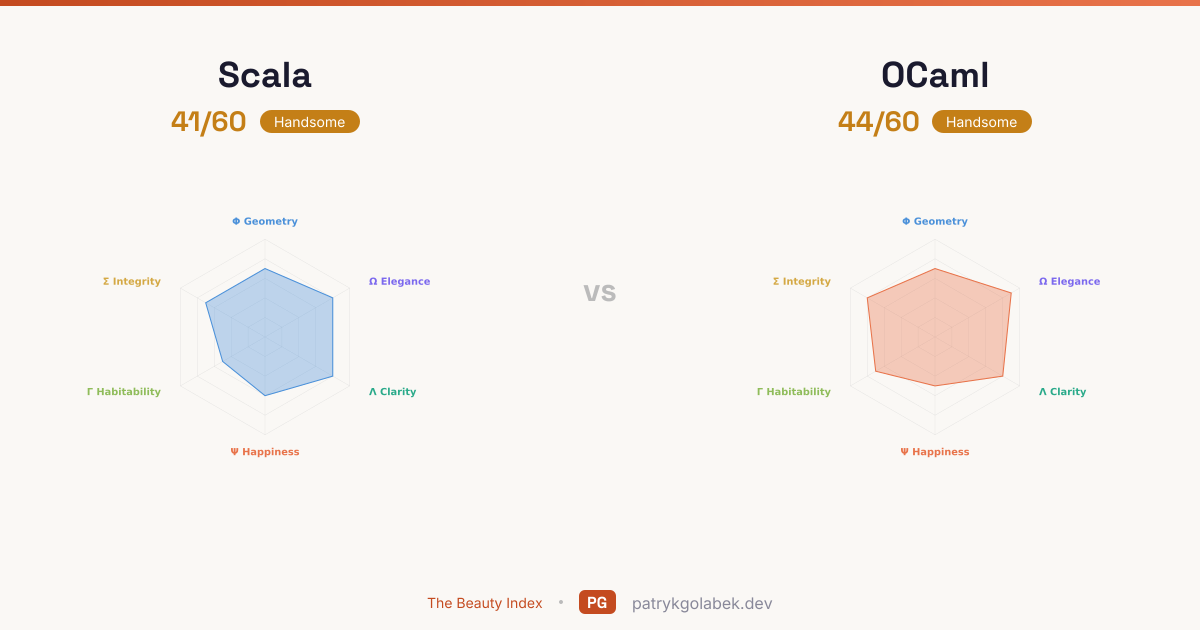
OCaml scores 44/60 against Scala's 41/60, leading in 3 of 6 dimensions. OCaml dominates the mathematical, human, and design axes. The pair splits practitioner joy from long-term habitability — Scala wins the week, OCaml wins the decade.
See also: PHP vs OCaml , Scala .
Dimension-by-dimension analysis
Γ Organic Habitability
OCaml wins Organic Habitability by 2 points — a meaningful extensibility gap. Strong types and module boundaries help code age well. The functors system enables reusable, extensible abstractions. Docked because the ecosystem's small size means fewer established patterns for common problems. OCaml invites modification; Scala rewards planning more than adjustment. The "better Java" vs. "Haskell on JVM" community split means codebases lack stylistic consensus. The Scala 2→3 migration has caused real ecosystem pain. Complex implicit resolution chains make codebases brittle to modify. Long-term habitability is uneven. In high-level work, the language that welcomes modification wins the decade, not the quarter.
Ω Mathematical Elegance
OCaml edges Scala by a single point on Mathematical Elegance; the practical difference is slim but real. MetaLanguage-family heritage gives OCaml one of the most expressive type systems in existence. GADTs, functors, and first-class modules enable algorithm expression that approaches mathematical proof. Type theory pioneers use OCaml for a reason. Both Scala and OCaml can express algorithms cleanly; OCaml merely gets there with slightly less ceremony. Higher-kinded types, implicits (now given/using), and for-comprehensions give Scala deep mathematical expressiveness. Capable of Haskell-tier abstraction when used by expert practitioners. In application code the elegance edge shows up as less boilerplate per idea.
Ψ Practitioner Happiness
Scala edges OCaml by a single point on Practitioner Happiness; the practical difference is slim but real. Respected but not beloved by the wider developer community. Build times, the Scala 2→3 migration pain, and the steep learning curve for advanced features create real friction. The community is engaged but fragmented. Both Scala and OCaml are broadly loved; Scala is loved a little harder, a little more loudly. A small community with niche adoption. Tooling has improved dramatically (opam, dune, Merlin), but the ecosystem remains thin compared to mainstream languages. Practitioners love it deeply, but they are few. The winner here invites the next generation of contributors without asking them to earn it first.
Σ Conceptual Integrity
OCaml edges Scala by a single point on Conceptual Integrity; the practical difference is slim but real. OCaml has always known what it is: a practical functional language with an exceptional type system. The design is focused and coherent, types as the organizing principle, everything else in service of that. Both Scala and OCaml have coherent design philosophies; OCaml merely holds to its centre with a firmer grip. Scala tries to unify OOP and FP at maximum power, resulting in a language with two souls rather than one. The Scala 2→3 evolution signals that even the designer's vision has shifted. Multi-paradigm breadth weakens the single coherent "language soul" that Sigma measures. In high-level work a coherent philosophy is the frame that holds the language's features together.
Λ Linguistic Clarity
Both score 8 — this is one dimension where Scala and OCaml genuinely agree. At its best, Scala reads clearly, users.filter(_.isActive).map(_.name). At its worst, implicit resolution chains create invisible logic. The gap between readable and opaque Scala is wider than most languages. Both Scala and OCaml aim for the same high bar on readability, and both reach it. The |> operator, descriptive module paths, and pattern matching make OCaml code readable to anyone familiar with ML conventions. The language communicates structure and intent through types rather than comments. The winner here treats readability as a core feature rather than a style preference.
Φ Aesthetic Geometry
Both score 7 — this is one dimension where Scala and OCaml genuinely agree. Case classes, pattern matching, and for-comprehensions produce visually clean code. The layout can be elegant. Docked because Scala's flexibility means visual style varies wildly between codebases and teams. On geometry the two languages converge; whatever separates them must be found on another axis. Pattern matching, let bindings, and module signatures create a structured visual feel. Clean but not striking, the syntax is functional without being visually adventurous. In a language where expressiveness is the selling point, visual calm amplifies the advantage.
Code comparison
Exception handling via try/catch or Result/Either patterns.
import scala.util.{Try, Success, Failure}
def parse(s: String): Either[String, Int] =  Try(s.toInt).toEither.left.map(_.getMessage)
val result = for  x <- parse("42")  y <- parse("7")yield x + y
result match case Right(v) => println(s"Got: $v") case Left(e) => println(s"Error: $e")let safe_divide a b = if b = 0.0 then Error "Division by zero" else Ok (a /. b)
let compute = Result.bind (safe_divide 10.0 2.0) (fun x -> safe_divide x 3.0)
match compute with| Ok v -> Printf.printf "Got: %f\n" v| Error e -> Printf.printf "Error: %s\n" eThe characteristic code snippet that best represents each language.
case class User(name: String, age: Int)
def findEligible( users: List[User], minAge: Int): List[String] = for { user <- users if user.age >= minAge initial = user.name.head.toUpper } yield s"$initial. ${user.name} (age ${user.age})"type 'a tree = | Leaf | Node of 'a tree * 'a * 'a tree
let rec fold f acc = function | Leaf -> acc | Node (left, value, right) -> let acc = fold f acc left in let acc = f acc value in fold f acc rightNative pattern matching constructs for destructuring and control flow.
def describe(x: Any): String = x match case i: Int if i > 0 => s"positive: $i" case s: String => s"string: $s" case (a, b) => s"pair: $a, $b" case head :: _ => s"list starting with $head" case _ => "unknown"let describe = function | [] -> "empty" | [x] -> Printf.sprintf "singleton: %d" x | x :: _ when x > 0 -> "starts positive" | _ -> "other"
let area = function | Circle r -> Float.pi *. r *. r | Rect (w, h) -> w *. hFrequently asked questions
- Which is easier to learn, Scala or OCaml?
- Scala scores 6 on Practitioner Happiness versus OCaml's 5. Respected but not beloved by the wider developer community. Build times, the Scala 2→3 migration pain, and the steep learning curve for advanced features create real friction. The community is engaged but fragmented. For a developer adding a new language to their toolbelt, the happier one is the one you will still be writing in six months.
- Is Scala or OCaml better for long-lived codebases?
- For long-lived codebases, OCaml has a clear edge — it scores 7/10 on Organic Habitability against Scala's 5/10. Strong types and module boundaries help code age well. The functors system enables reusable, extensible abstractions. Docked because the ecosystem's small size means fewer established patterns for common problems.
- Should I pick Scala or OCaml in 2026?
- Scala lands in the handsome tier at 41/60; OCaml in the handsome tier at 44/60. The gap is narrow enough that team familiarity and ecosystem fit should decide. Pick the one your hires already know. The score difference reflects years of community use, tooling maturity, and the editorial judgment of the Beauty Index rubric.