
Scala vs Go
Scala
The PhD student who insists on explaining category theory at dinner parties. Scala has the intellectual firepower of ten languages, which is precisely the problem.
Go
The minimalist architect who removed every feature you loved and somehow built something better. Go proves that what you leave out matters more than what you put in.
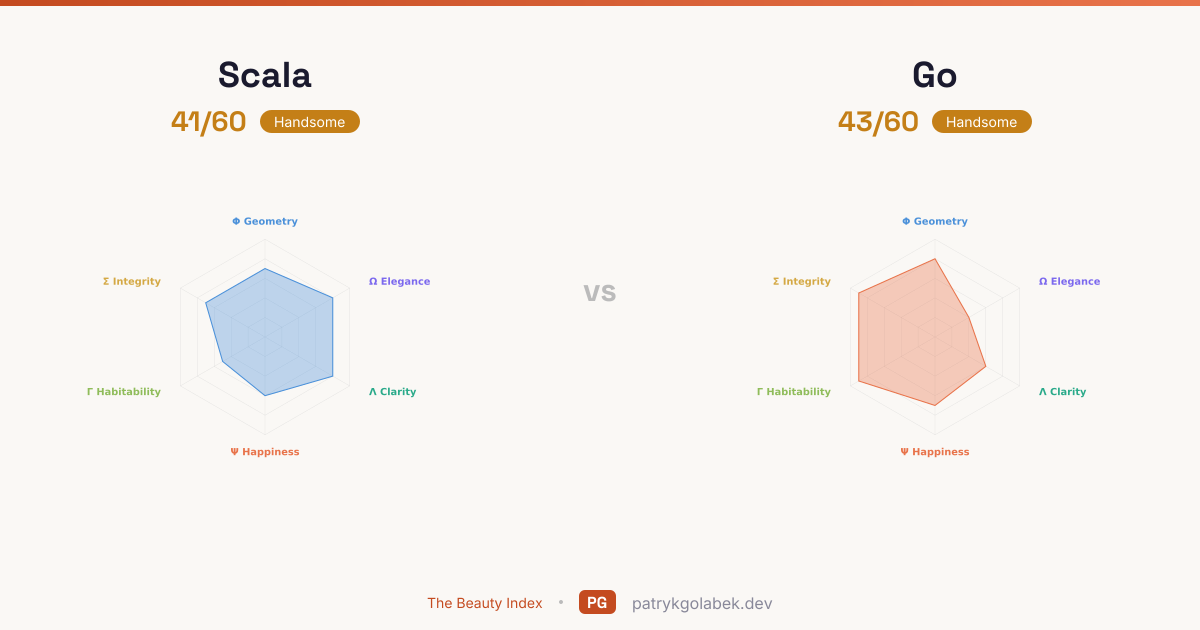
Go scores 43/60 against Scala's 41/60, leading in 4 of 6 dimensions. Scala owns aesthetic and mathematical while Go leads in human and design. Read the comparison through Organic Habitability first: Go wins that axis by 4 points over Scala, and it is the single best lens on the pair.
Dimension-by-dimension analysis
Γ Organic Habitability
Go wins Organic Habitability by 4 points — a meaningful extensibility gap. Go codebases are among the most maintainable in any language. The limited feature set means less stylistic drift over time. New developers can contribute immediately. Code ages gracefully because there's only one way to write it. The habitability gap shows in long-lived codebases — Go ages, Scala calcifies without careful discipline. The "better Java" vs. "Haskell on JVM" community split means codebases lack stylistic consensus. The Scala 2→3 migration has caused real ecosystem pain. Complex implicit resolution chains make codebases brittle to modify. Long-term habitability is uneven. The habitability advantage compounds across decades of maintenance.
Ω Mathematical Elegance
Scala wins Mathematical Elegance by 4 points — a decisive elegance advantage. Higher-kinded types, implicits (now given/using), and for-comprehensions give Scala deep mathematical expressiveness. Capable of Haskell-tier abstraction when used by expert practitioners. Scala lets algorithms approach mathematical statement, while Go asks more of the programmer when elegance is the goal. Go deliberately avoids mathematical abstraction. No generics (until recently, and limited), no algebraic types, no higher-order patterns. Algorithms in Go are written out explicitly, which is the opposite of Hardy's "economy." The philosophy is valid, but Omega measures what it measures. In application code the elegance edge shows up as less boilerplate per idea.
Λ Linguistic Clarity
Scala wins Linguistic Clarity by 2 points — a meaningful clarity gap. At its best, Scala reads clearly, users.filter(_.isActive).map(_.name). At its worst, implicit resolution chains create invisible logic. The gap between readable and opaque Scala is wider than most languages. Where Scala favours plain intent, Go trades clarity for control, capability, or history. Go is verbose but never confusing. There is zero ambiguity about what any line does. if err != nil is noise, but the signal-to-noise ratio on intent is actually quite high because the language has so few constructs. "Technical manual" clarity, not literary, but reliably communicative. For application code the clarity advantage is the whole point of the language category.
Σ Conceptual Integrity
Go wins Conceptual Integrity by 2 points — a decisive philosophical edge. "Simplicity is complicated." Rob Pike and Ken Thompson's vision is razor-sharp: remove every feature that isn't essential. Go is the most opinionated language about what it won't do, and that discipline is itself a form of conceptual integrity. The design philosophy of Go feels inevitable, each feature a consequence of one idea — Scala feels assembled from several good ideas instead of from one great one. Scala tries to unify OOP and FP at maximum power, resulting in a language with two souls rather than one. The Scala 2→3 evolution signals that even the designer's vision has shifted. Multi-paradigm breadth weakens the single coherent "language soul" that Sigma measures. At the systems level a coherent philosophy is the difference between a language you master and a language you survive.
Φ Aesthetic Geometry
Go edges Scala by a single point on Aesthetic Geometry; the practical difference is slim but real. gofmt produces the most visually uniform code of any language. Every Go file looks the same. Enforced formatting eliminates style debates entirely, this is the Bauhaus ideal realized through tooling. Both Scala and Go care about how code looks — they simply draw the line in slightly different places. Case classes, pattern matching, and for-comprehensions produce visually clean code. The layout can be elegant. Docked because Scala's flexibility means visual style varies wildly between codebases and teams. Where every byte matters, visual clarity still matters — and Go keeps that ledger honest.
Ψ Practitioner Happiness
Go edges Scala by a single point on Practitioner Happiness; the practical difference is slim but real. Excellent tooling (go fmt, go vet, go test, go mod), fast compilation, and simplicity that induces flow states. Docked from higher because the enforced simplicity can feel constraining, and the if err != nil repetition is a genuine pain point. Go noses ahead in surveys, but Scala retains a devoted following of its own. Respected but not beloved by the wider developer community. Build times, the Scala 2→3 migration pain, and the steep learning curve for advanced features create real friction. The community is engaged but fragmented. The practitioner-happiness edge in a systems language is unusual and worth noting.
Code comparison
The characteristic code snippet that best represents each language.
case class User(name: String, age: Int)
def findEligible( users: List[User], minAge: Int): List[String] = for { user <- users if user.age >= minAge initial = user.name.head.toUpper } yield s"$initial. ${user.name} (age ${user.age})"func fanIn(channels ...<-chan string) <-chan string { merged := make(chan string) var wg sync.WaitGroup for _, ch := range channels { wg.Add(1) go func(c <-chan string) { defer wg.Done() for msg := range c { merged <- msg } }(ch) } go func() { wg.Wait(); close(merged) }() return merged}Data structure definition using classes, structs, records, or equivalent.
case class User(    name: String,    email: String,    age: Int = 0):  def greeting: String = s"Hello, $name!"
val user = User("Alice", "alice@ex.com", 30)val updated = user.copy(age = 31)type User struct { Name string Email string Age int}
func NewUser(name, email string, age int) User { return User{Name: name, Email: email, Age: age}}
func (u User) Greeting() string { return fmt.Sprintf("Hello, %s!", u.Name)}Map, filter, reduce and functional collection transformations.
val numbers = (1 to 10).toList
val doubled = numbers.map(_ * 2)val evens = numbers.filter(_ % 2 == 0)val total = numbers.reduce(_ + _)
val result = numbers .filter(_ % 2 == 0) .map(n => n * n) .sumnumbers := []int{1, 2, 3, 4, 5, 6, 7, 8, 9, 10}
var evens []intfor _, n := range numbers { if n%2 == 0 { evens = append(evens, n) }}
sum := 0for _, n := range numbers { sum += n}Frequently asked questions
- Which is easier to learn, Scala or Go?
- Go scores 7 on Practitioner Happiness versus Scala's 6. Excellent tooling (go fmt, go vet, go test, go mod), fast compilation, and simplicity that induces flow states. Docked from higher because the enforced simplicity can feel constraining, and the if err != nil repetition is a genuine pain point. For a developer adding a new language to their toolbelt, the happier one is the one you will still be writing in six months.
- Is Scala or Go better for long-lived codebases?
- For long-lived codebases, Go has a clear edge — it scores 9/10 on Organic Habitability against Scala's 5/10. Go codebases are among the most maintainable in any language. The limited feature set means less stylistic drift over time. New developers can contribute immediately. Code ages gracefully because there's only one way to write it.
- Should I pick Scala or Go in 2026?
- Scala lands in the handsome tier at 41/60; Go in the handsome tier at 43/60. The gap is narrow enough that team familiarity and ecosystem fit should decide. Pick the one your hires already know. The score difference reflects years of community use, tooling maturity, and the editorial judgment of the Beauty Index rubric.