
Rust vs Lua
Rust
The overprotective friend who's always right. Rust won't let you make mistakes, and you'll resent it until you realize every error it caught would have been a 3am production incident.
Lua
The compact Swiss army knife that fits in any pocket. Lua is so small and embeddable that it powers everything from World of Warcraft to nginx configs without anyone noticing.
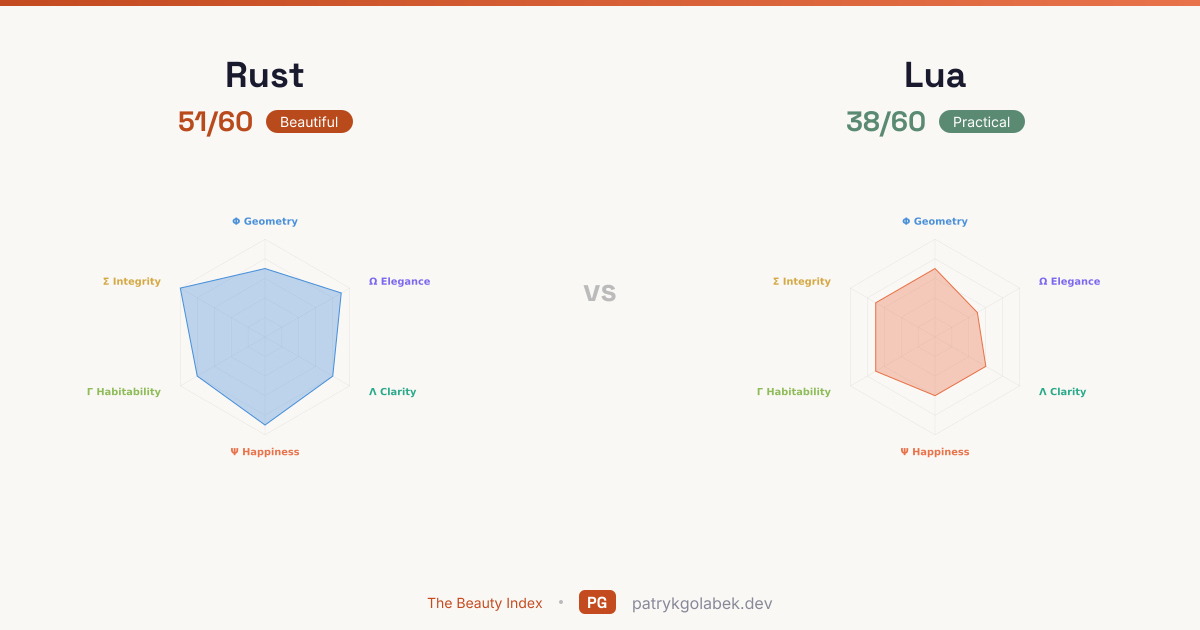
Rust scores 51/60 against Lua's 38/60, leading in 5 of 6 dimensions. Rust dominates the aesthetic, mathematical, human, and design axes. Read the comparison through Mathematical Elegance first: Rust wins that axis by 4 points over Lua, and it is the single best lens on the pair.
Dimension-by-dimension analysis
Ω Mathematical Elegance
Rust wins Mathematical Elegance by 4 points — a decisive elegance advantage. Algebraic data types, pattern matching, and zero-cost abstractions let you write algorithms that feel close to mathematical proofs. Ownership annotations interrupt the flow slightly — the ceremony is justified but still ceremony. Rust lets algorithms approach mathematical statement, while Lua asks more of the programmer when elegance is the goal. Lua is deliberately simple. Tables as the single data structure are elegant in concept, but the language doesn't provide tools for abstract mathematical expression. Practical economy rather than mathematical economy. At the systems level elegance is rare and valuable — the winner earns it under real constraints.
Ψ Practitioner Happiness
Rust wins Practitioner Happiness by 3 points — a real happiness advantage. Topped Stack Overflow's "Most Admired" for 7+ consecutive years at 72%. The community is evangelical in its love. Compiler error messages are genuinely helpful. The "fighting the borrow checker" phase gives way to deep satisfaction. Rust has done the harder cultural work: tooling that delights, a community that welcomes, documentation that explains. Appreciated by game developers and embedded systems programmers. The embedding experience is seamless. But as a standalone language, the ecosystem is thin and the community is niche. Even in low-level work the human experience matters — the winner proves systems code need not be joyless.
Σ Conceptual Integrity
Rust wins Conceptual Integrity by 3 points — a decisive philosophical edge. "Safety without sacrificing control." Every feature (ownership, borrowing, lifetimes, traits) follows from this single idea. Rust is the most opinionated systems language ever designed, and every opinion is justified by the core philosophy. Where Rust holds a line, Lua has negotiated with history, ecosystems, and legacy users. "Small, fast, embeddable." Lua knows exactly what it is and stays in its lane. The design is coherent and focused. Docked slightly because the minimalism is more pragmatic than philosophical — it's simple because it needs to be small, not because simplicity is the point. The winner's design discipline pays off most under the extreme constraints systems work imposes.
Λ Linguistic Clarity
Rust wins Linguistic Clarity by 2 points — a meaningful clarity gap. Trait-based design, expressive enums, and the ? operator make intent clear. Rust rewards you with readable code once you know the idioms. Lifetime annotations are information for the compiler rather than the human reader, which docks it from 9. Where Rust favours plain intent, Lua trades clarity for control, capability, or history. Lua reads simply and directly for small scripts. The table-as-everything paradigm is clear once understood. Docked because the lack of distinct data structures (no arrays, no classes, just tables) can make larger codebases harder to read. The winner proves that proximity to the machine need not mean distance from the reader.
Γ Organic Habitability
Rust edges Lua by a single point on Organic Habitability; the practical difference is slim but real. Ownership rules force you to think about structure upfront, which often produces code that ages well. Some modifications ("I just wanted to add a reference here") cascade more than expected, but the type system catches the fallout. Both Rust and Lua age reasonably well; Rust is merely a little kinder to the future reader. Lua's tiny footprint and simple embedding API make it exceptionally habitable in its niche, you can drop it into any C/C++ project. Metatables allow organic extension. Code accommodates change well within its scope. The habitability advantage compounds across decades of maintenance.
Φ Aesthetic Geometry
Both score 7 — this is one dimension where Rust and Lua genuinely agree. rustfmt enforces strong visual consistency, and match arms, impl blocks, and module structure create clear visual architecture. Docked because lifetime annotations, turbofish (::<>), and trait bounds add visual noise that breaks geometric serenity. On geometry the two languages converge; whatever separates them must be found on another axis. Lua's minimal syntax, function, end, local, tables, creates clean, visually proportional code. The lack of punctuation noise gives it a quiet, uncluttered feel. Small but well-composed. Where every byte matters, visual clarity still matters — and Rust keeps that ledger honest.
Code comparison
The characteristic code snippet that best represents each language.
enum Shape {    Circle(f64),    Rectangle(f64, f64),    Triangle(f64, f64, f64),}
fn area(shape: &Shape) -> f64 { match shape { Shape::Circle(r) => std::f64::consts::PI * r * r, Shape::Rectangle(w, h) => w * h, Shape::Triangle(a, b, c) => { let s = (a + b + c) / 2.0; (s * (s - a) * (s - b) * (s - c)).sqrt() } }}local Vector = {}Vector.__index = Vector
function Vector.new(x, y) return setmetatable({x = x, y = y}, Vector)end
function Vector:length() return math.sqrt(self.x^2 + self.y^2)end
function Vector.__add(a, b) return Vector.new(a.x + b.x, a.y + b.y)endMap, filter, reduce and functional collection transformations.
let numbers = vec![1, 2, 3, 4, 5, 6, 7, 8, 9, 10];
let result: Vec<i32> = numbers.iter()    .filter(|&&n| n % 2 == 0)    .map(|&n| n * n)    .collect();
let sum: i32 = numbers.iter().sum();local numbers = {1, 2, 3, 4, 5, 6, 7, 8, 9, 10}
local evens = {}for _, n in ipairs(numbers) do if n % 2 == 0 then evens[#evens + 1] = n endend
local sum = 0for _, n in ipairs(numbers) do sum = sum + n endException handling via try/catch or Result/Either patterns.
use std::num::ParseIntError;
fn parse_and_double(s: &str) -> Result<i32, ParseIntError> {    let n = s.parse::<i32>()?;    Ok(n * 2)}
fn main() { match parse_and_double("42") { Ok(val) => println!("Got: {}", val), Err(e) => eprintln!("Error: {}", e), }}local ok, result = pcall(function() return tonumber("42") or error("invalid")end)
if ok then print("Got: " .. result)else print("Error: " .. result)end
local ok2, val = xpcall(risky_fn, debug.traceback)Frequently asked questions
- Which is easier to learn, Rust or Lua?
- Rust scores 9 on Practitioner Happiness versus Lua's 6. Topped Stack Overflow's "Most Admired" for 7+ consecutive years at 72%. The community is evangelical in its love. Compiler error messages are genuinely helpful. The "fighting the borrow checker" phase gives way to deep satisfaction. For a developer adding a new language to their toolbelt, the happier one is the one you will still be writing in six months.
- Is Rust or Lua better for algorithm-heavy code?
- For algorithm-heavy code, Rust has a clear edge — it scores 9/10 on Mathematical Elegance against Lua's 5/10. Algebraic data types, pattern matching, and zero-cost abstractions let you write algorithms that feel close to mathematical proofs. Ownership annotations interrupt the flow slightly — the ceremony is justified but still ceremony.
- Should I pick Rust or Lua in 2026?
- Rust lands in the beautiful tier at 51/60; Lua in the practical tier at 38/60. On this score difference the answer is clear: the higher-ranked language wins unless you have an explicit reason to pay the cost of the other.