
Ruby vs Clojure
Ruby
The poet who became a startup founder. Matz designed Ruby explicitly to maximize programmer happiness, and it shows. Everything is an object, every expression returns a value, and blocks let you express ideas with a rhythm that feels literary.
Clojure
The Zen master who sees through your abstractions. Clojure distills programming to data, functions, and immutability, then watches smugly as your mutable-state codebase catches fire.
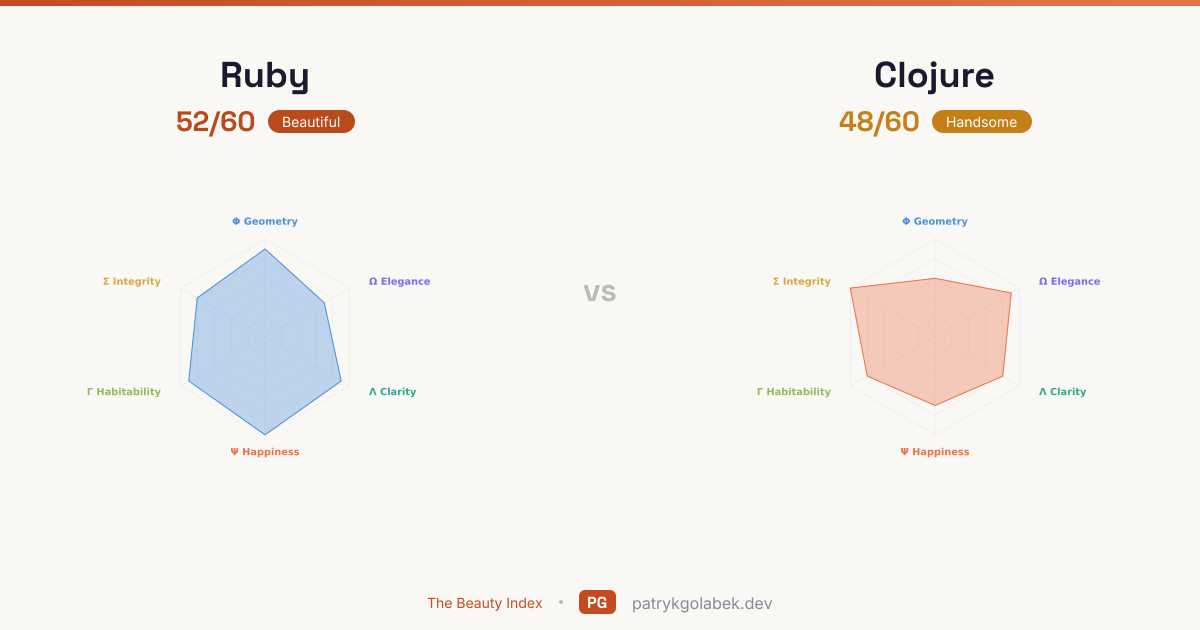
Ruby scores 52/60 against Clojure's 48/60, leading in 4 of 6 dimensions. Ruby owns aesthetic and human while Clojure leads in mathematical and design. Aesthetic Geometry is where the pair separates most cleanly — Ruby leads Clojure by 3 points and that gap colours everything else on the page.
See also: Ruby vs PHP , Ruby .
Dimension-by-dimension analysis
Φ Aesthetic Geometry
Ruby wins Aesthetic Geometry by 3 points — a decisive visual advantage. Ruby's block syntax, do...end and { } conventions, and method chaining create a natural visual flow. Code reads top-to-bottom with a literary rhythm. Indentation feels organic rather than enforced. The visual gap between the two is not subtle — where Ruby prizes geometric calm, Clojure trades that serenity for other commitments. Clojure's parentheses-heavy syntax is unconventional, but it's regular and tree-like. The uniform (verb noun noun) structure has its own geometric coherence once you internalize the visual grammar. Not chaotic, just non-traditional. For application code the geometry translates directly into readability for new contributors.
Ψ Practitioner Happiness
Ruby wins Practitioner Happiness by 3 points — a real happiness advantage. Ruby was designed to maximize programmer happiness, it's the explicit, stated mission. Matz's philosophy permeates everything from the standard library API to the community culture. The canonical 10 on this dimension. The practitioner experience on Ruby is simply more fun, day in and day out, than on Clojure. A devoted, intellectually engaged community. The REPL-driven workflow induces genuine flow states. The ecosystem is mature (for its size). Docked because the community is small and Lisp-family syntax creates a real adoption barrier. The winner here invites the next generation of contributors without asking them to earn it first.
Ω Mathematical Elegance
Clojure wins Mathematical Elegance by 2 points — a decisive elegance advantage. Homoiconicity (code is data) enables metaprogramming that feels mathematical. Persistent data structures, lazy sequences, and transducers let you express algorithms with remarkable economy. Among the most "Book", like in practice. The gap on Elegance is real: Clojure rewards precise thought, Ruby rewards precise bookkeeping. Everything is an object, every expression returns a value, and blocks enable higher-order patterns. Not a mathematical language per se, but its internal consistency gives algorithms a sense of inevitability. The winner lets the author think in algorithms rather than in ceremony.
Σ Conceptual Integrity
Clojure wins Conceptual Integrity by 2 points — a decisive philosophical edge. "Code is data. Data is code. Everything is immutable." Clojure is distilled philosophy, every design choice follows from a handful of axioms. Rich Hickey's talks are effectively the language's specification, and the language is the talks made concrete. Clojure speaks with a single design voice; Ruby speaks with a committee. "Optimize for programmer happiness" is a clear, singular vision. Ruby occasionally accumulates features (e.g., multiple ways to define lambdas), but the core philosophy holds. Docked slightly for the flexibility-creates-inconsistency tradeoff. The winner's philosophical discipline is what keeps its idioms stable as the language evolves.
Γ Organic Habitability
Ruby edges Clojure by a single point on Organic Habitability; the practical difference is slim but real. Monkey-patching, open classes, and convention-over-configuration make Ruby extremely habitable. Code accommodates change with minimal friction. The language invites you to extend it rather than fight it. On extensibility the two are close enough that the decision rarely hinges on this axis alone. Immutable data and pure functions produce code that is inherently easy to extend and modify, no hidden state to trip over. Rich Hickey's "simple made easy" philosophy is the definition of habitable design. In high-level work, the language that welcomes modification wins the decade, not the quarter.
Λ Linguistic Clarity
Ruby edges Clojure by a single point on Linguistic Clarity; the practical difference is slim but real. .reject(&:empty?), .each_with_index, File.readlines — Ruby reads aloud as English. Matz explicitly optimized for human communication over machine efficiency. Among the highest Knuthian "wit" in any language. On readability the edge is slim and disappears quickly as idioms are learned. Threading macros (->, ->>) transform nested Lisp into readable pipelines. The data-oriented philosophy, plain maps and vectors over custom types, makes intent transparent. Prefix notation is a barrier for newcomers, but the idioms are clear once learned. The winner here treats readability as a core feature rather than a style preference.
Code comparison
The characteristic code snippet that best represents each language.
class Array def histogram each_with_object(Hash.new(0)) { |item, counts| counts[item] += 1 } .sort_by { |_, count| -count } .map { |item, count| "#{item}: #{'*' * count}" } .join("\n") endend(defn process-users [users] (->> users (filter :active) (map :email) (map clojure.string/lower-case) (sort) (dedupe) (into [])))For/while iteration patterns and loop constructs.
Exception handling via try/catch or Result/Either patterns.
def parse_number(str)  Integer(str)rescue ArgumentError => e  raise "Invalid input: #{str}"end
begin result = parse_number(input)rescue => e puts "Error: #{e.message}" result = -1ensure cleanupend(defn parse-number [s] (try (Integer/parseInt s) (catch NumberFormatException _ (throw (ex-info "Invalid input" {:input s})))))
(try (parse-number "42") (catch Exception e (println "Error:" (ex-message e))))Frequently asked questions
- Which is easier to learn, Ruby or Clojure?
- Ruby scores 10 on Practitioner Happiness versus Clojure's 7. Ruby was designed to maximize programmer happiness, it's the explicit, stated mission. Matz's philosophy permeates everything from the standard library API to the community culture. The canonical 10 on this dimension. For a developer adding a new language to their toolbelt, the happier one is the one you will still be writing in six months.
- Is Ruby or Clojure better for visually clean syntax?
- For visually clean syntax, Ruby has a clear edge — it scores 9/10 on Aesthetic Geometry against Clojure's 6/10. Ruby's block syntax, do...end and { } conventions, and method chaining create a natural visual flow. Code reads top-to-bottom with a literary rhythm. Indentation feels organic rather than enforced.
- Should I pick Ruby or Clojure in 2026?
- Ruby lands in the beautiful tier at 52/60; Clojure in the handsome tier at 48/60. With this spread, default to the higher-ranked language and reserve the other for projects where its specific strengths matter. The score difference reflects years of community use, tooling maturity, and the editorial judgment of the Beauty Index rubric.