
Dart vs Elixir
Dart
The second-chance kid who found their calling in Flutter. Dart was nearly forgotten until mobile development gave it a purpose, and now it's living its best life painting pixels.
Elixir
The jazz musician who studied classical. Elixir takes Erlang's battle-tested concurrency and wraps it in syntax so pleasant you forget you're building distributed systems that never go down.
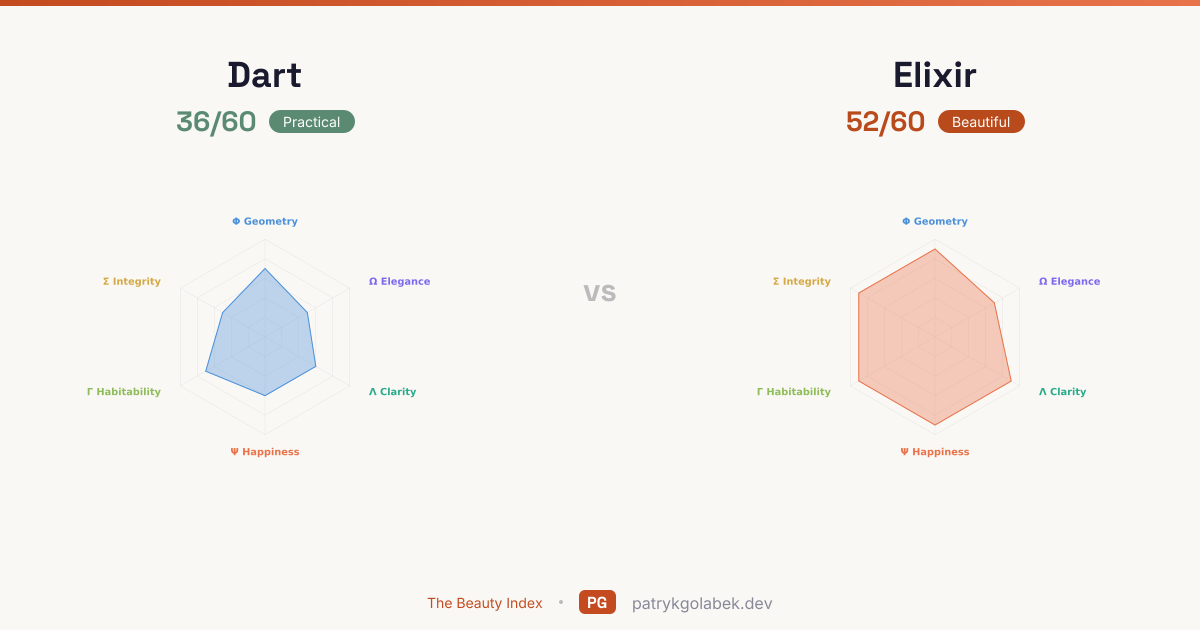
Elixir scores 52/60 against Dart's 36/60, leading in 6 of 6 dimensions. Elixir dominates the aesthetic, mathematical, human, and design axes. Read the comparison through Conceptual Integrity first: Elixir wins that axis by 4 points over Dart, and it is the single best lens on the pair.
See also: Dart vs C# , Dart .
Dimension-by-dimension analysis
Σ Conceptual Integrity
Elixir wins Conceptual Integrity by 4 points — a genuine lead in design coherence. "Erlang's power with modern syntax." José Valim had a clear vision: bring functional programming and fault-tolerant concurrency to a wider audience. The language feels designed by one mind with a singular purpose. Where Elixir holds a line, Dart has negotiated with history, ecosystems, and legacy users. Dart's identity crisis, initially a web language, then reborn as a Flutter companion, weakens its conceptual integrity. It's a good language in service of a framework, not a language with its own philosophical center. For application code the integrity edge means fewer "wait, why does it behave that way?" moments per week.
Λ Linguistic Clarity
Elixir wins Linguistic Clarity by 3 points — a real readability advantage. The pipe operator (|>) turns data transformation into a readable narrative. "hello" |> String.split() |> Enum.map(&String.capitalize/1) reads as a clear sequence of intentions. Among the most literate functional languages. Elixir reads like a well-edited paragraph; Dart reads like a sentence that is still being translated. Readable and predictable. Named parameters, cascade notation (..), and clear class syntax make intent visible. Not particularly literary, but consistently clear. For application code the clarity advantage is the whole point of the language category.
Ψ Practitioner Happiness
Elixir wins Practitioner Happiness by 3 points — an unmistakable experiential gap. Stack Overflow admiration at 66%. The Phoenix framework, LiveView, and OTP give practitioners a feeling of building something that "just works." The community is small but deeply enthusiastic and welcoming. Elixir has done the harder cultural work: tooling that delights, a community that welcomes, documentation that explains. Flutter developers generally enjoy the experience. Hot reload is a genuine joy. The language itself is pleasant enough, but Dart's identity is inseparable from Flutter, outside that context, enthusiasm drops significantly. In application languages the community culture compounds the language advantage.
Γ Organic Habitability
Elixir wins Organic Habitability by 2 points — a real habitability advantage. Pipelines are growth-point idioms, insert a transformation step anywhere without restructuring. OTP's supervision trees are the embodiment of habitable architecture: systems designed to fail gracefully and be extended incrementally. Elixir invites modification; Dart rewards planning more than adjustment. Dart codebases grow well within the Flutter paradigm. The widget composition model encourages incremental, modular extension. Sound null safety (added retroactively) improved long-term maintainability. For application codebases the habitability edge determines whether a project survives its second rewrite.
Ω Mathematical Elegance
Elixir wins Mathematical Elegance by 2 points — a clear algorithmic edge. Pattern matching, recursion, and immutable data structures support elegant algorithm expression. Not as abstract as Haskell or OCaml, but the BEAM VM's concurrency primitives give certain distributed algorithms an inevitable quality. Where Elixir compresses an idea into a line or two, Dart tends to spread the same idea across a paragraph. Dart is a pragmatic language without strong mathematical abstractions. It does what it needs to for UI programming. Generics and async/await are useful but not mathematically elegant. The winner lets the author think in algorithms rather than in ceremony.
Φ Aesthetic Geometry
Elixir wins Aesthetic Geometry by 2 points — a meaningful cleanliness gap. Pipeline operators, pattern-matching clauses, and module structure create a visual flow that scans beautifully. Elixir code looks like a series of clean, evenly weighted transformation steps. The difference is not cosmetic: Elixir rewards the eye, while Dart asks the reader to absorb more punctuation and more ceremony. Dart's syntax is clean and visually familiar to Java/JavaScript developers. Flutter's widget tree syntax, with its trailing commas and nested constructors, has a structured, tree-like visual geometry. For application code the geometry translates directly into readability for new contributors.
Code comparison
Exception handling via try/catch or Result/Either patterns.
int parseNumber(String s) {  try {    return int.parse(s);  } on FormatException catch (e) {    throw ArgumentError('Invalid: $s');  }}
try { final result = parseNumber('42'); print(result);} catch (e) { print('Error: $e');}with {:ok, user} <- fetch_user(id), {:ok, posts} <- fetch_posts(user.id), {:ok, _} <- validate(posts) do {:ok, format_response(user, posts)}else {:error, :not_found} -> {:error, "User not found"} {:error, reason} -> {:error, reason}endNative pattern matching constructs for destructuring and control flow.
String describe(Object obj) => switch (obj) { int n when n > 0 => 'positive: $n', String s => 'string: $s', (int x, int y) => 'point: $x, $y', _ => 'unknown',};case list do [] -> "empty" [x] -> "just #{x}" [h | _] when h > 0 -> "starts positive" _ -> "other"end
# Function clause pattern matching (inside a module)# def handle({:ok, result}), do: result# def handle({:error, reason}), do: raise reason
{:ok, value} = {:ok, 42}Basic variable syntax, type annotations, and initialization patterns.
final name = 'Dart';var count = 0;final languages = <String>['Dart', 'Flutter'];
count++;
const maxSize = 1024;String? nullable;late final String deferred;name = "Elixir"age = 12{status, message} = {:ok, "Connected"}
[head | tail] = [1, 2, 3, 4]%{name: lang} = %{name: "Elixir", year: 2011}Frequently asked questions
- Which is easier to learn, Dart or Elixir?
- Elixir scores 9 on Practitioner Happiness versus Dart's 6. Stack Overflow admiration at 66%. The Phoenix framework, LiveView, and OTP give practitioners a feeling of building something that "just works." The community is small but deeply enthusiastic and welcoming. For classroom or self-directed study, the practitioner-happiness winner almost always has better learning materials and kinder error messages.
- Is Dart or Elixir better for principled design?
- For principled design, Elixir has a clear edge — it scores 9/10 on Conceptual Integrity against Dart's 5/10. "Erlang's power with modern syntax." José Valim had a clear vision: bring functional programming and fault-tolerant concurrency to a wider audience. The language feels designed by one mind with a singular purpose.
- Should I pick Dart or Elixir in 2026?
- Dart lands in the practical tier at 36/60; Elixir in the beautiful tier at 52/60. The gap is wide. Unless a specific platform or ecosystem constraint forces the other choice, go with the higher-scoring language. The score difference reflects years of community use, tooling maturity, and the editorial judgment of the Beauty Index rubric.