
Python vs Java
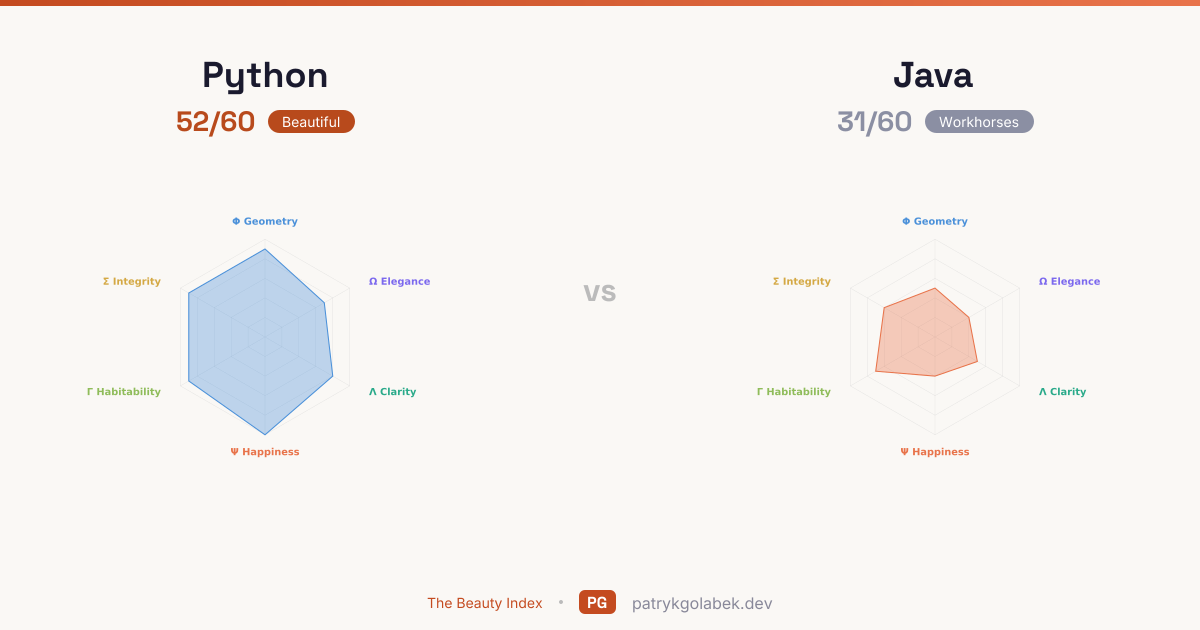
Python
Everyone's first love and nobody's last. Python's beauty is the beauty of clarity, indentation is structure, the most readable way is the correct way, and a newcomer can read someone else's code without a tutorial.
Java
The enterprise middle manager who requires a meeting to schedule a meeting. Java turned verbosity into a virtue and AbstractSingletonProxyFactoryBean into a punchline.
Python scores 52/60 against Java's 31/60, leading in 6 of 6 dimensions. Python dominates the aesthetic, mathematical, human, and design axes. Practitioner Happiness is where the pair separates most cleanly — Python leads Java by 6 points and that gap colours everything else on the page.
See also: Python vs Elixir , Python .
Dimension-by-dimension analysis
Ψ Practitioner Happiness
Python wins Practitioner Happiness by 6 points — a real happiness advantage. Universally liked, beginner-friendly, and the default choice across data science, web, scripting, and education. The community is enormous, warm, and productive. Packaging friction (pip vs. poetry vs. uv) is a real blemish, but the read-write experience remains unmatched in reach. The practitioner experience on Python is simply more fun, day in and day out, than on Java. Widely used, rarely loved. Stack Overflow admiration is moderate. The ecosystem is massive and mature, but developer experience surveys consistently place Java in the "tolerated" category. The JVM is respected; the language syntax is endured. The winner here invites the next generation of contributors without asking them to earn it first.
Φ Aesthetic Geometry
Python wins Aesthetic Geometry by 4 points — a decisive visual advantage. Indentation is syntax. Python enforces geometric structure at the grammar level. A screenful of Python has natural visual rhythm with minimal punctuation noise. The visual gap between the two is not subtle — where Python prizes geometric calm, Java trades that serenity for other commitments. Java code is visually heavy, class wrappers, access modifiers, type declarations, and boilerplate create dense blocks. Modern Java (records, sealed classes) helps, but the language's verbosity is structural, not stylistic. For application code the geometry translates directly into readability for new contributors.
Λ Linguistic Clarity
Python wins Linguistic Clarity by 3 points — a meaningful clarity gap. The closest any general-purpose language gets to executable pseudocode. Variable naming conventions, keyword arguments, and minimal ceremony make intent self-evident to readers at nearly any experience level. The clarity gap is felt on first contact — Python invites, Java introduces friction before trust is earned. Java communicates intent through names and types, but the signal is buried under ceremony. AbstractSingletonProxyFactoryBean communicates structure but not wit. Java code is precise, but reading it is work. For application code the clarity advantage is the whole point of the language category.
Ω Mathematical Elegance
Python wins Mathematical Elegance by 3 points — a decisive elegance advantage. List comprehensions, generators, and first-class functions bring Python closer to mathematical notation than most dynamic languages. sum(x**2 for x in range(10)) reads like a formula. Not Haskell-tier, but a clear step above "workhorse" expressiveness. Python lets algorithms approach mathematical statement, while Java asks more of the programmer when elegance is the goal. Java's OOP-first design resists mathematical abstraction. Expressing algorithms requires ceremony, AbstractFactory, Iterator, Consumer<T>. The patterns are powerful but the opposite of Hardy's "economy." The winner lets the author think in algorithms rather than in ceremony.
Σ Conceptual Integrity
Python wins Conceptual Integrity by 3 points — a decisive philosophical edge. "There should be one, and preferably only one, obvious way to do it." The Zen of Python is a genuine design philosophy, not a marketing tagline. Guido's benevolent-dictator era gave the language a coherent soul that has mostly survived committee evolution. Python speaks with a single design voice; Java speaks with a committee. "Write once, run anywhere" was a clear mission, and the JVM delivered. But decades of committee-driven feature additions (generics via erasure, streams, modules, records) have layered paradigms without fully integrating them. Coherent enough, not focused. In high-level work a coherent philosophy is the frame that holds the language's features together.
Γ Organic Habitability
Python wins Organic Habitability by 2 points — a meaningful extensibility gap. Python codebases age well. Duck typing, simple module structure, and a culture of readability make modification and extension feel natural. The language bends to the domain rather than imposing rigid abstractions. The habitability gap shows in long-lived codebases — Python ages, Java calcifies without careful discipline. Java's greatest strength: codebases survive decades. Backward compatibility is nearly absolute. Enterprise patterns, for all their verbosity, create predictable structures that large teams can maintain. Java is habitable in the way a well-run office building is habitable. For application codebases the habitability edge determines whether a project survives its second rewrite.
Code comparison
The characteristic code snippet that best represents each language.
from itertools import takewhile
def fibonacci():    a, b = 0, 1    while True:        yield a        a, b = b, a + b
squares = { n: n**2 for n in takewhile(lambda x: x < 100, fibonacci()) if n > 0}Map<String, Long> wordFrequency = Files.lines(Path.of("book.txt")) .flatMap(line -> Arrays.stream(line.split("\\s+"))) .map(String::toLowerCase) .filter(w -> w.length() > 3) .collect(Collectors.groupingBy( Function.identity(), Collectors.counting() ));Embedding expressions and variables within string literals.
name = "Python"version = 3.12
msg = f"Hello, {name}! Version: {version}"expr = f"Length: {len(name)}, Upper: {name.upper()}"aligned = f"{name:<10} | {version:>5.1f}"debug = f"{name!r} has {len(name)} chars"String name = "Java";int version = 21;
String msg = "Hello, %s! Version: %d".formatted(name, version);
String multi = """ Welcome to %s. Version: %d """.formatted(name, version);
String concat = "Hello, " + name + "! Version: " + version;Basic variable syntax, type annotations, and initialization patterns.
Frequently asked questions
- Which is easier to learn, Python or Java?
- Python scores 10 on Practitioner Happiness versus Java's 4. Universally liked, beginner-friendly, and the default choice across data science, web, scripting, and education. The community is enormous, warm, and productive. Packaging friction (pip vs. poetry vs. uv) is a real blemish, but the read-write experience remains unmatched in reach. For a developer adding a new language to their toolbelt, the happier one is the one you will still be writing in six months.
- Is Python or Java better for developer happiness?
- For developer happiness, Python has a clear edge — it scores 10/10 on Practitioner Happiness against Java's 4/10. Universally liked, beginner-friendly, and the default choice across data science, web, scripting, and education. The community is enormous, warm, and productive. Packaging friction (pip vs. poetry vs. uv) is a real blemish, but the read-write experience remains unmatched in reach.
- Should I pick Python or Java in 2026?
- Python lands in the beautiful tier at 52/60; Java in the workhorses tier at 31/60. The gap is wide. Unless a specific platform or ecosystem constraint forces the other choice, go with the higher-scoring language. The score difference reflects years of community use, tooling maturity, and the editorial judgment of the Beauty Index rubric.