
Python vs C++
Python
Everyone's first love and nobody's last. Python's beauty is the beauty of clarity, indentation is structure, the most readable way is the correct way, and a newcomer can read someone else's code without a tutorial.
C++
The gothic cathedral — ornate, imposing, awe-inspiring, occasionally terrifying. Fifty years of features layered onto a C foundation. Template metaprogramming is many things, but visually clean isn't one of them.
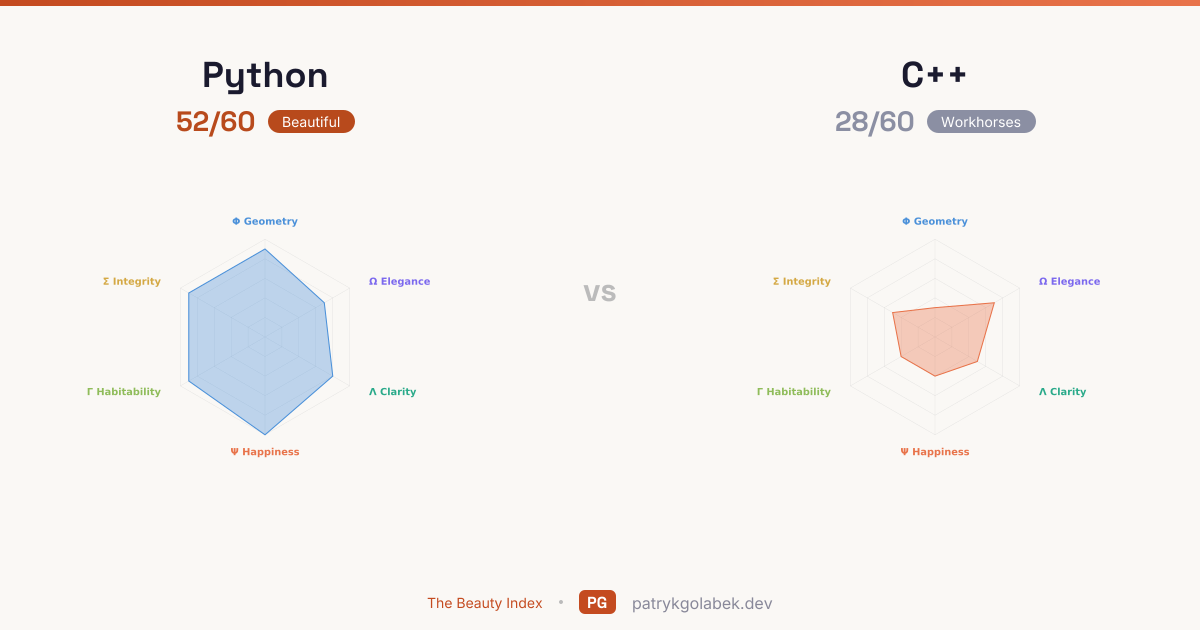
Python scores 52/60 against C++'s 28/60, leading in 5 of 6 dimensions. Python dominates the aesthetic, human, and design axes. Aesthetic Geometry is where the pair separates most cleanly — Python leads C++ by 6 points and that gap colours everything else on the page.
See also: Python vs Elixir , Python .
Dimension-by-dimension analysis
Φ Aesthetic Geometry
Python wins Aesthetic Geometry by 6 points — a clear geometric edge. Indentation is syntax. Python enforces geometric structure at the grammar level. A screenful of Python has natural visual rhythm with minimal punctuation noise. C++, by contrast, accepts visual density in exchange for other priorities. Template metaprogramming, #include chains, and nested angle brackets (std::vector<std::pair<int, std::string>>) create some of the most visually dense code in any language. Modern C++ is cleaner, but the language's visual floor is very low. In a language where expressiveness is the selling point, visual calm amplifies the advantage.
Ψ Practitioner Happiness
Python wins Practitioner Happiness by 6 points — a decisive cultural edge. Universally liked, beginner-friendly, and the default choice across data science, web, scripting, and education. The community is enormous, warm, and productive. Packaging friction (pip vs. poetry vs. uv) is a real blemish, but the read-write experience remains unmatched in reach. Python has done the harder cultural work: tooling that delights, a community that welcomes, documentation that explains. Respected for power, rarely enjoyed for developer experience. Build systems, header management, cryptic template error messages, and undefined behavior create constant friction. Developers use C++ because nothing else does what it does, not because they prefer it. In application languages the community culture compounds the language advantage.
Γ Organic Habitability
Python wins Organic Habitability by 5 points — an unmistakable lead in how well code ages. Python codebases age well. Duck typing, simple module structure, and a culture of readability make modification and extension feel natural. The language bends to the domain rather than imposing rigid abstractions. The habitability gap shows in long-lived codebases — Python ages, C++ calcifies without careful discipline. Adding a feature to a C++ codebase can require understanding templates, RAII, move semantics, and exception safety simultaneously. The language's complexity makes modification risky. Codebases tend to become more brittle over time as layers of C++ eras accumulate. In high-level work, the language that welcomes modification wins the decade, not the quarter.
Σ Conceptual Integrity
Python wins Conceptual Integrity by 4 points — a clear integrity advantage. "There should be one, and preferably only one, obvious way to do it." The Zen of Python is a genuine design philosophy, not a marketing tagline. Guido's benevolent-dictator era gave the language a coherent soul that has mostly survived committee evolution. The design philosophy of Python feels inevitable, each feature a consequence of one idea — C++ feels assembled from several good ideas instead of from one great one. "C with classes" was a clear idea, but 40+ years of committee additions have layered paradigms without full integration. C++11/14 brought more coherence (RAII, value semantics, move), but the language remains a cathedral built by many architects across many centuries. The winner's philosophical discipline is what keeps its idioms stable as the language evolves.
Λ Linguistic Clarity
Python wins Linguistic Clarity by 3 points — a clear signal-to-noise edge. The closest any general-purpose language gets to executable pseudocode. Variable naming conventions, keyword arguments, and minimal ceremony make intent self-evident to readers at nearly any experience level. Python reads like a well-edited paragraph; C++ reads like a sentence that is still being translated. Modern C++ is more readable than legacy C++, but the language's accumulated complexity means any line might require knowing 10 different features. Range-based for loops and structured bindings help, but the cognitive load of "which C++ era is this?" persists. For application code the clarity advantage is the whole point of the language category.
Ω Mathematical Elegance
Both score 7 — this is one dimension where Python and C++ genuinely agree. List comprehensions, generators, and first-class functions bring Python closer to mathematical notation than most dynamic languages. sum(x**2 for x in range(10)) reads like a formula. Not Haskell-tier, but a clear step above "workhorse" expressiveness. Both Python and C++ support the same class of elegant patterns — the decision lives on another axis. C++ is Turing-complete at compile time. Template metaprogramming and concepts (C++20) enable powerful abstractions. The mathematical capability is real, but std::transform(v.begin(), v.end(), v.begin(), [](int x){ return x*x; }) vs. Haskell's map (^2) v tells the story, the machinery is always visible. The winner lets the author think in algorithms rather than in ceremony.
Code comparison
The characteristic code snippet that best represents each language.
from itertools import takewhile
def fibonacci():    a, b = 0, 1    while True:        yield a        a, b = b, a + b
squares = { n: n**2 for n in takewhile(lambda x: x < 100, fibonacci()) if n > 0}class ResourcePool { std::vector<std::unique_ptr<Connection>> pool_;public: auto acquire() { if (pool_.empty()) pool_.push_back(std::make_unique<Connection>()); auto conn = std::move(pool_.back()); pool_.pop_back(); return std::shared_ptr<Connection>( conn.release(), [this](Connection* c) { pool_.emplace_back(c); } ); }};Exception handling via try/catch or Result/Either patterns.
def parse_number(s: str) -> int:    try:        return int(s)    except ValueError as e:        raise ValueError(f"Invalid: {s}") from e
try: result = parse_number(input_str)except ValueError: result = -1finally: cleanup()#include <stdexcept>
int parseNumber(const std::string& s) { try { return std::stoi(s); } catch (const std::invalid_argument& e) { throw std::runtime_error("Invalid: " + s); }}
try { auto result = parseNumber("42");} catch (const std::exception& e) { std::cerr << e.what() << "\n";}Data structure definition using classes, structs, records, or equivalent.
from dataclasses import dataclass
@dataclassclass User:    name: str    email: str    age: int = 0
def greeting(self) -> str: return f"Hello, {self.name}!"struct User { std::string name; std::string email; int age;
User(std::string n, std::string e, int a) : name(std::move(n)), email(std::move(e)), age(a) {}
std::string greeting() const { return std::format("Hello, {}!", name); }};Frequently asked questions
- Which is easier to learn, Python or C++?
- Python scores 10 on Practitioner Happiness versus C++'s 4. Universally liked, beginner-friendly, and the default choice across data science, web, scripting, and education. The community is enormous, warm, and productive. Packaging friction (pip vs. poetry vs. uv) is a real blemish, but the read-write experience remains unmatched in reach. For a newcomer picking up their first serious language in 2026, the happiness-score winner is the more forgiving starting point.
- Is Python or C++ better for visually clean syntax?
- For visually clean syntax, Python has a clear edge — it scores 9/10 on Aesthetic Geometry against C++'s 3/10. Indentation is syntax. Python enforces geometric structure at the grammar level. A screenful of Python has natural visual rhythm with minimal punctuation noise.
- Should I pick Python or C++ in 2026?
- Python lands in the beautiful tier at 52/60; C++ in the workhorses tier at 28/60. The gap is wide. Unless a specific platform or ecosystem constraint forces the other choice, go with the higher-scoring language. The score difference reflects years of community use, tooling maturity, and the editorial judgment of the Beauty Index rubric.