
PHP vs Zig
PHP
The duct tape that holds 40% of the web together while everyone pretends it doesn't exist. PHP is the cockroach of programming: ugly, everywhere, and absolutely unkillable.
Zig
The systems programmer who looked at C and said 'I can fix this without adding complexity.' Zig is the rare language that removes footguns by making the right thing the easy thing.
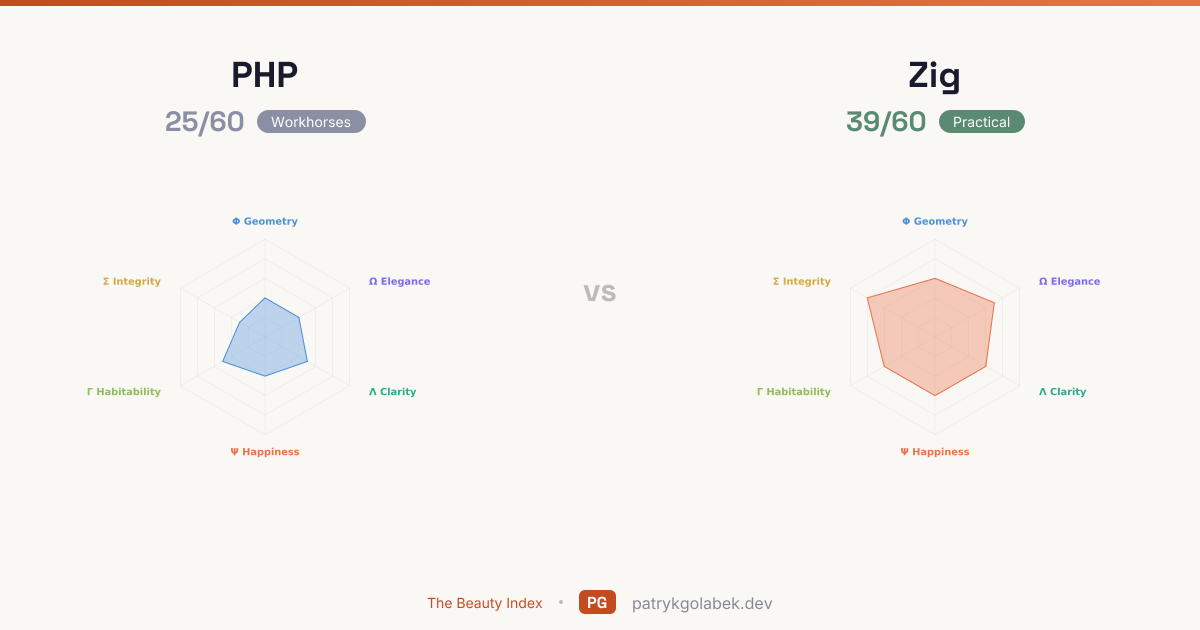
Zig scores 39/60 against PHP's 25/60, leading in 6 of 6 dimensions. Zig dominates the aesthetic, mathematical, human, and design axes. The widest gap sits on Conceptual Integrity, where Zig's 5-point lead over PHP shapes most of the pair's character.
See also: TypeScript vs Zig , PHP .
Dimension-by-dimension analysis
Σ Conceptual Integrity
Zig wins Conceptual Integrity by 5 points — a decisive philosophical edge. "No hidden control flow, no hidden memory allocators." Andrew Kelley's vision is sharp and consistent. Every design choice follows from the principle that implicit behavior is the enemy. A focused, opinionated systems language. Zig speaks with a single design voice; PHP speaks with a committee. PHP was not designed; it was accumulated. Rasmus Lerdorf's personal homepage tools grew into a language without a coherent philosophy. Each version has improved quality, but there is no "soul", no single idea that all features follow from. The quintessential committee language. Philosophical unity in a systems language is a rare and load-bearing virtue.
Ω Mathematical Elegance
Zig wins Mathematical Elegance by 3 points — a decisive elegance advantage. comptime is genuinely clever, compile-time code generation without metaprogramming complexity. The approach to generics and allocators is elegant in a systems-programming context, though not mathematically abstract. Where Zig compresses an idea into a line or two, PHP tends to spread the same idea across a paragraph. PHP is a templating language that grew into a general-purpose one. Array functions exist but lack the composability of functional languages. Mathematical elegance is not the design space PHP occupies. When performance and precision matter, the language that expresses the algorithm most directly wins twice.
Φ Aesthetic Geometry
Zig wins Aesthetic Geometry by 2 points — a decisive visual advantage. Clean and minimal but not visually distinctive. Zig code is functional and well-structured, but the syntax doesn't create the kind of visual rhythm that scores above 7. Workmanlike layout. The visual gap between the two is not subtle — where Zig prizes geometric calm, PHP trades that serenity for other commitments. $ on every variable, -> for method calls, inconsistent brace styles across frameworks, and <?php tags create visual clutter. Modern PHP (8.x) with named arguments and match expressions is cleaner, but the legacy visual debt remains. Where every byte matters, visual clarity still matters — and Zig keeps that ledger honest.
Ψ Practitioner Happiness
Zig wins Practitioner Happiness by 2 points — a real happiness advantage. Growing admiration in the systems programming community. The compiler's error messages are good, and the community is enthusiastic. Still young enough that tooling and ecosystem maturity lag behind established languages. Where Zig feels designed for the human, PHP feels designed for the machine first — the human catches up second. PHP developers themselves joke about PHP. The community is large and productive, but "most admired" it is not. Modern PHP (8.x with Laravel) has improved the experience significantly, but the reputation, and the daily reality of legacy code, weighs on happiness. Even in low-level work the human experience matters — the winner proves systems code need not be joyless.
Γ Organic Habitability
Zig edges PHP by a single point on Organic Habitability; the practical difference is slim but real. Zig's explicitness makes code predictable to modify but also verbose to evolve. The language removes footguns but doesn't actively create growth-point idioms. Habitable by being unsurprising rather than by being inviting. The habitability edge is slim and often dominated by team culture rather than language choice. PHP codebases survive, 77% of the web runs on PHP, and that code keeps working. The language is pragmatically habitable. But the inconsistent standard library and multiple paradigm shifts (procedural → OOP → modern PHP) make long-term evolution uneven. In systems work habitability is rare — the winner has managed to make change cheap without sacrificing correctness.
Λ Linguistic Clarity
Zig edges PHP by a single point on Linguistic Clarity; the practical difference is slim but real. Explicit by design, no hidden control flow, no hidden allocators. This makes code predictable but verbose. You always know what's happening, but you're reading more to know it. Both PHP and Zig communicate their intent without heroic effort; Zig is only a little more forgiving. PHP can be readable in modern frameworks (Laravel's fluent syntax reads well). But str_replace vs. strpos vs. substr, inconsistent parameter ordering, and the legacy API are the antithesis of linguistic clarity. Two PHPs coexist: modern and legacy. The winner proves that proximity to the machine need not mean distance from the reader.
Code comparison
The characteristic code snippet that best represents each language.
$results = array_map( fn($user) => [ 'name' => $user['name'], 'email' => strtolower($user['email']), 'score' => array_sum($user['grades']) / count($user['grades']), ], array_filter( $users, fn($u) => $u['active'] && count($u['grades']) > 0 ));fn fibonacci(comptime n: u32) u128 { var a: u128 = 0; var b: u128 = 1; for (0..n) |_| { const tmp = a; a = b; b = tmp + b; } return a;}
// Computed at compile time, zero runtime costconst fib_50 = fibonacci(50);Embedding expressions and variables within string literals.
$name = 'PHP';$version = 8.3;
$msg = "Hello, $name! Version: $version";$expr = "Length: " . strlen($name) . ", Upper: " . strtoupper($name);$heredoc = <<<EOTWelcome to $name.Version: $versionEOT;
$formatted = sprintf("%-10s | %5.1f", $name, $version);const name = "Zig";const version: f32 = 0.12;
std.debug.print("Hello, {s}! Version: {d:.2}\n", .{ name, version });
var buf: [256]u8 = undefined;const msg = std.fmt.bufPrint(&buf, "Welcome to {s}", .{name}) catch unreachable;Map, filter, reduce and functional collection transformations.
$numbers = range(1, 10);
$doubled = array_map(fn($n) => $n * 2, $numbers);$evens = array_filter($numbers, fn($n) => $n % 2 === 0);$total = array_sum($numbers);
$result = array_map( fn($n) => $n ** 2, array_filter($numbers, fn($n) => $n % 2 === 0));const numbers = [_]i32{ 1, 2, 3, 4, 5, 6, 7, 8, 9, 10 };
var sum: i32 = 0;for (numbers) |n| { sum += n;}
var evens: [5]i32 = undefined;var idx: usize = 0;for (numbers) |n| { if (@rem(n, 2) == 0) { evens[idx] = n; idx += 1; }}Frequently asked questions
- Which is easier to learn, PHP or Zig?
- Zig scores 6 on Practitioner Happiness versus PHP's 4. Growing admiration in the systems programming community. The compiler's error messages are good, and the community is enthusiastic. Still young enough that tooling and ecosystem maturity lag behind established languages. For a developer adding a new language to their toolbelt, the happier one is the one you will still be writing in six months.
- Is PHP or Zig better for principled design?
- For principled design, Zig has a clear edge — it scores 8/10 on Conceptual Integrity against PHP's 3/10. "No hidden control flow, no hidden memory allocators." Andrew Kelley's vision is sharp and consistent. Every design choice follows from the principle that implicit behavior is the enemy. A focused, opinionated systems language.
- Should I pick PHP or Zig in 2026?
- PHP lands in the workhorses tier at 25/60; Zig in the practical tier at 39/60. The gap is wide. Unless a specific platform or ecosystem constraint forces the other choice, go with the higher-scoring language. The score difference reflects years of community use, tooling maturity, and the editorial judgment of the Beauty Index rubric.