
C vs Elixir
C
The grizzled veteran who built the foundations everyone else stands on. C gives you a knife, a piece of rope, and unlimited trust — the scars are your problem.
Elixir
The jazz musician who studied classical. Elixir takes Erlang's battle-tested concurrency and wraps it in syntax so pleasant you forget you're building distributed systems that never go down.
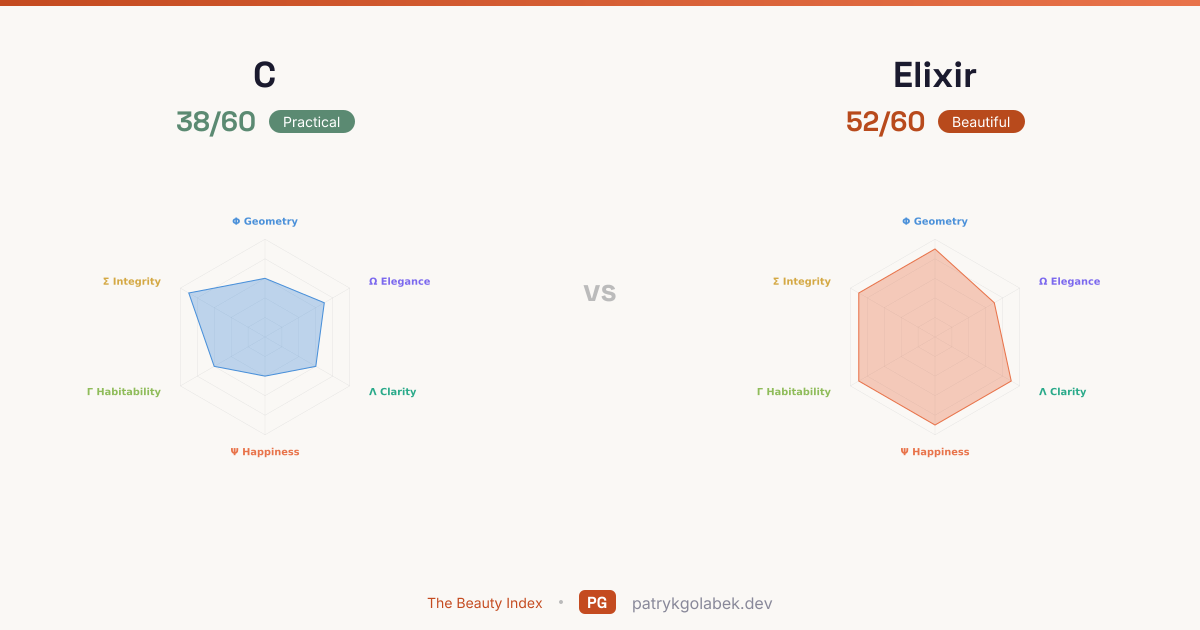
Elixir scores 52/60 against C's 38/60, leading in 4 of 6 dimensions. C and Elixir share the four axis clusters evenly, trading leads without either side claiming the frame. Read the comparison through Practitioner Happiness first: Elixir wins that axis by 5 points over C, and it is the single best lens on the pair.
Dimension-by-dimension analysis
Ψ Practitioner Happiness
Elixir wins Practitioner Happiness by 5 points — a real happiness advantage. Stack Overflow admiration at 66%. The Phoenix framework, LiveView, and OTP give practitioners a feeling of building something that "just works." The community is small but deeply enthusiastic and welcoming. Where Elixir feels designed for the human, C feels designed for the machine first — the human catches up second. Respected but not loved. Debugging segfaults, managing memory manually, and undefined behavior create constant friction. The tooling ecosystem is mature but the developer experience is unforgiving. The winner here invites the next generation of contributors without asking them to earn it first.
Γ Organic Habitability
Elixir wins Organic Habitability by 3 points — a meaningful extensibility gap. Pipelines are growth-point idioms, insert a transformation step anywhere without restructuring. OTP's supervision trees are the embodiment of habitable architecture: systems designed to fail gracefully and be extended incrementally. Elixir invites modification; C rewards planning more than adjustment. C's simplicity means codebases can age well, and many have (Linux kernel, SQLite). But the lack of safety guardrails makes modification risky, one wrong pointer and you're debugging memory corruption. Habitable for experts, hostile to newcomers. For application codebases the habitability edge determines whether a project survives its second rewrite.
Λ Linguistic Clarity
Elixir wins Linguistic Clarity by 3 points — a meaningful clarity gap. The pipe operator (|>) turns data transformation into a readable narrative. "hello" |> String.split() |> Enum.map(&String.capitalize/1) reads as a clear sequence of intentions. Among the most literate functional languages. The clarity gap is felt on first contact — Elixir invites, C introduces friction before trust is earned. C communicates what the machine is doing, not what the programmer intends. Skilled C programmers write beautifully clear code, but the language itself doesn't guide you toward Knuthian "wit." You earn clarity; it's not given. For application code the clarity advantage is the whole point of the language category.
Φ Aesthetic Geometry
Elixir wins Aesthetic Geometry by 3 points — a decisive visual advantage. Pipeline operators, pattern-matching clauses, and module structure create a visual flow that scans beautifully. Elixir code looks like a series of clean, evenly weighted transformation steps. The visual gap between the two is not subtle — where Elixir prizes geometric calm, C trades that serenity for other commitments. C code can be visually clean, function signatures, struct definitions, and #define blocks have a spare, architectural quality. But pointer notation, preprocessor macros, and manual memory management create visual noise. Designers of high-level code feel this difference the moment they open an unfamiliar module.
Ω Mathematical Elegance
Both score 7 — this is one dimension where C and Elixir genuinely agree. Algorithms in C are explicit and transparent, you can see every machine operation. This clarity has its own elegance, but the manual machinery (malloc, sizeof, void* casts) obscures the mathematical intent. Power, not economy. Both C and Elixir support the same class of elegant patterns — the decision lives on another axis. Pattern matching, recursion, and immutable data structures support elegant algorithm expression. Not as abstract as Haskell or OCaml, but the BEAM VM's concurrency primitives give certain distributed algorithms an inevitable quality. When performance and precision matter, the language that expresses the algorithm most directly wins twice.
Σ Conceptual Integrity
Both score 9 — this is one dimension where C and Elixir genuinely agree. "Trust the programmer." Dennis Ritchie's design philosophy is one of the clearest and most consistent in computing history. Every C feature follows from the idea that the programmer should have direct, unsupervised access to the machine. Neither language apologises for its philosophy — and the philosophies, though different, are equally complete. "Erlang's power with modern syntax." José Valim had a clear vision: bring functional programming and fault-tolerant concurrency to a wider audience. The language feels designed by one mind with a singular purpose. Philosophical unity in a systems language is a rare and load-bearing virtue.
Code comparison
Exception handling via try/catch or Result/Either patterns.
#include <errno.h>
int parse_number(const char *s, int *out) {    char *end;    errno = 0;    long val = strtol(s, &end, 10);    if (errno != 0 || *end != '\0') return -1;    *out = (int)val;    return 0;}
int result;if (parse_number("42", &result) != 0) fprintf(stderr, "Invalid input\n");with {:ok, user} <- fetch_user(id), {:ok, posts} <- fetch_posts(user.id), {:ok, _} <- validate(posts) do {:ok, format_response(user, posts)}else {:error, :not_found} -> {:error, "User not found"} {:error, reason} -> {:error, reason}endThe characteristic code snippet that best represents each language.
void reverse(char *str) {    char *end = str;    while (*end) end++;    end--;
while (str < end) { char tmp = *str; *str++ = *end; *end-- = tmp; }}def process_order(%Order{items: items, user: user}) do items |> Enum.filter(&(&1.in_stock)) |> Enum.map(&apply_discount(&1, user.tier)) |> Enum.reduce(0, &(&1.price + &2)) |> apply_tax(user.region) |> format_total()endFor/while iteration patterns and loop constructs.
Frequently asked questions
- Which is easier to learn, C or Elixir?
- Elixir scores 9 on Practitioner Happiness versus C's 4. Stack Overflow admiration at 66%. The Phoenix framework, LiveView, and OTP give practitioners a feeling of building something that "just works." The community is small but deeply enthusiastic and welcoming. For a developer adding a new language to their toolbelt, the happier one is the one you will still be writing in six months.
- Is C or Elixir better for developer happiness?
- For developer happiness, Elixir has a clear edge — it scores 9/10 on Practitioner Happiness against C's 4/10. Stack Overflow admiration at 66%. The Phoenix framework, LiveView, and OTP give practitioners a feeling of building something that "just works." The community is small but deeply enthusiastic and welcoming.
- Should I pick C or Elixir in 2026?
- C lands in the practical tier at 38/60; Elixir in the beautiful tier at 52/60. On this score difference the answer is clear: the higher-ranked language wins unless you have an explicit reason to pay the cost of the other.