
PHP vs Scala
PHP
The duct tape that holds 40% of the web together while everyone pretends it doesn't exist. PHP is the cockroach of programming: ugly, everywhere, and absolutely unkillable.
Scala
The PhD student who insists on explaining category theory at dinner parties. Scala has the intellectual firepower of ten languages, which is precisely the problem.
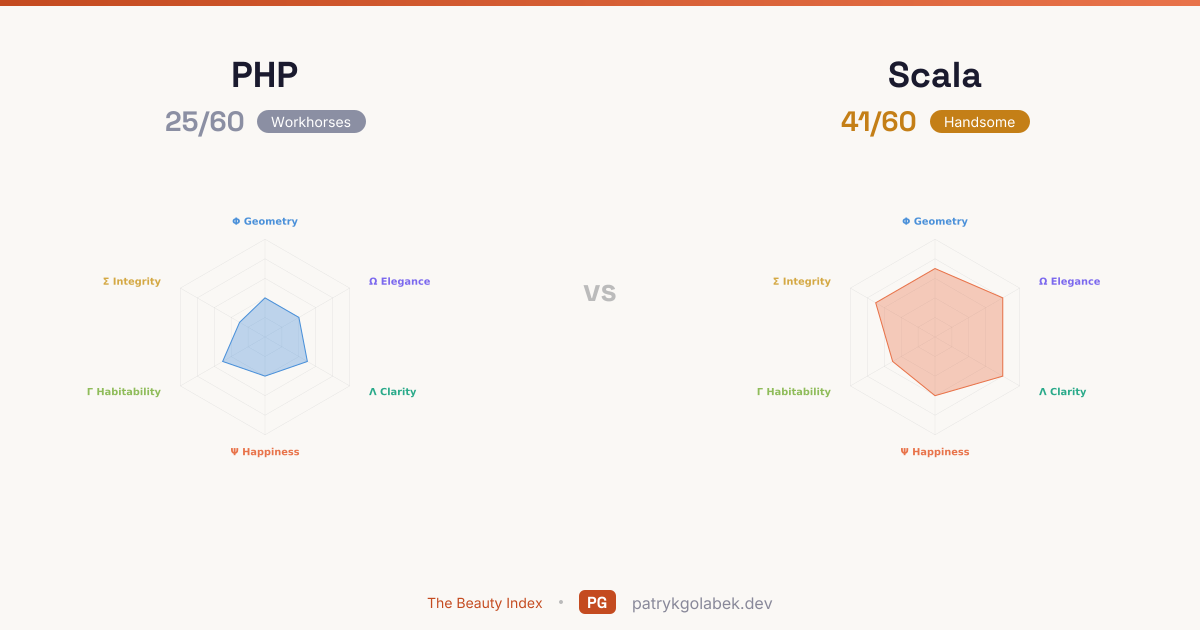
Scala scores 41/60 against PHP's 25/60, leading in 5 of 6 dimensions. Scala dominates the aesthetic, mathematical, human, and design axes. Mathematical Elegance is where the pair separates most cleanly — Scala leads PHP by 4 points and that gap colours everything else on the page.
See also: Go vs Scala , PHP .
Dimension-by-dimension analysis
Ω Mathematical Elegance
Scala wins Mathematical Elegance by 4 points — a decisive elegance advantage. Higher-kinded types, implicits (now given/using), and for-comprehensions give Scala deep mathematical expressiveness. Capable of Haskell-tier abstraction when used by expert practitioners. The gap on Elegance is real: Scala rewards precise thought, PHP rewards precise bookkeeping. PHP is a templating language that grew into a general-purpose one. Array functions exist but lack the composability of functional languages. Mathematical elegance is not the design space PHP occupies. In application code the elegance edge shows up as less boilerplate per idea.
Σ Conceptual Integrity
Scala wins Conceptual Integrity by 4 points — a decisive philosophical edge. Scala tries to unify OOP and FP at maximum power, resulting in a language with two souls rather than one. The Scala 2→3 evolution signals that even the designer's vision has shifted. Multi-paradigm breadth weakens the single coherent "language soul" that Sigma measures. Where Scala holds a line, PHP has negotiated with history, ecosystems, and legacy users. PHP was not designed; it was accumulated. Rasmus Lerdorf's personal homepage tools grew into a language without a coherent philosophy. Each version has improved quality, but there is no "soul", no single idea that all features follow from. The quintessential committee language. For application code the integrity edge means fewer "wait, why does it behave that way?" moments per week.
Λ Linguistic Clarity
Scala wins Linguistic Clarity by 3 points — a meaningful clarity gap. At its best, Scala reads clearly, users.filter(_.isActive).map(_.name). At its worst, implicit resolution chains create invisible logic. The gap between readable and opaque Scala is wider than most languages. The clarity gap is felt on first contact — Scala invites, PHP introduces friction before trust is earned. PHP can be readable in modern frameworks (Laravel's fluent syntax reads well). But str_replace vs. strpos vs. substr, inconsistent parameter ordering, and the legacy API are the antithesis of linguistic clarity. Two PHPs coexist: modern and legacy. For application code the clarity advantage is the whole point of the language category.
Φ Aesthetic Geometry
Scala wins Aesthetic Geometry by 3 points — a decisive visual advantage. Case classes, pattern matching, and for-comprehensions produce visually clean code. The layout can be elegant. Docked because Scala's flexibility means visual style varies wildly between codebases and teams. The visual gap between the two is not subtle — where Scala prizes geometric calm, PHP trades that serenity for other commitments. $ on every variable, -> for method calls, inconsistent brace styles across frameworks, and <?php tags create visual clutter. Modern PHP (8.x) with named arguments and match expressions is cleaner, but the legacy visual debt remains. For application code the geometry translates directly into readability for new contributors.
Ψ Practitioner Happiness
Scala wins Practitioner Happiness by 2 points — a real happiness advantage. Respected but not beloved by the wider developer community. Build times, the Scala 2→3 migration pain, and the steep learning curve for advanced features create real friction. The community is engaged but fragmented. Scala has done the harder cultural work: tooling that delights, a community that welcomes, documentation that explains. PHP developers themselves joke about PHP. The community is large and productive, but "most admired" it is not. Modern PHP (8.x with Laravel) has improved the experience significantly, but the reputation, and the daily reality of legacy code, weighs on happiness. The winner here invites the next generation of contributors without asking them to earn it first.
Γ Organic Habitability
Both score 5 — this is one dimension where PHP and Scala genuinely agree. PHP codebases survive, 77% of the web runs on PHP, and that code keeps working. The language is pragmatically habitable. But the inconsistent standard library and multiple paradigm shifts (procedural → OOP → modern PHP) make long-term evolution uneven. On habitability the outcome is even; what tips the scale is elsewhere. The "better Java" vs. "Haskell on JVM" community split means codebases lack stylistic consensus. The Scala 2→3 migration has caused real ecosystem pain. Complex implicit resolution chains make codebases brittle to modify. Long-term habitability is uneven. In systems work habitability is rare — the winner has managed to make change cheap without sacrificing correctness.
Code comparison
Basic variable syntax, type annotations, and initialization patterns.
Data structure definition using classes, structs, records, or equivalent.
readonly class User {    public function __construct(        public string $name,        public string $email,        public int $age = 0,    ) {}
public function greeting(): string { return "Hello, {$this->name}!"; }}case class User( name: String, email: String, age: Int = 0): def greeting: String = s"Hello, $name!"
val user = User("Alice", "alice@ex.com", 30)val updated = user.copy(age = 31)The characteristic code snippet that best represents each language.
$results = array_map( fn($user) => [ 'name' => $user['name'], 'email' => strtolower($user['email']), 'score' => array_sum($user['grades']) / count($user['grades']), ], array_filter( $users, fn($u) => $u['active'] && count($u['grades']) > 0 ));case class User(name: String, age: Int)
def findEligible( users: List[User], minAge: Int): List[String] = for { user <- users if user.age >= minAge initial = user.name.head.toUpper } yield s"$initial. ${user.name} (age ${user.age})"Frequently asked questions
- Which is easier to learn, PHP or Scala?
- Scala scores 6 on Practitioner Happiness versus PHP's 4. Respected but not beloved by the wider developer community. Build times, the Scala 2→3 migration pain, and the steep learning curve for advanced features create real friction. The community is engaged but fragmented. For a developer adding a new language to their toolbelt, the happier one is the one you will still be writing in six months.
- Is PHP or Scala better for algorithm-heavy code?
- For algorithm-heavy code, Scala has a clear edge — it scores 8/10 on Mathematical Elegance against PHP's 4/10. Higher-kinded types, implicits (now given/using), and for-comprehensions give Scala deep mathematical expressiveness. Capable of Haskell-tier abstraction when used by expert practitioners. The score difference reflects years of community use, tooling maturity, and the editorial judgment of the Beauty Index rubric.
- Should I pick PHP or Scala in 2026?
- PHP lands in the workhorses tier at 25/60; Scala in the handsome tier at 41/60. The gap is wide. Unless a specific platform or ecosystem constraint forces the other choice, go with the higher-scoring language. The score difference reflects years of community use, tooling maturity, and the editorial judgment of the Beauty Index rubric.