
Lisp vs PHP
Lisp
The ancient architect whose blueprints everyone copies but nobody credits. Lisp invented garbage collection, conditionals, recursion, and the very concept of code-as-data in 1958, then watched sixty years of languages reinvent its ideas with different syntax.
PHP
The duct tape that holds 40% of the web together while everyone pretends it doesn't exist. PHP is the cockroach of programming: ugly, everywhere, and absolutely unkillable.
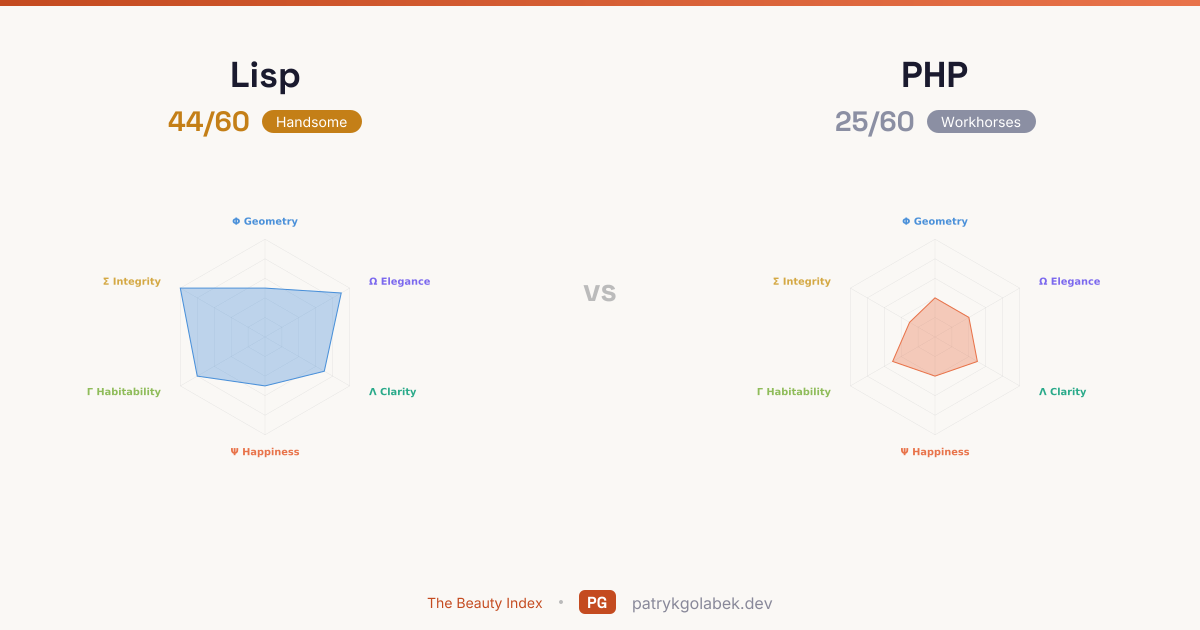
Lisp scores 44/60 against PHP's 25/60, leading in 6 of 6 dimensions. Lisp dominates the aesthetic, mathematical, human, and design axes. Read the comparison through Conceptual Integrity first: Lisp wins that axis by 7 points over PHP, and it is the single best lens on the pair.
See also: Lisp vs OCaml , Lisp .
Dimension-by-dimension analysis
Σ Conceptual Integrity
Lisp wins Conceptual Integrity by 7 points — a decisive philosophical edge. "Code is data, data is code." John McCarthy's 1958 paper demonstrated that seven primitive operators could define an entire programming language. This is the most singular design principle in computing history. Every Lisp since, including Clojure, inherits this axiom. Common Lisp was ANSI standardized in 1994, crystallizing sixty years of accumulated language design wisdom into a coherent, if sprawling, specification. The soul is pure even if the body grew large. Where Lisp holds a line, PHP has negotiated with history, ecosystems, and legacy users. PHP was not designed; it was accumulated. Rasmus Lerdorf's personal homepage tools grew into a language without a coherent philosophy. Each version has improved quality, but there is no "soul", no single idea that all features follow from. The quintessential committee language. The winner's philosophical discipline is what keeps its idioms stable as the language evolves.
Ω Mathematical Elegance
Lisp wins Mathematical Elegance by 5 points — a decisive elegance advantage. defmacro gives programmers full access to the compiler's code representation, enabling language extensions that other languages can only dream of. Common Lisp macros are unhygienic and more powerful than Clojure's: reader macros can redefine syntax itself, and macrolet enables local macro bindings. Homoiconicity is not just a feature here, it is the founding idea of computing's most influential language. Ties Clojure at 9, as both inherit the same code-as-data foundation. The gap on Elegance is real: Lisp rewards precise thought, PHP rewards precise bookkeeping. PHP is a templating language that grew into a general-purpose one. Array functions exist but lack the composability of functional languages. Mathematical elegance is not the design space PHP occupies. In application code the elegance edge shows up as less boilerplate per idea.
Γ Organic Habitability
Lisp wins Organic Habitability by 3 points — a meaningful extensibility gap. CLOS generic functions allow extending behavior without modifying existing code, a form of the open-closed principle baked into the language decades before the term existed. The condition/restart system enables graceful error recovery without unwinding the stack, something no other language in this index offers. Image-based development, saving and restoring an entire running Lisp system, makes the environment uniquely habitable for exploratory programming. Lisp invites modification; PHP rewards planning more than adjustment. PHP codebases survive, 77% of the web runs on PHP, and that code keeps working. The language is pragmatically habitable. But the inconsistent standard library and multiple paradigm shifts (procedural → OOP → modern PHP) make long-term evolution uneven. The winner here is the language you will still enjoy reading in five years.
Λ Linguistic Clarity
Lisp wins Linguistic Clarity by 2 points — a meaningful clarity gap. Prefix notation is unambiguous but unnatural for mathematical expressions. CLOS generic functions, the format directive language (a Turing-complete sublanguage for string formatting), and the condition/restart system add conceptual layers that Clojure avoids. Scored below Clojure (8) because Clojure's threading macros (->>) actively improve readability, while Common Lisp relies on deeply nested forms. Lisp reads like a well-edited paragraph; PHP reads like a sentence that is still being translated. PHP can be readable in modern frameworks (Laravel's fluent syntax reads well). But str_replace vs. strpos vs. substr, inconsistent parameter ordering, and the legacy API are the antithesis of linguistic clarity. Two PHPs coexist: modern and legacy. For application code the clarity advantage is the whole point of the language category.
Φ Aesthetic Geometry
Lisp edges PHP by a single point on Aesthetic Geometry; the practical difference is slim but real. Parentheses-only syntax creates a uniform tree structure that is mathematically regular but visually monotonous. Unlike Clojure, which introduces [] for vectors and {} for maps to break the visual rhythm, Common Lisp uses parentheses for everything. The result is walls of nested parens that demand careful indentation to parse. There is a geometric coherence to it, but it scores below Clojure's bracket variety. Lisp edges ahead on visual rhythm, but PHP is comfortably readable in its own right. $ on every variable, -> for method calls, inconsistent brace styles across frameworks, and <?php tags create visual clutter. Modern PHP (8.x) with named arguments and match expressions is cleaner, but the legacy visual debt remains. In a language where expressiveness is the selling point, visual calm amplifies the advantage.
Ψ Practitioner Happiness
Lisp edges PHP by a single point on Practitioner Happiness; the practical difference is slim but real. The community is small and fragmented across implementations: SBCL, CCL, ECL, ABCL, and others each have their own strengths and quirks. There is no unified package manager comparable to Clojure's Leiningen or the JVM ecosystem. Quicklisp exists but is maintained by a single person. The language's age means much tribal knowledge lives in books from the 1980s and 1990s rather than Stack Overflow. Scored well below Clojure (7) which benefits from JVM interop and a cohesive modern community. Both Lisp and PHP are broadly loved; Lisp is loved a little harder, a little more loudly. PHP developers themselves joke about PHP. The community is large and productive, but "most admired" it is not. Modern PHP (8.x with Laravel) has improved the experience significantly, but the reputation, and the daily reality of legacy code, weighs on happiness. In application languages the community culture compounds the language advantage.
Code comparison
The characteristic code snippet that best represents each language.
(defmacro when-let ((var expr) &body body)  `(let ((,var ,expr))     (when ,var       ,@body)))
(when-let (user (find-user "ada")) (format t "Hello, ~a!" (user-name user)) (log-visit user))$results = array_map( fn($user) => [ 'name' => $user['name'], 'email' => strtolower($user['email']), 'score' => array_sum($user['grades']) / count($user['grades']), ], array_filter( $users, fn($u) => $u['active'] && count($u['grades']) > 0 ));For/while iteration patterns and loop constructs.
Embedding expressions and variables within string literals.
(defvar *name* "Lisp")(defvar *version* 1994)
(format nil "Hello, ~a!" *name*)(format nil "v~d, caps: ~:@(~a~)"        *version* *name*)
(format nil "Items: ~{~a~^, ~}" '("a" "b" "c"))$name = 'PHP';$version = 8.3;
$msg = "Hello, $name! Version: $version";$expr = "Length: " . strlen($name) . ", Upper: " . strtoupper($name);$heredoc = <<<EOTWelcome to $name.Version: $versionEOT;
$formatted = sprintf("%-10s | %5.1f", $name, $version);Frequently asked questions
- Which is easier to learn, Lisp or PHP?
- Lisp scores 5 on Practitioner Happiness versus PHP's 4. The community is small and fragmented across implementations: SBCL, CCL, ECL, ABCL, and others each have their own strengths and quirks. There is no unified package manager comparable to Clojure's Leiningen or the JVM ecosystem. Quicklisp exists but is maintained by a single person. The language's age means much tribal knowledge lives in books from the 1980s and 1990s rather than Stack Overflow. Scored well below Clojure (7) which benefits from.
- Is Lisp or PHP better for principled design?
- For principled design, Lisp has a clear edge — it scores 10/10 on Conceptual Integrity against PHP's 3/10. "Code is data, data is code." John McCarthy's 1958 paper demonstrated that seven primitive operators could define an entire programming language. This is the most singular design principle in computing history. Every Lisp since, including Clojure, inherits this axiom. Common Lisp was ANSI standardized in 1994, crystallizing sixty years of accumulated language design wisdom into a coherent, if sprawling, specification. The soul.
- Should I pick Lisp or PHP in 2026?
- Lisp lands in the handsome tier at 44/60; PHP in the workhorses tier at 25/60. With this much daylight between them, the higher scorer is the default and the lower scorer needs a business case. The score difference reflects years of community use, tooling maturity, and the editorial judgment of the Beauty Index rubric.