
Kotlin vs Rust
Kotlin
The diplomat who made peace between Java and good taste. Kotlin looked at decades of JVM pain and said 'what if we just... didn't do that?' and everyone agreed.
Rust
The overprotective friend who's always right. Rust won't let you make mistakes, and you'll resent it until you realize every error it caught would have been a 3am production incident.
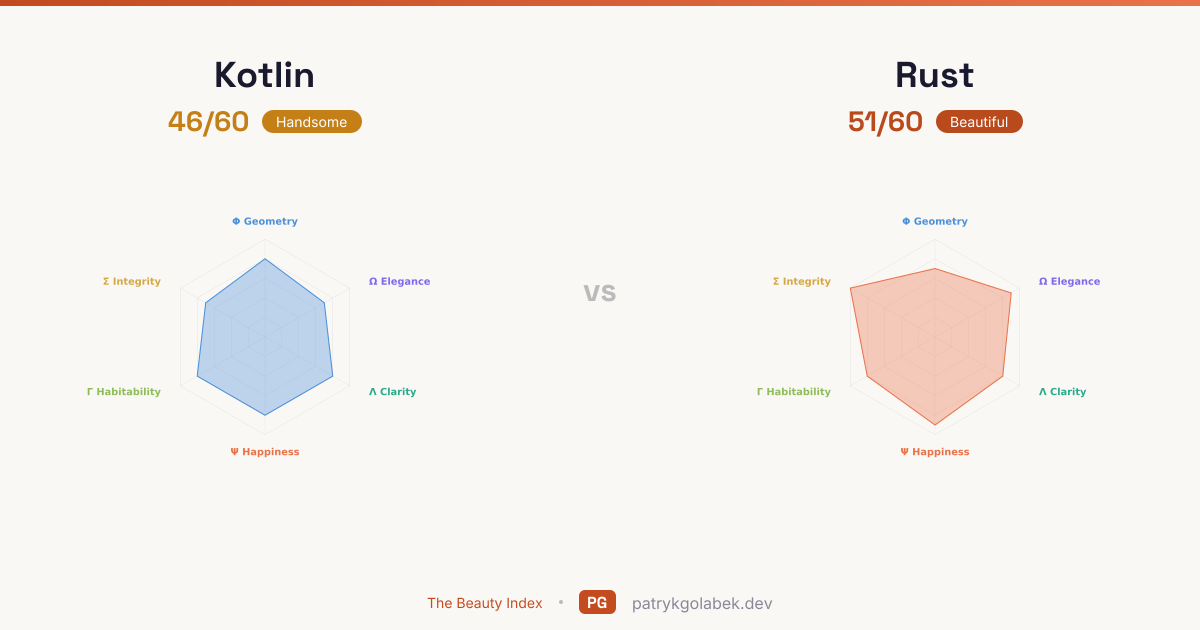
Rust scores 51/60 against Kotlin's 46/60, leading in 3 of 6 dimensions. Rust dominates the mathematical, human, and design axes. The widest gap sits on Conceptual Integrity, where Rust's 3-point lead over Kotlin shapes most of the pair's character.
See also: PHP vs Rust , Kotlin .
Dimension-by-dimension analysis
Σ Conceptual Integrity
Rust wins Conceptual Integrity by 3 points — a clear integrity advantage. "Safety without sacrificing control." Every feature (ownership, borrowing, lifetimes, traits) follows from this single idea. Rust is the most opinionated systems language ever designed, and every opinion is justified by the core philosophy. Rust speaks with a single design voice; Kotlin speaks with a committee. "What if Java, but good?" is a clear mission, but it's defined in opposition to something else rather than from first principles. The pragmatic "fix everything" approach is coherent but doesn't have the singular philosophical punch of Rust or Clojure. The winner's design discipline pays off most under the extreme constraints systems work imposes.
Ω Mathematical Elegance
Rust wins Mathematical Elegance by 2 points — a genuine expressive lead. Algebraic data types, pattern matching, and zero-cost abstractions let you write algorithms that feel close to mathematical proofs. Ownership annotations interrupt the flow slightly — the ceremony is justified but still ceremony. Rust lets algorithms approach mathematical statement, while Kotlin asks more of the programmer when elegance is the goal. Extension functions, sealed classes, and functional collection operations (map, filter, fold) support elegant algorithm expression within a pragmatic framework. Not pushing mathematical frontiers, but consistently economical. Elegance under tight constraints is the hardest kind; the winner here does not take it for granted.
Φ Aesthetic Geometry
Kotlin edges Rust by a single point on Aesthetic Geometry; the practical difference is slim but real. Data classes, named arguments, and concise lambda syntax produce clean, well-proportioned code. The visual improvement over Java is immediately obvious, less ceremony, more signal. Kotlin edges ahead on visual rhythm, but Rust is comfortably readable in its own right. rustfmt enforces strong visual consistency, and match arms, impl blocks, and module structure create clear visual architecture. Docked because lifetime annotations, turbofish (::<>), and trait bounds add visual noise that breaks geometric serenity. In a language where expressiveness is the selling point, visual calm amplifies the advantage.
Ψ Practitioner Happiness
Rust edges Kotlin by a single point on Practitioner Happiness; the practical difference is slim but real. Topped Stack Overflow's "Most Admired" for 7+ consecutive years at 72%. The community is evangelical in its love. Compiler error messages are genuinely helpful. The "fighting the borrow checker" phase gives way to deep satisfaction. Rust noses ahead in surveys, but Kotlin retains a devoted following of its own. Strong admiration in the Android community and growing JVM adoption. JetBrains' tooling (IntelliJ integration) is best-in-class. Developers who switch from Java rarely want to go back. Even in low-level work the human experience matters — the winner proves systems code need not be joyless.
Γ Organic Habitability
Both score 8 — this is one dimension where Kotlin and Rust genuinely agree. Interoperability with Java means Kotlin codebases can grow incrementally. Null-safety, sealed classes, and coroutines provide guardrails that help code age well without over-constraining structure. Both Kotlin and Rust have proven they can carry code across decades — this is not where they differ. Ownership rules force you to think about structure upfront, which often produces code that ages well. Some modifications ("I just wanted to add a reference here") cascade more than expected, but the type system catches the fallout. The winner here is the language you will still enjoy reading in five years.
Λ Linguistic Clarity
Both score 8 — this is one dimension where Kotlin and Rust genuinely agree. Kotlin reads clearly, listOf, when, ?.let { } communicate intent without requiring deep language knowledge. Scope functions (let, run, apply) can slightly obscure control flow when overused, preventing a 9. Both Kotlin and Rust aim for the same high bar on readability, and both reach it. Trait-based design, expressive enums, and the ? operator make intent clear. Rust rewards you with readable code once you know the idioms. Lifetime annotations are information for the compiler rather than the human reader, which docks it from 9. In high-level work, readable code is the difference between a 6-month onboarding and a 6-week one.
Code comparison
The characteristic code snippet that best represents each language.
data class User(val name: String, val email: String?)
fun greet(users: List<User>): List<String> = users .filter { it.email != null } .sortedBy { it.name } .map { user -> "Hello, ${user.name} (${user.email!!})" }enum Shape { Circle(f64), Rectangle(f64, f64), Triangle(f64, f64, f64),}
fn area(shape: &Shape) -> f64 { match shape { Shape::Circle(r) => std::f64::consts::PI * r * r, Shape::Rectangle(w, h) => w * h, Shape::Triangle(a, b, c) => { let s = (a + b + c) / 2.0; (s * (s - a) * (s - b) * (s - c)).sqrt() } }}Native pattern matching constructs for destructuring and control flow.
fun describe(shape: Shape): String = when (shape) {    is Circle -> "circle r=${shape.radius}"    is Rectangle -> "rect ${shape.w}x${shape.h}"    is Triangle -> "triangle"}
val (name, age) = personwhen { age < 18 -> "minor" else -> "adult"}fn describe(value: &Option<Vec<i32>>) -> &str { match value { None => "nothing", Some(v) if v.is_empty() => "empty list", Some(v) if v.len() == 1 => "singleton", Some(v) => "list", }}Data structure definition using classes, structs, records, or equivalent.
data class User(    val name: String,    val email: String,    val age: Int) {    fun greeting(): String = "Hello, $name!"}
val user = User("Alice", "alice@ex.com", 30)val updated = user.copy(age = 31)#[derive(Debug, Clone)]struct User { name: String, email: String, age: u32,}
impl User { fn new(name: &str, email: &str, age: u32) -> Self { Self { name: name.into(), email: email.into(), age } }}Frequently asked questions
- Which is easier to learn, Kotlin or Rust?
- Rust scores 9 on Practitioner Happiness versus Kotlin's 8. Topped Stack Overflow's "Most Admired" for 7+ consecutive years at 72%. The community is evangelical in its love. Compiler error messages are genuinely helpful. The "fighting the borrow checker" phase gives way to deep satisfaction. For a newcomer picking up their first serious language in 2026, the happiness-score winner is the more forgiving starting point.
- Is Kotlin or Rust better for principled design?
- For principled design, Rust has a clear edge — it scores 10/10 on Conceptual Integrity against Kotlin's 7/10. "Safety without sacrificing control." Every feature (ownership, borrowing, lifetimes, traits) follows from this single idea. Rust is the most opinionated systems language ever designed, and every opinion is justified by the core philosophy.
- Should I pick Kotlin or Rust in 2026?
- Kotlin lands in the handsome tier at 46/60; Rust in the beautiful tier at 51/60. With this spread, default to the higher-ranked language and reserve the other for projects where its specific strengths matter. The score difference reflects years of community use, tooling maturity, and the editorial judgment of the Beauty Index rubric.