
Kotlin vs F#
Kotlin
The diplomat who made peace between Java and good taste. Kotlin looked at decades of JVM pain and said 'what if we just... didn't do that?' and everyone agreed.
F#
The brilliant cousin nobody invites to parties. F# does everything right on the .NET platform, writes more elegant code than C# ever could, and wonders why nobody's paying attention.
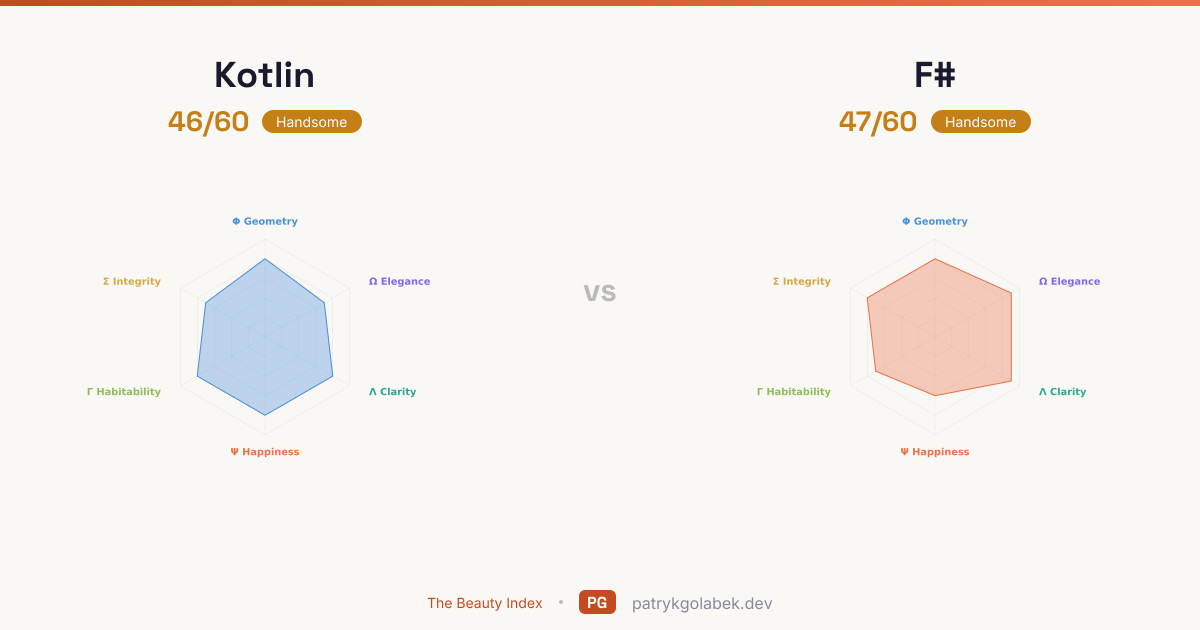
F# scores 47/60 against Kotlin's 46/60, leading in 3 of 6 dimensions. F# dominates the aesthetic, mathematical, and design axes. Read the comparison through Mathematical Elegance first: F# wins that axis by 2 points over Kotlin, and it is the single best lens on the pair.
See also: PHP vs F# , Kotlin .
Dimension-by-dimension analysis
Ω Mathematical Elegance
F# wins Mathematical Elegance by 2 points — a genuine expressive lead. MetaLanguage-family heritage gives F# deep mathematical roots. Computation expressions, active patterns, and type providers enable algorithm expression that approaches Hardy's "economy" criterion. Where F# compresses an idea into a line or two, Kotlin tends to spread the same idea across a paragraph. Extension functions, sealed classes, and functional collection operations (map, filter, fold) support elegant algorithm expression within a pragmatic framework. Not pushing mathematical frontiers, but consistently economical. In application code the elegance edge shows up as less boilerplate per idea.
Ψ Practitioner Happiness
Kotlin wins Practitioner Happiness by 2 points — a decisive cultural edge. Strong admiration in the Android community and growing JVM adoption. JetBrains' tooling (IntelliJ integration) is best-in-class. Developers who switch from Java rarely want to go back. Where Kotlin feels designed for the human, F# feels designed for the machine first — the human catches up second. A small, devoted community, but limited industry adoption creates friction, fewer libraries, fewer tutorials, fewer jobs. The .NET ecosystem helps, but F# often feels like a second-class citizen behind C#. The winner here invites the next generation of contributors without asking them to earn it first.
Γ Organic Habitability
Kotlin edges F# by a single point on Organic Habitability; the practical difference is slim but real. Interoperability with Java means Kotlin codebases can grow incrementally. Null-safety, sealed classes, and coroutines provide guardrails that help code age well without over-constraining structure. Both Kotlin and F# age reasonably well; Kotlin is merely a little kinder to the future reader. Type inference and immutability-by-default produce code that ages reasonably well. The .NET interop story is good. Docked because the ecosystem's size means patterns and libraries are less battle-tested than in larger communities. The winner here is the language you will still enjoy reading in five years.
Λ Linguistic Clarity
F# edges Kotlin by a single point on Linguistic Clarity; the practical difference is slim but real. The pipeline operator, discriminated unions, and lack of ceremony make F# remarkably readable. items |> List.filter isValid |> List.map transform reads as a clear chain of intent. One of the most literate typed languages. Both Kotlin and F# communicate their intent without heroic effort; F# is only a little more forgiving. Kotlin reads clearly, listOf, when, ?.let { } communicate intent without requiring deep language knowledge. Scope functions (let, run, apply) can slightly obscure control flow when overused, preventing a 9. The winner here treats readability as a core feature rather than a style preference.
Σ Conceptual Integrity
F# edges Kotlin by a single point on Conceptual Integrity; the practical difference is slim but real. "Functional-first on .NET" is a clear, focused vision that Don Syme has maintained consistently. F# knows what it is and doesn't try to be everything. The design is opinionated in the right ways. The integrity gap is narrow and more visible in edge cases than in everyday code. "What if Java, but good?" is a clear mission, but it's defined in opposition to something else rather than from first principles. The pragmatic "fix everything" approach is coherent but doesn't have the singular philosophical punch of Rust or Clojure. The winner's philosophical discipline is what keeps its idioms stable as the language evolves.
Φ Aesthetic Geometry
Both score 8 — this is one dimension where Kotlin and F# genuinely agree. Data classes, named arguments, and concise lambda syntax produce clean, well-proportioned code. The visual improvement over Java is immediately obvious, less ceremony, more signal. Visually they stand in similar territory — any difference here is a matter of taste, not of kind. Significant whitespace, pipeline operators, and concise type definitions give F# a clean, proportional visual feel. Pattern matching arms align naturally. Less visual noise than C# by a wide margin. For application code the geometry translates directly into readability for new contributors.
Code comparison
The characteristic code snippet that best represents each language.
data class User(val name: String, val email: String?)
fun greet(users: List<User>): List<String> = users .filter { it.email != null } .sortedBy { it.name } .map { user -> "Hello, ${user.name} (${user.email!!})" }type Shape = | Circle of radius: float | Rect of width: float * height: float
let area = function | Circle r -> System.Math.PI * r * r | Rect (w, h) -> w * h
let totalArea shapes = shapes |> List.map area |> List.sumNative pattern matching constructs for destructuring and control flow.
fun describe(shape: Shape): String = when (shape) {    is Circle -> "circle r=${shape.radius}"    is Rectangle -> "rect ${shape.w}x${shape.h}"    is Triangle -> "triangle"}
val (name, age) = personwhen { age < 18 -> "minor" else -> "adult"}let describe = function | [] -> "empty" | [x] -> sprintf "singleton: %A" x | x :: _ when x > 0 -> "starts positive" | _ -> "other"
let area = function | Circle r -> System.Math.PI * r * r | Rect (w, h) -> w * hException handling via try/catch or Result/Either patterns.
fun parseNumber(s: String): Result<Int> =    runCatching { s.toInt() }
val result = parseNumber("42")    .map { it * 2 }    .getOrElse { -1 }
val value = try { riskyOperation()} catch (e: IOException) { fallbackValue}let safeDivide a b = if b = 0.0 then Error "Division by zero" else Ok (a / b)
let compute = safeDivide 10.0 2.0 |> Result.bind (fun x -> safeDivide x 3.0) |> Result.map (fun y -> y + 1.0)
match compute with| Ok v -> printfn "Got: %f" v| Error e -> printfn "Error: %s" eFrequently asked questions
- Which is easier to learn, Kotlin or F#?
- Kotlin scores 8 on Practitioner Happiness versus F#'s 6. Strong admiration in the Android community and growing JVM adoption. JetBrains' tooling (IntelliJ integration) is best-in-class. Developers who switch from Java rarely want to go back. For a newcomer picking up their first serious language in 2026, the happiness-score winner is the more forgiving starting point.
- Is Kotlin or F# better for algorithm-heavy code?
- For algorithm-heavy code, F# has a clear edge — it scores 9/10 on Mathematical Elegance against Kotlin's 7/10. MetaLanguage-family heritage gives F# deep mathematical roots. Computation expressions, active patterns, and type providers enable algorithm expression that approaches Hardy's "economy" criterion.
- Should I pick Kotlin or F# in 2026?
- Kotlin lands in the handsome tier at 46/60; F# in the handsome tier at 47/60. With so little between them on raw score, choose on ecosystem: the library set, hiring market, and tooling you already own. The score difference reflects years of community use, tooling maturity, and the editorial judgment of the Beauty Index rubric.