
Kotlin vs Dart
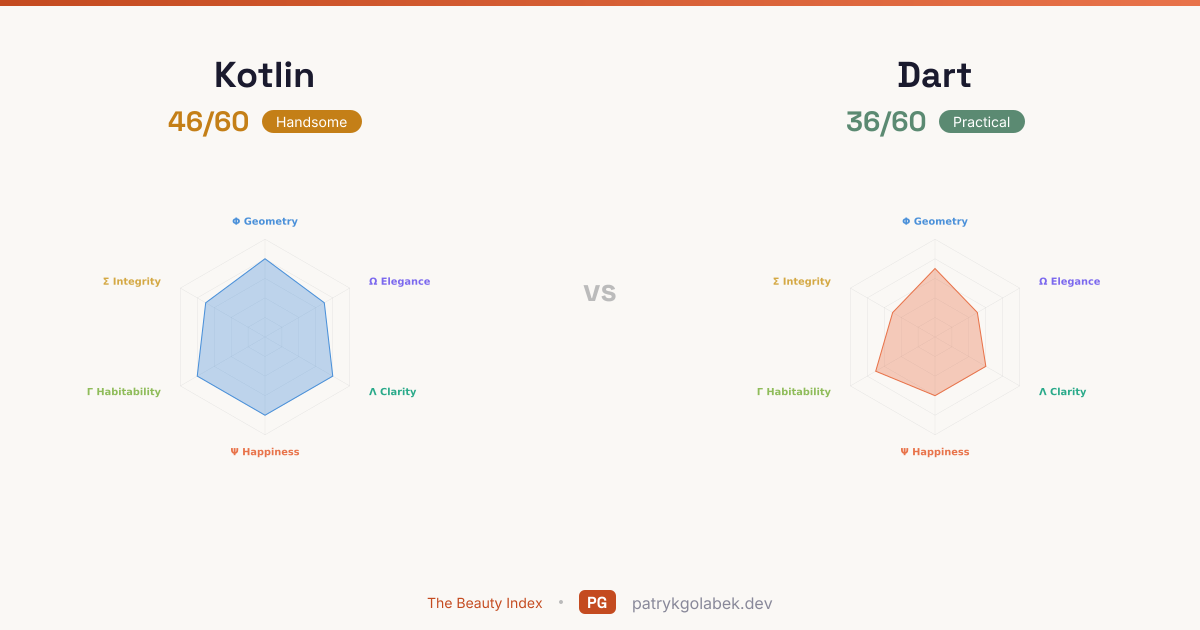
Kotlin
The diplomat who made peace between Java and good taste. Kotlin looked at decades of JVM pain and said 'what if we just... didn't do that?' and everyone agreed.
Dart
The second-chance kid who found their calling in Flutter. Dart was nearly forgotten until mobile development gave it a purpose, and now it's living its best life painting pixels.
Kotlin scores 46/60 against Dart's 36/60, leading in 6 of 6 dimensions. Kotlin dominates the aesthetic, mathematical, human, and design axes. The widest gap sits on Linguistic Clarity, where Kotlin's 2-point lead over Dart shapes most of the pair's character.
See also: Kotlin vs PHP , Kotlin .
Dimension-by-dimension analysis
Λ Linguistic Clarity
Kotlin wins Linguistic Clarity by 2 points — a meaningful clarity gap. Kotlin reads clearly, listOf, when, ?.let { } communicate intent without requiring deep language knowledge. Scope functions (let, run, apply) can slightly obscure control flow when overused, preventing a 9. The clarity gap is felt on first contact — Kotlin invites, Dart introduces friction before trust is earned. Readable and predictable. Named parameters, cascade notation (..), and clear class syntax make intent visible. Not particularly literary, but consistently clear. The winner here treats readability as a core feature rather than a style preference.
Ω Mathematical Elegance
Kotlin wins Mathematical Elegance by 2 points — a decisive elegance advantage. Extension functions, sealed classes, and functional collection operations (map, filter, fold) support elegant algorithm expression within a pragmatic framework. Not pushing mathematical frontiers, but consistently economical. The gap on Elegance is real: Kotlin rewards precise thought, Dart rewards precise bookkeeping. Dart is a pragmatic language without strong mathematical abstractions. It does what it needs to for UI programming. Generics and async/await are useful but not mathematically elegant. The winner lets the author think in algorithms rather than in ceremony.
Ψ Practitioner Happiness
Kotlin wins Practitioner Happiness by 2 points — a real happiness advantage. Strong admiration in the Android community and growing JVM adoption. JetBrains' tooling (IntelliJ integration) is best-in-class. Developers who switch from Java rarely want to go back. Where Kotlin feels designed for the human, Dart feels designed for the machine first — the human catches up second. Flutter developers generally enjoy the experience. Hot reload is a genuine joy. The language itself is pleasant enough, but Dart's identity is inseparable from Flutter, outside that context, enthusiasm drops significantly. In application languages the community culture compounds the language advantage.
Σ Conceptual Integrity
Kotlin wins Conceptual Integrity by 2 points — a decisive philosophical edge. "What if Java, but good?" is a clear mission, but it's defined in opposition to something else rather than from first principles. The pragmatic "fix everything" approach is coherent but doesn't have the singular philosophical punch of Rust or Clojure. The design philosophy of Kotlin feels inevitable, each feature a consequence of one idea — Dart feels assembled from several good ideas instead of from one great one. Dart's identity crisis, initially a web language, then reborn as a Flutter companion, weakens its conceptual integrity. It's a good language in service of a framework, not a language with its own philosophical center. The winner's philosophical discipline is what keeps its idioms stable as the language evolves.
Γ Organic Habitability
Kotlin edges Dart by a single point on Organic Habitability; the practical difference is slim but real. Interoperability with Java means Kotlin codebases can grow incrementally. Null-safety, sealed classes, and coroutines provide guardrails that help code age well without over-constraining structure. Both Kotlin and Dart age reasonably well; Kotlin is merely a little kinder to the future reader. Dart codebases grow well within the Flutter paradigm. The widget composition model encourages incremental, modular extension. Sound null safety (added retroactively) improved long-term maintainability. The winner here is the language you will still enjoy reading in five years.
Φ Aesthetic Geometry
Kotlin edges Dart by a single point on Aesthetic Geometry; the practical difference is slim but real. Data classes, named arguments, and concise lambda syntax produce clean, well-proportioned code. The visual improvement over Java is immediately obvious, less ceremony, more signal. The edge here is thin; a seasoned reader might prefer one strictly on personal taste. Dart's syntax is clean and visually familiar to Java/JavaScript developers. Flutter's widget tree syntax, with its trailing commas and nested constructors, has a structured, tree-like visual geometry. In a language where expressiveness is the selling point, visual calm amplifies the advantage.
Code comparison
Native pattern matching constructs for destructuring and control flow.
fun describe(shape: Shape): String = when (shape) {    is Circle -> "circle r=${shape.radius}"    is Rectangle -> "rect ${shape.w}x${shape.h}"    is Triangle -> "triangle"}
val (name, age) = personwhen { age < 18 -> "minor" else -> "adult"}String describe(Object obj) => switch (obj) { int n when n > 0 => 'positive: $n', String s => 'string: $s', (int x, int y) => 'point: $x, $y', _ => 'unknown',};The characteristic code snippet that best represents each language.
data class User(val name: String, val email: String?)
fun greet(users: List<User>): List<String> = users .filter { it.email != null } .sortedBy { it.name } .map { user -> "Hello, ${user.name} (${user.email!!})" }final paint = Paint() ..color = Colors.blue ..strokeWidth = 4.0 ..style = PaintingStyle.stroke;
final path = Path() ..moveTo(0, 0) ..lineTo(100, 0) ..lineTo(100, 100) ..close();
canvas.drawPath(path, paint);Data structure definition using classes, structs, records, or equivalent.
data class User(    val name: String,    val email: String,    val age: Int) {    fun greeting(): String = "Hello, $name!"}
val user = User("Alice", "alice@ex.com", 30)val updated = user.copy(age = 31)class User { final String name; final String email; final int age;
const User({ required this.name, required this.email, this.age = 0, });
String greeting() => 'Hello, $name!';}Frequently asked questions
- Which is easier to learn, Kotlin or Dart?
- Kotlin scores 8 on Practitioner Happiness versus Dart's 6. Strong admiration in the Android community and growing JVM adoption. JetBrains' tooling (IntelliJ integration) is best-in-class. Developers who switch from Java rarely want to go back. For a developer adding a new language to their toolbelt, the happier one is the one you will still be writing in six months.
- Is Kotlin or Dart better for readable code?
- For readable code, Kotlin has a clear edge — it scores 8/10 on Linguistic Clarity against Dart's 6/10. Kotlin reads clearly, listOf, when, ?.let { } communicate intent without requiring deep language knowledge. Scope functions (let, run, apply) can slightly obscure control flow when overused, preventing a 9.
- Should I pick Kotlin or Dart in 2026?
- Kotlin lands in the handsome tier at 46/60; Dart in the practical tier at 36/60. With this much daylight between them, the higher scorer is the default and the lower scorer needs a business case. The score difference reflects years of community use, tooling maturity, and the editorial judgment of the Beauty Index rubric.