
Java vs Elixir
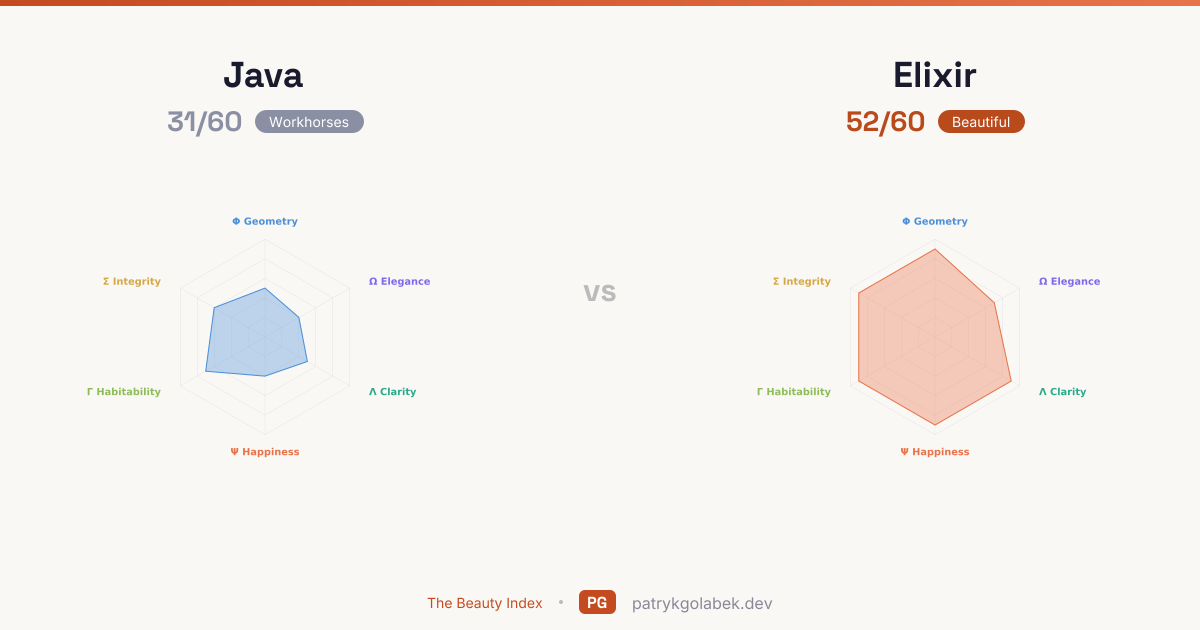
Java
The enterprise middle manager who requires a meeting to schedule a meeting. Java turned verbosity into a virtue and AbstractSingletonProxyFactoryBean into a punchline.
Elixir
The jazz musician who studied classical. Elixir takes Erlang's battle-tested concurrency and wraps it in syntax so pleasant you forget you're building distributed systems that never go down.
Elixir scores 52/60 against Java's 31/60, leading in 6 of 6 dimensions. Elixir dominates the aesthetic, mathematical, human, and design axes. Read the comparison through Practitioner Happiness first: Elixir wins that axis by 5 points over Java, and it is the single best lens on the pair.
See also: Python vs Elixir , Java .
Dimension-by-dimension analysis
Ψ Practitioner Happiness
Elixir wins Practitioner Happiness by 5 points — a genuine community lead. Stack Overflow admiration at 66%. The Phoenix framework, LiveView, and OTP give practitioners a feeling of building something that "just works." The community is small but deeply enthusiastic and welcoming. Elixir has done the harder cultural work: tooling that delights, a community that welcomes, documentation that explains. Widely used, rarely loved. Stack Overflow admiration is moderate. The ecosystem is massive and mature, but developer experience surveys consistently place Java in the "tolerated" category. The JVM is respected; the language syntax is endured. In application languages the community culture compounds the language advantage.
Λ Linguistic Clarity
Elixir wins Linguistic Clarity by 4 points — an unmistakable prose-like flow. The pipe operator (|>) turns data transformation into a readable narrative. "hello" |> String.split() |> Enum.map(&String.capitalize/1) reads as a clear sequence of intentions. Among the most literate functional languages. Elixir reads like a well-edited paragraph; Java reads like a sentence that is still being translated. Java communicates intent through names and types, but the signal is buried under ceremony. AbstractSingletonProxyFactoryBean communicates structure but not wit. Java code is precise, but reading it is work. The winner here treats readability as a core feature rather than a style preference.
Φ Aesthetic Geometry
Elixir wins Aesthetic Geometry by 4 points — an unmistakable aesthetic lead. Pipeline operators, pattern-matching clauses, and module structure create a visual flow that scans beautifully. Elixir code looks like a series of clean, evenly weighted transformation steps. Set the two side by side and the shape of each language announces itself before you read a single identifier. Java code is visually heavy, class wrappers, access modifiers, type declarations, and boilerplate create dense blocks. Modern Java (records, sealed classes) helps, but the language's verbosity is structural, not stylistic. Designers of high-level code feel this difference the moment they open an unfamiliar module.
Ω Mathematical Elegance
Elixir wins Mathematical Elegance by 3 points — a substantive reach beyond idiom. Pattern matching, recursion, and immutable data structures support elegant algorithm expression. Not as abstract as Haskell or OCaml, but the BEAM VM's concurrency primitives give certain distributed algorithms an inevitable quality. Where Elixir compresses an idea into a line or two, Java tends to spread the same idea across a paragraph. Java's OOP-first design resists mathematical abstraction. Expressing algorithms requires ceremony, AbstractFactory, Iterator, Consumer<T>. The patterns are powerful but the opposite of Hardy's "economy." In application code the elegance edge shows up as less boilerplate per idea.
Σ Conceptual Integrity
Elixir wins Conceptual Integrity by 3 points — an unmistakable unity of purpose. "Erlang's power with modern syntax." José Valim had a clear vision: bring functional programming and fault-tolerant concurrency to a wider audience. The language feels designed by one mind with a singular purpose. Elixir speaks with a single design voice; Java speaks with a committee. "Write once, run anywhere" was a clear mission, and the JVM delivered. But decades of committee-driven feature additions (generics via erasure, streams, modules, records) have layered paradigms without fully integrating them. Coherent enough, not focused. For application code the integrity edge means fewer "wait, why does it behave that way?" moments per week.
Γ Organic Habitability
Elixir wins Organic Habitability by 2 points — a clear edge for long-lived code. Pipelines are growth-point idioms, insert a transformation step anywhere without restructuring. OTP's supervision trees are the embodiment of habitable architecture: systems designed to fail gracefully and be extended incrementally. Where Elixir accommodates change gracefully, Java makes you earn each new direction. Java's greatest strength: codebases survive decades. Backward compatibility is nearly absolute. Enterprise patterns, for all their verbosity, create predictable structures that large teams can maintain. Java is habitable in the way a well-run office building is habitable. For application codebases the habitability edge determines whether a project survives its second rewrite.
Code comparison
Basic variable syntax, type annotations, and initialization patterns.
Exception handling via try/catch or Result/Either patterns.
int parseNumber(String s) throws NumberFormatException {    return Integer.parseInt(s);}
try { var result = parseNumber("42"); System.out.println(result);} catch (NumberFormatException e) { System.err.println("Invalid: " + e.getMessage());} finally { cleanup();}with {:ok, user} <- fetch_user(id), {:ok, posts} <- fetch_posts(user.id), {:ok, _} <- validate(posts) do {:ok, format_response(user, posts)}else {:error, :not_found} -> {:error, "User not found"} {:error, reason} -> {:error, reason}endFor/while iteration patterns and loop constructs.
for (var item : items) {    System.out.println(item);}
for (int i = 0; i < 10; i++) {    System.out.println(i);}
int sum = 0;while (sum < 100) { sum += 10; }Enum.each(1..10, fn i -> IO.puts(i)end)
for x <- 1..10, rem(x, 2) == 0, do: x * x
def sum_to(0), do: 0def sum_to(n), do: n + sum_to(n - 1)Frequently asked questions
- Which is easier to learn, Java or Elixir?
- Elixir scores 9 on Practitioner Happiness versus Java's 4. Stack Overflow admiration at 66%. The Phoenix framework, LiveView, and OTP give practitioners a feeling of building something that "just works." The community is small but deeply enthusiastic and welcoming. When ease of learning is the deciding factor, the happier community wins every time — mentors, docs, and examples are simply more abundant.
- Is Java or Elixir better for developer happiness?
- For developer happiness, Elixir has a clear edge — it scores 9/10 on Practitioner Happiness against Java's 4/10. Stack Overflow admiration at 66%. The Phoenix framework, LiveView, and OTP give practitioners a feeling of building something that "just works." The community is small but deeply enthusiastic and welcoming.
- Should I pick Java or Elixir in 2026?
- Java lands in the workhorses tier at 31/60; Elixir in the beautiful tier at 52/60. On this score difference the answer is clear: the higher-ranked language wins unless you have an explicit reason to pay the cost of the other.