
Haskell vs Swift
Haskell
The beautifully dressed philosopher who can't find their car keys. Haskell writes the most elegant code in any language, then spends 45 minutes explaining why IO is actually a monad.
Swift
The architect who redesigned the entire house because the kitchen drawer was 2mm off. Swift pursues perfection with Apple-level obsession, and the result is a language that feels inevitable.
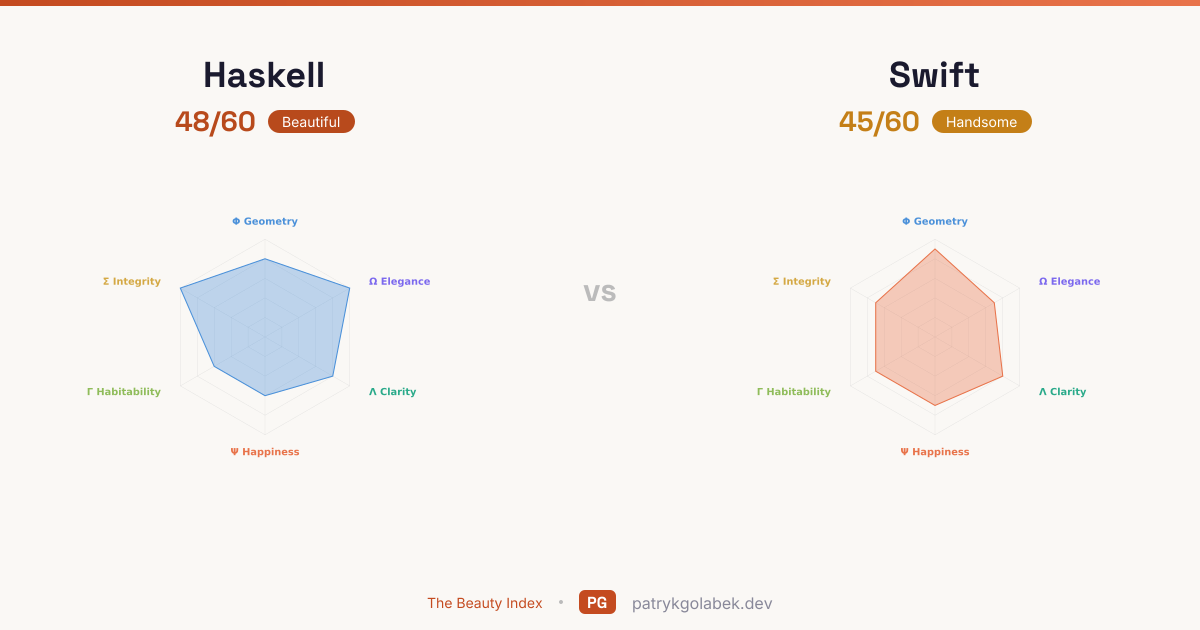
Haskell scores 48/60 against Swift's 45/60, leading in 2 of 6 dimensions. Haskell owns mathematical and design while Swift leads in aesthetic and human. The widest gap sits on Mathematical Elegance, where Haskell's 3-point lead over Swift shapes most of the pair's character.
See also: Haskell vs PHP , Haskell .
Dimension-by-dimension analysis
Ω Mathematical Elegance
Haskell wins Mathematical Elegance by 3 points — a substantive reach beyond idiom. The gold standard. fibs = 0 : 1 : zipWith (+) fibs (tail fibs) defines infinity by self-reference. Purity, lazy evaluation, and higher-kinded types let algorithms approach Erdős's "Book" proofs. No other language comes close. The gap on Elegance is real: Haskell rewards precise thought, Swift rewards precise bookkeeping. Generics, protocol extensions, and enum-associated values support expressive algorithm design. Not in the functional-language Omega tier, but protocol-oriented programming enables elegant domain modeling. For high-level work, the gap compounds: fewer lines per algorithm means fewer bugs per feature.
Σ Conceptual Integrity
Haskell wins Conceptual Integrity by 3 points — an unmistakable unity of purpose. "Avoid success at all costs." Haskell is about something: purity, types, and mathematical foundations. Every feature follows from a coherent worldview. It's the most internally consistent language design on this list. Where Haskell holds a line, Swift has negotiated with history, ecosystems, and legacy users. "Safe, fast, expressive" with protocol-oriented programming as a distinctive paradigm. The design is opinionated, but Apple's commercial interests and platform-specific priorities dilute the pure language-design vision. For application code the integrity edge means fewer "wait, why does it behave that way?" moments per week.
Γ Organic Habitability
Swift edges Haskell by a single point on Organic Habitability; the practical difference is slim but real. Protocol-oriented design encourages extensible architecture. Codebases can grow along protocol boundaries. Docked because Apple's rapid language evolution (Swift 1→6) has imposed migration costs, and the tight platform coupling limits organic growth beyond Apple's garden. On extensibility the two are close enough that the decision rarely hinges on this axis alone. Purity is a double-edged sword, you can't "just add a side effect here" without restructuring. Changing one type signature can cascade through an entire module. Haskell code is correct but often brittle to modify, which is the opposite of Gabriel's habitability ideal. For application codebases the habitability edge determines whether a project survives its second rewrite.
Φ Aesthetic Geometry
Swift edges Haskell by a single point on Aesthetic Geometry; the practical difference is slim but real. Swift's syntax is visually clean and well-proportioned, closures, guard statements, and trailing closure syntax create a natural reading flow. Apple's design obsession shows in the visual weight of the code. The edge here is thin; a seasoned reader might prefer one strictly on personal taste. Clean Haskell is visually striking, where clauses, pattern matching, and type signatures create a structured, proportional layout. Docked from 9 because production Haskell with GADTs and monad transformer stacks can produce dense type-signature walls. In a language where expressiveness is the selling point, visual calm amplifies the advantage.
Ψ Practitioner Happiness
Swift edges Haskell by a single point on Practitioner Happiness; the practical difference is slim but real. Strong satisfaction among iOS/macOS developers. Swift Playgrounds and Xcode integration create pleasant workflows. Docked because the ecosystem is Apple-locked, and build times plus ABI stability issues have caused real friction. Both Haskell and Swift are broadly loved; Swift is loved a little harder, a little more loudly. Moderate Stack Overflow admiration (~57%), well below Rust, Elixir, or Gleam. The learning curve is brutal, Cabal/Stack tooling fragmentation has caused years of pain, and cryptic error messages for type-level code create real frustration. The community is passionate but small. Developers admire Haskell more than they enjoy it day-to-day. The winner here invites the next generation of contributors without asking them to earn it first.
Λ Linguistic Clarity
Both score 8 — this is one dimension where Haskell and Swift genuinely agree. Simple Haskell reads like mathematics rendered in prose. Point-free style and function composition create elegant chains of meaning. Docked from 9 because lens operators (^., .~) and advanced type-level code can be opaque even to intermediate Haskellers. On linguistic clarity the two converge; what separates them is elsewhere. Named parameters, guard clauses, and descriptive API naming conventions (inherited from Objective-C culture) make Swift code read clearly. array.filter { $0.isValid }.map { $0.name } communicates intent directly. The winner here treats readability as a core feature rather than a style preference.
Code comparison
The characteristic code snippet that best represents each language.
quicksort :: Ord a => [a] -> [a]quicksort [] = []quicksort (x:xs) = quicksort smaller ++ [x] ++ quicksort bigger where smaller = [a | a <- xs, a <= x] bigger = [a | a <- xs, a > x]protocol Drawable { func draw() -> String}
extension Drawable { func debugDraw() -> String { "[(draw())]" }}
struct Circle: Drawable { let radius: Double func draw() -> String { "Circle(r=(radius))" }}For/while iteration patterns and loop constructs.
-- Haskell uses recursion, not loopsfactorial :: Integer -> Integerfactorial 0 = 1factorial n = n * factorial (n - 1)
evens :: [Int] -> [Int]evens xs = [x | x <- xs, even x]for i in 1...10 { print(i)}
for (index, value) in list.enumerated() { print("\(index): \(value)")}
for i in stride(from: 0, to: 100, by: 5) { print(i)}Conditional branching and control flow expressions.
classify :: Int -> Stringclassify n | n < 0 = "negative" | n == 0 = "zero" | n < 100 = "small" | otherwise = "large"var label: Stringif score >= 90 { label = "excellent"} else if score >= 70 { label = "good"} else if score >= 50 { label = "average"} else { label = "needs improvement"}Frequently asked questions
- Which is easier to learn, Haskell or Swift?
- Swift scores 7 on Practitioner Happiness versus Haskell's 6. Strong satisfaction among iOS/macOS developers. Swift Playgrounds and Xcode integration create pleasant workflows. Docked because the ecosystem is Apple-locked, and build times plus ABI stability issues have caused real friction. When ease of learning is the deciding factor, the happier community wins every time — mentors, docs, and examples are simply more abundant.
- Is Haskell or Swift better for algorithm-heavy code?
- For algorithm-heavy code, Haskell has a clear edge — it scores 10/10 on Mathematical Elegance against Swift's 7/10. The gold standard. fibs = 0 : 1 : zipWith (+) fibs (tail fibs) defines infinity by self-reference. Purity, lazy evaluation, and higher-kinded types let algorithms approach Erdős's "Book" proofs. No other language comes close.
- Should I pick Haskell or Swift in 2026?
- Haskell lands in the beautiful tier at 48/60; Swift in the handsome tier at 45/60. With so little between them on raw score, choose on ecosystem: the library set, hiring market, and tooling you already own. The score difference reflects years of community use, tooling maturity, and the editorial judgment of the Beauty Index rubric.