
Haskell vs PHP
Haskell
The beautifully dressed philosopher who can't find their car keys. Haskell writes the most elegant code in any language, then spends 45 minutes explaining why IO is actually a monad.
PHP
The duct tape that holds 40% of the web together while everyone pretends it doesn't exist. PHP is the cockroach of programming: ugly, everywhere, and absolutely unkillable.
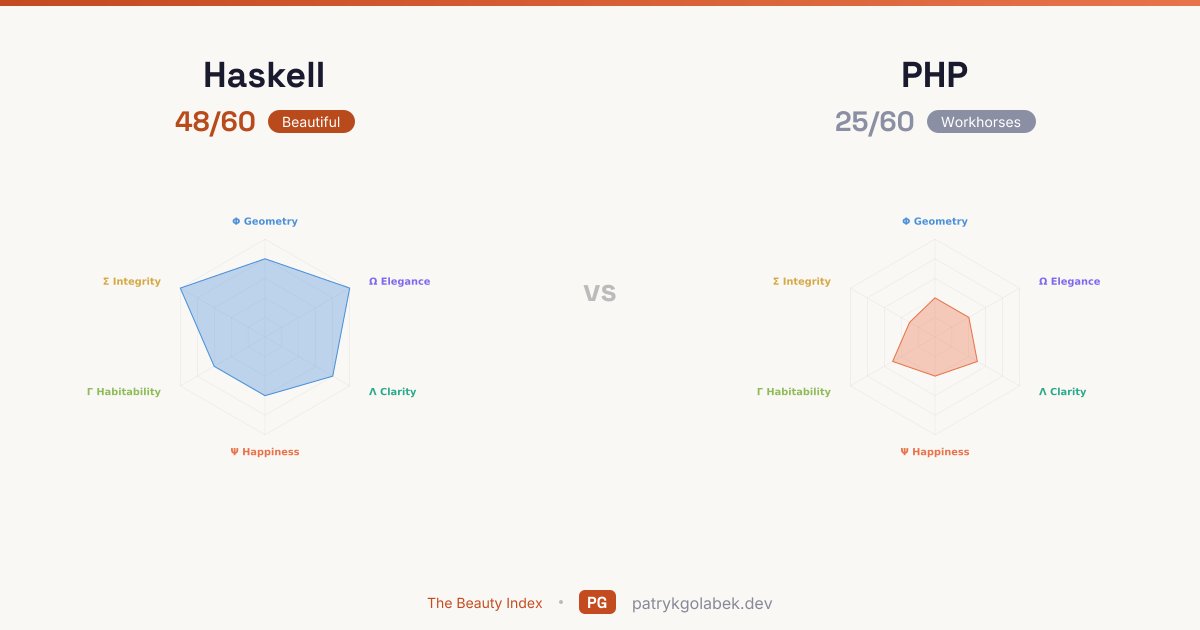
Haskell scores 48/60 against PHP's 25/60, leading in 6 of 6 dimensions. Haskell dominates the aesthetic, mathematical, human, and design axes. The widest gap sits on Conceptual Integrity, where Haskell's 7-point lead over PHP shapes most of the pair's character.
See also: Haskell vs Clojure , Haskell .
Dimension-by-dimension analysis
Σ Conceptual Integrity
Haskell wins Conceptual Integrity by 7 points — a genuine lead in design coherence. "Avoid success at all costs." Haskell is about something: purity, types, and mathematical foundations. Every feature follows from a coherent worldview. It's the most internally consistent language design on this list. Where Haskell holds a line, PHP has negotiated with history, ecosystems, and legacy users. PHP was not designed; it was accumulated. Rasmus Lerdorf's personal homepage tools grew into a language without a coherent philosophy. Each version has improved quality, but there is no "soul", no single idea that all features follow from. The quintessential committee language. For application code the integrity edge means fewer "wait, why does it behave that way?" moments per week.
Ω Mathematical Elegance
Haskell wins Mathematical Elegance by 6 points — a clear algorithmic edge. The gold standard. fibs = 0 : 1 : zipWith (+) fibs (tail fibs) defines infinity by self-reference. Purity, lazy evaluation, and higher-kinded types let algorithms approach Erdős's "Book" proofs. No other language comes close. The gap on Elegance is real: Haskell rewards precise thought, PHP rewards precise bookkeeping. PHP is a templating language that grew into a general-purpose one. Array functions exist but lack the composability of functional languages. Mathematical elegance is not the design space PHP occupies. For high-level work, the gap compounds: fewer lines per algorithm means fewer bugs per feature.
Φ Aesthetic Geometry
Haskell wins Aesthetic Geometry by 4 points — a meaningful cleanliness gap. Clean Haskell is visually striking, where clauses, pattern matching, and type signatures create a structured, proportional layout. Docked from 9 because production Haskell with GADTs and monad transformer stacks can produce dense type-signature walls. The difference is not cosmetic: Haskell rewards the eye, while PHP asks the reader to absorb more punctuation and more ceremony. $ on every variable, -> for method calls, inconsistent brace styles across frameworks, and <?php tags create visual clutter. Modern PHP (8.x) with named arguments and match expressions is cleaner, but the legacy visual debt remains. In a language where expressiveness is the selling point, visual calm amplifies the advantage.
Λ Linguistic Clarity
Haskell wins Linguistic Clarity by 3 points — a real readability advantage. Simple Haskell reads like mathematics rendered in prose. Point-free style and function composition create elegant chains of meaning. Docked from 9 because lens operators (^., .~) and advanced type-level code can be opaque even to intermediate Haskellers. Haskell reads like a well-edited paragraph; PHP reads like a sentence that is still being translated. PHP can be readable in modern frameworks (Laravel's fluent syntax reads well). But str_replace vs. strpos vs. substr, inconsistent parameter ordering, and the legacy API are the antithesis of linguistic clarity. Two PHPs coexist: modern and legacy. For application code the clarity advantage is the whole point of the language category.
Ψ Practitioner Happiness
Haskell wins Practitioner Happiness by 2 points — an unmistakable experiential gap. Moderate Stack Overflow admiration (~57%), well below Rust, Elixir, or Gleam. The learning curve is brutal, Cabal/Stack tooling fragmentation has caused years of pain, and cryptic error messages for type-level code create real frustration. The community is passionate but small. Developers admire Haskell more than they enjoy it day-to-day. Haskell has done the harder cultural work: tooling that delights, a community that welcomes, documentation that explains. PHP developers themselves joke about PHP. The community is large and productive, but "most admired" it is not. Modern PHP (8.x with Laravel) has improved the experience significantly, but the reputation, and the daily reality of legacy code, weighs on happiness. The winner here invites the next generation of contributors without asking them to earn it first.
Γ Organic Habitability
Haskell edges PHP by a single point on Organic Habitability; the practical difference is slim but real. Purity is a double-edged sword, you can't "just add a side effect here" without restructuring. Changing one type signature can cascade through an entire module. Haskell code is correct but often brittle to modify, which is the opposite of Gabriel's habitability ideal. Both Haskell and PHP age reasonably well; Haskell is merely a little kinder to the future reader. PHP codebases survive, 77% of the web runs on PHP, and that code keeps working. The language is pragmatically habitable. But the inconsistent standard library and multiple paradigm shifts (procedural → OOP → modern PHP) make long-term evolution uneven. The winner here is the language you will still enjoy reading in five years.
Code comparison
The characteristic code snippet that best represents each language.
quicksort :: Ord a => [a] -> [a]quicksort [] = []quicksort (x:xs) = quicksort smaller ++ [x] ++ quicksort bigger where smaller = [a | a <- xs, a <= x] bigger = [a | a <- xs, a > x]$results = array_map( fn($user) => [ 'name' => $user['name'], 'email' => strtolower($user['email']), 'score' => array_sum($user['grades']) / count($user['grades']), ], array_filter( $users, fn($u) => $u['active'] && count($u['grades']) > 0 ));Exception handling via try/catch or Result/Either patterns.
type Error = String
safeDivide :: Double -> Double -> Either Error DoublesafeDivide _ 0 = Left "Division by zero"safeDivide a b = Right (a / b)
compute :: Either Error Doublecompute = do x <- safeDivide 10 2 y <- safeDivide x 3 return (x + y)function parseNumber(string $s): int { if (!is_numeric($s)) { throw new InvalidArgumentException("Invalid: $s"); } return (int) $s;}
try { $result = parseNumber('42');} catch (InvalidArgumentException $e) { echo "Error: " . $e->getMessage();} finally { cleanup();}Data structure definition using classes, structs, records, or equivalent.
data User = User  { userName  :: String  , userEmail :: String  , userAge   :: Int  } deriving (Show, Eq)
data Shape = Circle Double | Rectangle Double Doublereadonly class User { public function __construct( public string $name, public string $email, public int $age = 0, ) {}
public function greeting(): string { return "Hello, {$this->name}!"; }}Frequently asked questions
- Which is easier to learn, Haskell or PHP?
- Haskell scores 6 on Practitioner Happiness versus PHP's 4. Moderate Stack Overflow admiration (~57%), well below Rust, Elixir, or Gleam. The learning curve is brutal, Cabal/Stack tooling fragmentation has caused years of pain, and cryptic error messages for type-level code create real frustration. The community is passionate but small. Developers admire Haskell more than they enjoy it day-to-day. For classroom or self-directed study, the practitioner-happiness winner almost always has better learning materials and kinder error messages.
- Is Haskell or PHP better for principled design?
- For principled design, Haskell has a clear edge — it scores 10/10 on Conceptual Integrity against PHP's 3/10. "Avoid success at all costs." Haskell is about something: purity, types, and mathematical foundations. Every feature follows from a coherent worldview. It's the most internally consistent language design on this list.
- Should I pick Haskell or PHP in 2026?
- Haskell lands in the beautiful tier at 48/60; PHP in the workhorses tier at 25/60. The gap is wide. Unless a specific platform or ecosystem constraint forces the other choice, go with the higher-scoring language. The score difference reflects years of community use, tooling maturity, and the editorial judgment of the Beauty Index rubric.