
Haskell vs Ruby
Haskell
The beautifully dressed philosopher who can't find their car keys. Haskell writes the most elegant code in any language, then spends 45 minutes explaining why IO is actually a monad.
Ruby
The poet who became a startup founder. Matz designed Ruby explicitly to maximize programmer happiness, and it shows. Everything is an object, every expression returns a value, and blocks let you express ideas with a rhythm that feels literary.
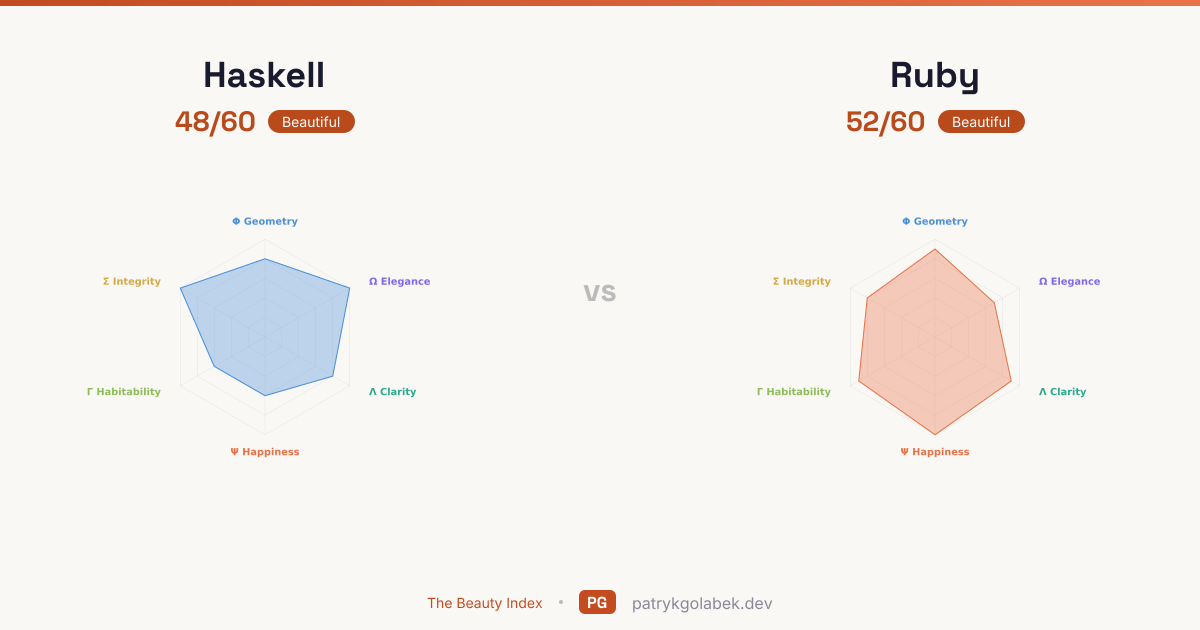
Ruby scores 52/60 against Haskell's 48/60, leading in 4 of 6 dimensions. Haskell owns mathematical and design while Ruby leads in aesthetic and human. Read the comparison through Practitioner Happiness first: Ruby wins that axis by 4 points over Haskell, and it is the single best lens on the pair.
See also: PHP vs Ruby , Haskell .
Dimension-by-dimension analysis
Ψ Practitioner Happiness
Ruby wins Practitioner Happiness by 4 points — a real happiness advantage. Ruby was designed to maximize programmer happiness, it's the explicit, stated mission. Matz's philosophy permeates everything from the standard library API to the community culture. The canonical 10 on this dimension. Where Ruby feels designed for the human, Haskell feels designed for the machine first — the human catches up second. Moderate Stack Overflow admiration (~57%), well below Rust, Elixir, or Gleam. The learning curve is brutal, Cabal/Stack tooling fragmentation has caused years of pain, and cryptic error messages for type-level code create real frustration. The community is passionate but small. Developers admire Haskell more than they enjoy it day-to-day. The winner here invites the next generation of contributors without asking them to earn it first.
Γ Organic Habitability
Ruby wins Organic Habitability by 3 points — a meaningful extensibility gap. Monkey-patching, open classes, and convention-over-configuration make Ruby extremely habitable. Code accommodates change with minimal friction. The language invites you to extend it rather than fight it. Ruby invites modification; Haskell rewards planning more than adjustment. Purity is a double-edged sword, you can't "just add a side effect here" without restructuring. Changing one type signature can cascade through an entire module. Haskell code is correct but often brittle to modify, which is the opposite of Gabriel's habitability ideal. For application codebases the habitability edge determines whether a project survives its second rewrite.
Ω Mathematical Elegance
Haskell wins Mathematical Elegance by 3 points — a decisive elegance advantage. The gold standard. fibs = 0 : 1 : zipWith (+) fibs (tail fibs) defines infinity by self-reference. Purity, lazy evaluation, and higher-kinded types let algorithms approach Erdős's "Book" proofs. No other language comes close. Haskell lets algorithms approach mathematical statement, while Ruby asks more of the programmer when elegance is the goal. Everything is an object, every expression returns a value, and blocks enable higher-order patterns. Not a mathematical language per se, but its internal consistency gives algorithms a sense of inevitability. In application code the elegance edge shows up as less boilerplate per idea.
Σ Conceptual Integrity
Haskell wins Conceptual Integrity by 2 points — a decisive philosophical edge. "Avoid success at all costs." Haskell is about something: purity, types, and mathematical foundations. Every feature follows from a coherent worldview. It's the most internally consistent language design on this list. The design philosophy of Haskell feels inevitable, each feature a consequence of one idea — Ruby feels assembled from several good ideas instead of from one great one. "Optimize for programmer happiness" is a clear, singular vision. Ruby occasionally accumulates features (e.g., multiple ways to define lambdas), but the core philosophy holds. Docked slightly for the flexibility-creates-inconsistency tradeoff. The winner's philosophical discipline is what keeps its idioms stable as the language evolves.
Λ Linguistic Clarity
Ruby edges Haskell by a single point on Linguistic Clarity; the practical difference is slim but real. .reject(&:empty?), .each_with_index, File.readlines — Ruby reads aloud as English. Matz explicitly optimized for human communication over machine efficiency. Among the highest Knuthian "wit" in any language. On readability the edge is slim and disappears quickly as idioms are learned. Simple Haskell reads like mathematics rendered in prose. Point-free style and function composition create elegant chains of meaning. Docked from 9 because lens operators (^., .~) and advanced type-level code can be opaque even to intermediate Haskellers. In high-level work, readable code is the difference between a 6-month onboarding and a 6-week one.
Φ Aesthetic Geometry
Ruby edges Haskell by a single point on Aesthetic Geometry; the practical difference is slim but real. Ruby's block syntax, do...end and { } conventions, and method chaining create a natural visual flow. Code reads top-to-bottom with a literary rhythm. Indentation feels organic rather than enforced. Ruby edges ahead on visual rhythm, but Haskell is comfortably readable in its own right. Clean Haskell is visually striking, where clauses, pattern matching, and type signatures create a structured, proportional layout. Docked from 9 because production Haskell with GADTs and monad transformer stacks can produce dense type-signature walls. Designers of high-level code feel this difference the moment they open an unfamiliar module.
Code comparison
The characteristic code snippet that best represents each language.
quicksort :: Ord a => [a] -> [a]quicksort [] = []quicksort (x:xs) = quicksort smaller ++ [x] ++ quicksort bigger where smaller = [a | a <- xs, a <= x] bigger = [a | a <- xs, a > x]class Array def histogram each_with_object(Hash.new(0)) { |item, counts| counts[item] += 1 } .sort_by { |_, count| -count } .map { |item, count| "#{item}: #{'*' * count}" } .join("\n") endendConditional branching and control flow expressions.
Exception handling via try/catch or Result/Either patterns.
type Error = String
safeDivide :: Double -> Double -> Either Error DoublesafeDivide _ 0 = Left "Division by zero"safeDivide a b = Right (a / b)
compute :: Either Error Doublecompute = do x <- safeDivide 10 2 y <- safeDivide x 3 return (x + y)def parse_number(str) Integer(str)rescue ArgumentError => e raise "Invalid input: #{str}"end
begin result = parse_number(input)rescue => e puts "Error: #{e.message}" result = -1ensure cleanupendFrequently asked questions
- Which is easier to learn, Haskell or Ruby?
- Ruby scores 10 on Practitioner Happiness versus Haskell's 6. Ruby was designed to maximize programmer happiness, it's the explicit, stated mission. Matz's philosophy permeates everything from the standard library API to the community culture. The canonical 10 on this dimension. For a developer adding a new language to their toolbelt, the happier one is the one you will still be writing in six months.
- Is Haskell or Ruby better for developer happiness?
- For developer happiness, Ruby has a clear edge — it scores 10/10 on Practitioner Happiness against Haskell's 6/10. Ruby was designed to maximize programmer happiness, it's the explicit, stated mission. Matz's philosophy permeates everything from the standard library API to the community culture. The canonical 10 on this dimension.
- Should I pick Haskell or Ruby in 2026?
- Haskell lands in the beautiful tier at 48/60; Ruby in the beautiful tier at 52/60. With this spread, default to the higher-ranked language and reserve the other for projects where its specific strengths matter. The score difference reflects years of community use, tooling maturity, and the editorial judgment of the Beauty Index rubric.