
Haskell vs OCaml
Haskell
The beautifully dressed philosopher who can't find their car keys. Haskell writes the most elegant code in any language, then spends 45 minutes explaining why IO is actually a monad.
OCaml
The quiet genius in the corner who invented half of modern type theory and never got credit. OCaml's type system is a masterpiece; its ecosystem is an archaeology dig.
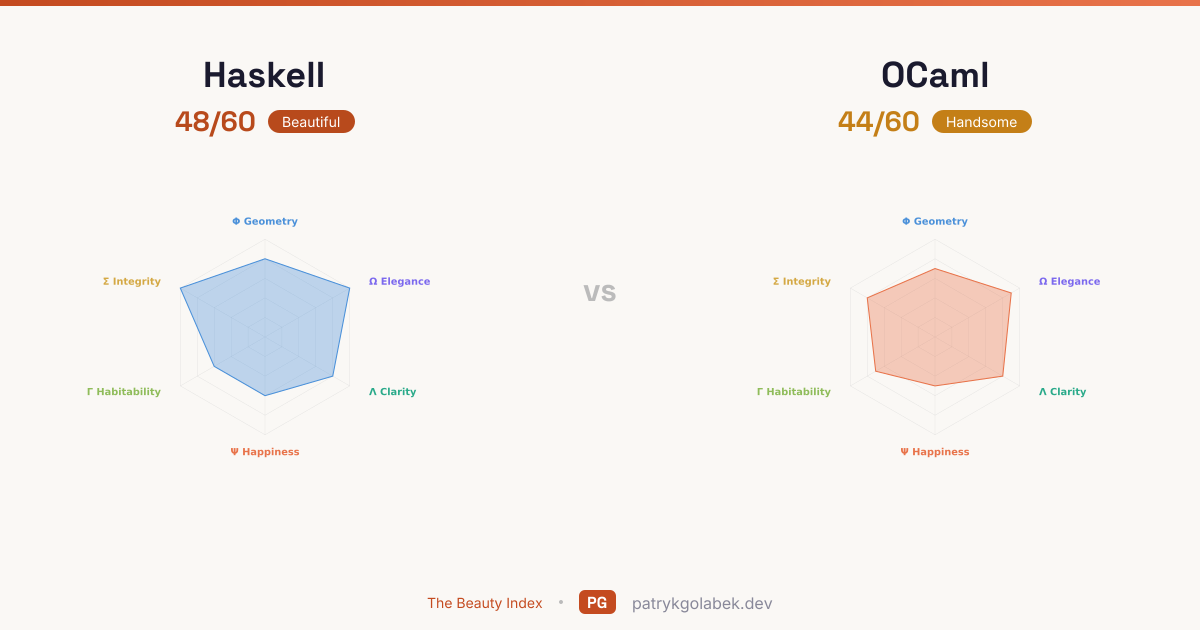
Haskell scores 48/60 against OCaml's 44/60, leading in 4 of 6 dimensions. Haskell dominates the aesthetic, mathematical, and design axes. The pair splits practitioner joy from long-term habitability — Haskell wins the week, OCaml wins the decade.
See also: Haskell vs PHP , Haskell .
Dimension-by-dimension analysis
Σ Conceptual Integrity
Haskell wins Conceptual Integrity by 2 points — a genuine lead in design coherence. "Avoid success at all costs." Haskell is about something: purity, types, and mathematical foundations. Every feature follows from a coherent worldview. It's the most internally consistent language design on this list. The design philosophy of Haskell feels inevitable, each feature a consequence of one idea — OCaml feels assembled from several good ideas instead of from one great one. OCaml has always known what it is: a practical functional language with an exceptional type system. The design is focused and coherent, types as the organizing principle, everything else in service of that. In high-level work a coherent philosophy is the frame that holds the language's features together.
Γ Organic Habitability
OCaml edges Haskell by a single point on Organic Habitability; the practical difference is slim but real. Strong types and module boundaries help code age well. The functors system enables reusable, extensible abstractions. Docked because the ecosystem's small size means fewer established patterns for common problems. The habitability edge is slim and often dominated by team culture rather than language choice. Purity is a double-edged sword, you can't "just add a side effect here" without restructuring. Changing one type signature can cascade through an entire module. Haskell code is correct but often brittle to modify, which is the opposite of Gabriel's habitability ideal. For application codebases the habitability edge determines whether a project survives its second rewrite.
Ω Mathematical Elegance
Haskell edges OCaml by a single point on Mathematical Elegance; the practical difference is slim but real. The gold standard. fibs = 0 : 1 : zipWith (+) fibs (tail fibs) defines infinity by self-reference. Purity, lazy evaluation, and higher-kinded types let algorithms approach Erdős's "Book" proofs. No other language comes close. Haskell nudges ahead, but OCaml is capable of the same expressive heights in the hands of a confident user. MetaLanguage-family heritage gives OCaml one of the most expressive type systems in existence. GADTs, functors, and first-class modules enable algorithm expression that approaches mathematical proof. Type theory pioneers use OCaml for a reason. In application code the elegance edge shows up as less boilerplate per idea.
Φ Aesthetic Geometry
Haskell edges OCaml by a single point on Aesthetic Geometry; the practical difference is slim but real. Clean Haskell is visually striking, where clauses, pattern matching, and type signatures create a structured, proportional layout. Docked from 9 because production Haskell with GADTs and monad transformer stacks can produce dense type-signature walls. The edge here is thin; a seasoned reader might prefer one strictly on personal taste. Pattern matching, let bindings, and module signatures create a structured visual feel. Clean but not striking, the syntax is functional without being visually adventurous. Designers of high-level code feel this difference the moment they open an unfamiliar module.
Ψ Practitioner Happiness
Haskell edges OCaml by a single point on Practitioner Happiness; the practical difference is slim but real. Moderate Stack Overflow admiration (~57%), well below Rust, Elixir, or Gleam. The learning curve is brutal, Cabal/Stack tooling fragmentation has caused years of pain, and cryptic error messages for type-level code create real frustration. The community is passionate but small. Developers admire Haskell more than they enjoy it day-to-day. Haskell noses ahead in surveys, but OCaml retains a devoted following of its own. A small community with niche adoption. Tooling has improved dramatically (opam, dune, Merlin), but the ecosystem remains thin compared to mainstream languages. Practitioners love it deeply, but they are few. In application languages the community culture compounds the language advantage.
Λ Linguistic Clarity
Both score 8 — this is one dimension where Haskell and OCaml genuinely agree. Simple Haskell reads like mathematics rendered in prose. Point-free style and function composition create elegant chains of meaning. Docked from 9 because lens operators (^., .~) and advanced type-level code can be opaque even to intermediate Haskellers. On linguistic clarity the two converge; what separates them is elsewhere. The |> operator, descriptive module paths, and pattern matching make OCaml code readable to anyone familiar with ML conventions. The language communicates structure and intent through types rather than comments. For application code the clarity advantage is the whole point of the language category.
Code comparison
The characteristic code snippet that best represents each language.
quicksort :: Ord a => [a] -> [a]quicksort [] = []quicksort (x:xs) = quicksort smaller ++ [x] ++ quicksort bigger where smaller = [a | a <- xs, a <= x] bigger = [a | a <- xs, a > x]type 'a tree = | Leaf | Node of 'a tree * 'a * 'a tree
let rec fold f acc = function | Leaf -> acc | Node (left, value, right) -> let acc = fold f acc left in let acc = f acc value in fold f acc rightEmbedding expressions and variables within string literals.
import Text.Printf (printf)
-- Haskell uses concatenation or printfgreeting :: String -> Int -> Stringgreeting name age =  "Hello, " ++ name ++ "! You are "    ++ show age ++ " years old."
msg :: Stringmsg = printf "Hello, %s! Age: %d" name agelet name = "OCaml"let version = 5.1
let msg = Printf.sprintf "Hello, %s! Version: %.1f" name versionlet () = Printf.printf "Welcome to %s.\nVersion: %.1f\n" name versionConditional branching and control flow expressions.
Frequently asked questions
- Which is easier to learn, Haskell or OCaml?
- Haskell scores 6 on Practitioner Happiness versus OCaml's 5. Moderate Stack Overflow admiration (~57%), well below Rust, Elixir, or Gleam. The learning curve is brutal, Cabal/Stack tooling fragmentation has caused years of pain, and cryptic error messages for type-level code create real frustration. The community is passionate but small. Developers admire Haskell more than they enjoy it day-to-day. For classroom or self-directed study, the practitioner-happiness winner almost always has better learning materials and kinder error messages.
- Is Haskell or OCaml better for principled design?
- For principled design, Haskell has a clear edge — it scores 10/10 on Conceptual Integrity against OCaml's 8/10. "Avoid success at all costs." Haskell is about something: purity, types, and mathematical foundations. Every feature follows from a coherent worldview. It's the most internally consistent language design on this list.
- Should I pick Haskell or OCaml in 2026?
- Haskell lands in the beautiful tier at 48/60; OCaml in the handsome tier at 44/60. With this spread, default to the higher-ranked language and reserve the other for projects where its specific strengths matter. The score difference reflects years of community use, tooling maturity, and the editorial judgment of the Beauty Index rubric.