
Haskell vs Julia
Haskell
The beautifully dressed philosopher who can't find their car keys. Haskell writes the most elegant code in any language, then spends 45 minutes explaining why IO is actually a monad.
Julia
The prodigy who wants to be Python, R, and Fortran simultaneously. Julia solves the two-language problem by being fast enough for C programmers and readable enough for scientists.
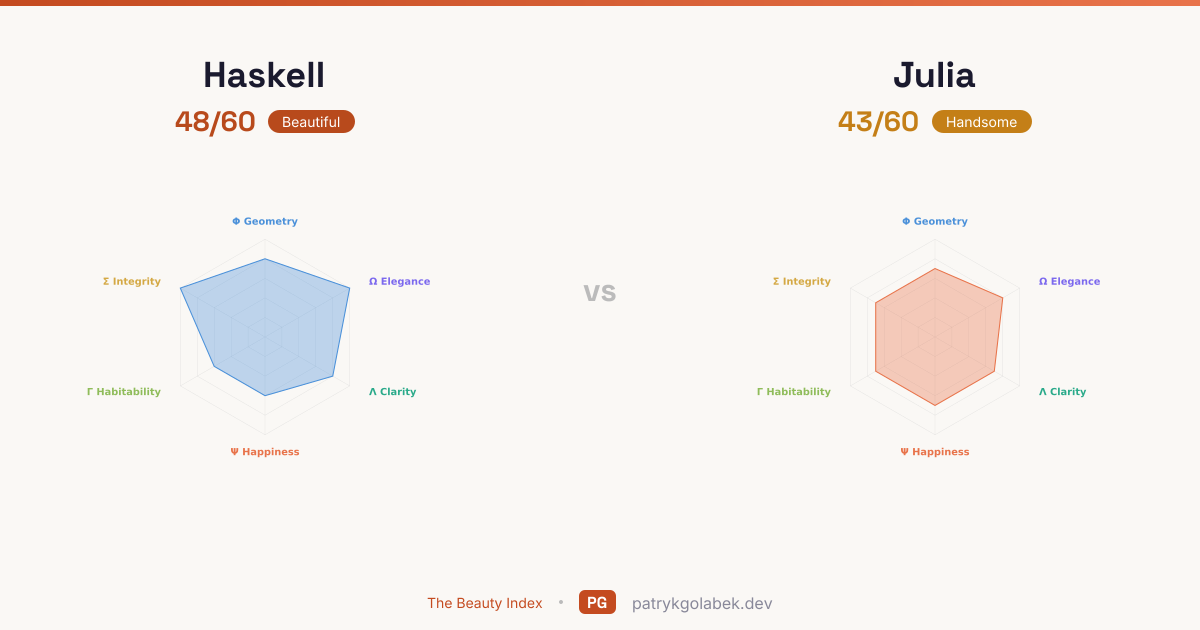
Haskell scores 48/60 against Julia's 43/60, leading in 4 of 6 dimensions. Haskell dominates the aesthetic, mathematical, and design axes. Read the comparison through Conceptual Integrity first: Haskell wins that axis by 3 points over Julia, and it is the single best lens on the pair.
See also: Haskell vs PHP , Haskell .
Dimension-by-dimension analysis
Σ Conceptual Integrity
Haskell wins Conceptual Integrity by 3 points — a clear integrity advantage. "Avoid success at all costs." Haskell is about something: purity, types, and mathematical foundations. Every feature follows from a coherent worldview. It's the most internally consistent language design on this list. Haskell speaks with a single design voice; Julia speaks with a committee. "Solve the two-language problem" is a clear mission, and multiple dispatch as the unifying principle is distinctive. Docked because the "be Python, R, and Fortran simultaneously" ambition stretches the conceptual focus. In high-level work a coherent philosophy is the frame that holds the language's features together.
Ω Mathematical Elegance
Haskell wins Mathematical Elegance by 2 points — a genuine expressive lead. The gold standard. fibs = 0 : 1 : zipWith (+) fibs (tail fibs) defines infinity by self-reference. Purity, lazy evaluation, and higher-kinded types let algorithms approach Erdős's "Book" proofs. No other language comes close. The gap on Elegance is real: Haskell rewards precise thought, Julia rewards precise bookkeeping. Multiple dispatch as the core paradigm enables elegant mathematical abstractions. Julia's type system lets you write generic algorithms that specialize naturally. Scientific algorithms can approach "Book" elegance. In application code the elegance edge shows up as less boilerplate per idea.
Γ Organic Habitability
Julia edges Haskell by a single point on Organic Habitability; the practical difference is slim but real. Multiple dispatch and scientific workflow patterns age more gracefully than originally credited. Julia codebases tend to grow organically along domain boundaries — new methods extend existing types naturally without modification. Both Haskell and Julia age reasonably well; Julia is merely a little kinder to the future reader. Purity is a double-edged sword, you can't "just add a side effect here" without restructuring. Changing one type signature can cascade through an entire module. Haskell code is correct but often brittle to modify, which is the opposite of Gabriel's habitability ideal. For application codebases the habitability edge determines whether a project survives its second rewrite.
Λ Linguistic Clarity
Haskell edges Julia by a single point on Linguistic Clarity; the practical difference is slim but real. Simple Haskell reads like mathematics rendered in prose. Point-free style and function composition create elegant chains of meaning. Docked from 9 because lens operators (^., .~) and advanced type-level code can be opaque even to intermediate Haskellers. Both Haskell and Julia communicate their intent without heroic effort; Haskell is only a little more forgiving. Julia reads clearly for scientific audiences, broadcasting syntax, comprehensions, and mathematical operators make domain intent visible. Less clear for general-purpose tasks outside its scientific home turf. The winner here treats readability as a core feature rather than a style preference.
Φ Aesthetic Geometry
Haskell edges Julia by a single point on Aesthetic Geometry; the practical difference is slim but real. Clean Haskell is visually striking, where clauses, pattern matching, and type signatures create a structured, proportional layout. Docked from 9 because production Haskell with GADTs and monad transformer stacks can produce dense type-signature walls. The edge here is thin; a seasoned reader might prefer one strictly on personal taste. Unicode operators, mathematical notation support, and clean function definitions give Julia a visual feel closer to mathematics than most languages. Matrix operations look like textbook equations. In a language where expressiveness is the selling point, visual calm amplifies the advantage.
Ψ Practitioner Happiness
Julia edges Haskell by a single point on Practitioner Happiness; the practical difference is slim but real. Loved by its scientific computing community. The "two-language problem" solution is real and appreciated. Docked because time-to-first-plot latency, package precompilation times, and ecosystem maturity create friction. On developer happiness the edge is modest — the two communities are both thriving. Moderate Stack Overflow admiration (~57%), well below Rust, Elixir, or Gleam. The learning curve is brutal, Cabal/Stack tooling fragmentation has caused years of pain, and cryptic error messages for type-level code create real frustration. The community is passionate but small. Developers admire Haskell more than they enjoy it day-to-day. The winner here invites the next generation of contributors without asking them to earn it first.
Code comparison
For/while iteration patterns and loop constructs.
-- Haskell uses recursion, not loopsfactorial :: Integer -> Integerfactorial 0 = 1factorial n = n * factorial (n - 1)
evens :: [Int] -> [Int]evens xs = [x | x <- xs, even x]for i in 1:10 println(i)end
for (i, val) in enumerate(items) println("$i: $val")end
total = 0while total < 100 total += 10endException handling via try/catch or Result/Either patterns.
type Error = String
safeDivide :: Double -> Double -> Either Error DoublesafeDivide _ 0 = Left "Division by zero"safeDivide a b = Right (a / b)
compute :: Either Error Doublecompute = do x <- safeDivide 10 2 y <- safeDivide x 3 return (x + y)function parse_number(s::String) try parse(Int, s) catch e if isa(e, ArgumentError) error("Invalid input: $s") end rethrow() endend
result = try parse_number("42")catch e -1endFrequently asked questions
- Which is easier to learn, Haskell or Julia?
- Julia scores 7 on Practitioner Happiness versus Haskell's 6. Loved by its scientific computing community. The "two-language problem" solution is real and appreciated. Docked because time-to-first-plot latency, package precompilation times, and ecosystem maturity create friction. For a newcomer picking up their first serious language in 2026, the happiness-score winner is the more forgiving starting point.
- Is Haskell or Julia better for principled design?
- For principled design, Haskell has a clear edge — it scores 10/10 on Conceptual Integrity against Julia's 7/10. "Avoid success at all costs." Haskell is about something: purity, types, and mathematical foundations. Every feature follows from a coherent worldview. It's the most internally consistent language design on this list.
- Should I pick Haskell or Julia in 2026?
- Haskell lands in the beautiful tier at 48/60; Julia in the handsome tier at 43/60. The score gap is real; the higher-scoring language has a measurable edge. Go the other way only if a concrete ecosystem need pulls you there.