
Haskell vs F#
Haskell
The beautifully dressed philosopher who can't find their car keys. Haskell writes the most elegant code in any language, then spends 45 minutes explaining why IO is actually a monad.
F#
The brilliant cousin nobody invites to parties. F# does everything right on the .NET platform, writes more elegant code than C# ever could, and wonders why nobody's paying attention.
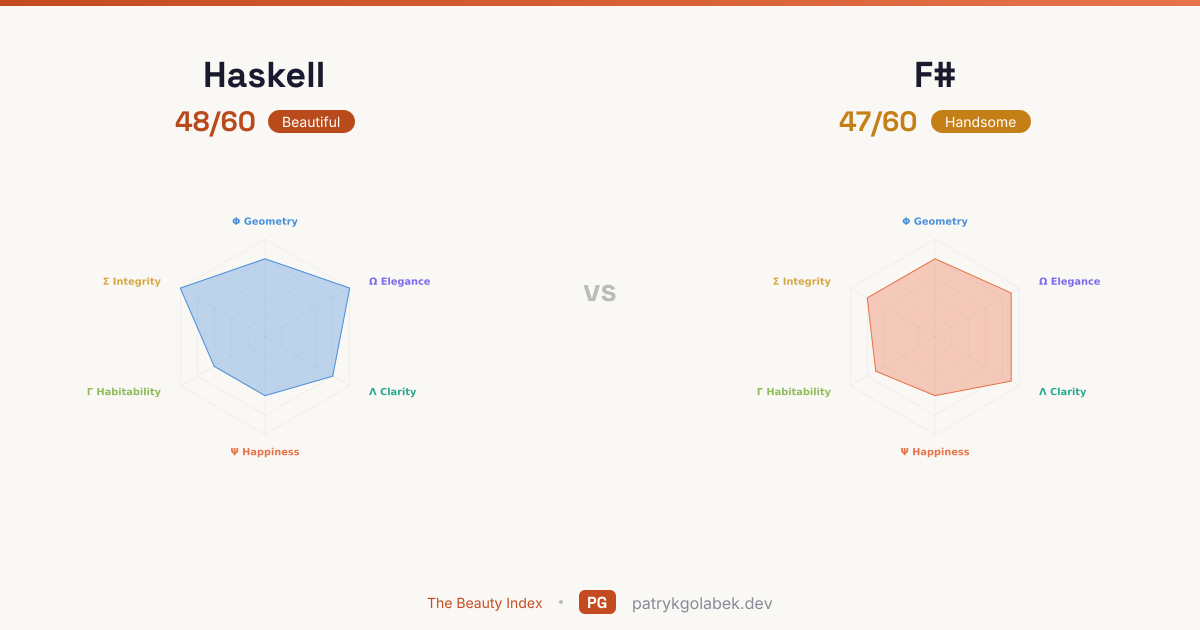
Haskell scores 48/60 against F#'s 47/60, leading in 2 of 6 dimensions. Haskell owns mathematical and design while F# leads in aesthetic and human. The widest gap sits on Conceptual Integrity, where Haskell's 2-point lead over F# shapes most of the pair's character.
See also: Haskell vs PHP , Haskell .
Dimension-by-dimension analysis
Σ Conceptual Integrity
Haskell wins Conceptual Integrity by 2 points — a genuine lead in design coherence. "Avoid success at all costs." Haskell is about something: purity, types, and mathematical foundations. Every feature follows from a coherent worldview. It's the most internally consistent language design on this list. Haskell speaks with a single design voice; F# speaks with a committee. "Functional-first on .NET" is a clear, focused vision that Don Syme has maintained consistently. F# knows what it is and doesn't try to be everything. The design is opinionated in the right ways. For application code the integrity edge means fewer "wait, why does it behave that way?" moments per week.
Γ Organic Habitability
F# edges Haskell by a single point on Organic Habitability; the practical difference is slim but real. Type inference and immutability-by-default produce code that ages reasonably well. The .NET interop story is good. Docked because the ecosystem's size means patterns and libraries are less battle-tested than in larger communities. On extensibility the two are close enough that the decision rarely hinges on this axis alone. Purity is a double-edged sword, you can't "just add a side effect here" without restructuring. Changing one type signature can cascade through an entire module. Haskell code is correct but often brittle to modify, which is the opposite of Gabriel's habitability ideal. The winner here is the language you will still enjoy reading in five years.
Λ Linguistic Clarity
F# edges Haskell by a single point on Linguistic Clarity; the practical difference is slim but real. The pipeline operator, discriminated unions, and lack of ceremony make F# remarkably readable. items |> List.filter isValid |> List.map transform reads as a clear chain of intent. One of the most literate typed languages. Both Haskell and F# communicate their intent without heroic effort; F# is only a little more forgiving. Simple Haskell reads like mathematics rendered in prose. Point-free style and function composition create elegant chains of meaning. Docked from 9 because lens operators (^., .~) and advanced type-level code can be opaque even to intermediate Haskellers. In high-level work, readable code is the difference between a 6-month onboarding and a 6-week one.
Ω Mathematical Elegance
Haskell edges F# by a single point on Mathematical Elegance; the practical difference is slim but real. The gold standard. fibs = 0 : 1 : zipWith (+) fibs (tail fibs) defines infinity by self-reference. Purity, lazy evaluation, and higher-kinded types let algorithms approach Erdős's "Book" proofs. No other language comes close. Both Haskell and F# can express algorithms cleanly; Haskell merely gets there with slightly less ceremony. MetaLanguage-family heritage gives F# deep mathematical roots. Computation expressions, active patterns, and type providers enable algorithm expression that approaches Hardy's "economy" criterion. In application code the elegance edge shows up as less boilerplate per idea.
Φ Aesthetic Geometry
Both score 8 — this is one dimension where Haskell and F# genuinely agree. Clean Haskell is visually striking, where clauses, pattern matching, and type signatures create a structured, proportional layout. Docked from 9 because production Haskell with GADTs and monad transformer stacks can produce dense type-signature walls. Visually they stand in similar territory — any difference here is a matter of taste, not of kind. Significant whitespace, pipeline operators, and concise type definitions give F# a clean, proportional visual feel. Pattern matching arms align naturally. Less visual noise than C# by a wide margin. For application code the geometry translates directly into readability for new contributors.
Ψ Practitioner Happiness
Both score 6 — this is one dimension where Haskell and F# genuinely agree. Moderate Stack Overflow admiration (~57%), well below Rust, Elixir, or Gleam. The learning curve is brutal, Cabal/Stack tooling fragmentation has caused years of pain, and cryptic error messages for type-level code create real frustration. The community is passionate but small. Developers admire Haskell more than they enjoy it day-to-day. Both communities love their language with equal fervour; this is the one dimension where Haskell and F# genuinely agree. A small, devoted community, but limited industry adoption creates friction, fewer libraries, fewer tutorials, fewer jobs. The .NET ecosystem helps, but F# often feels like a second-class citizen behind C#. For high-level work, developer happiness is the main driver of long-term retention.
Code comparison
The characteristic code snippet that best represents each language.
quicksort :: Ord a => [a] -> [a]quicksort [] = []quicksort (x:xs) = quicksort smaller ++ [x] ++ quicksort bigger where smaller = [a | a <- xs, a <= x] bigger = [a | a <- xs, a > x]type Shape = | Circle of radius: float | Rect of width: float * height: float
let area = function | Circle r -> System.Math.PI * r * r | Rect (w, h) -> w * h
let totalArea shapes = shapes |> List.map area |> List.sumEmbedding expressions and variables within string literals.
import Text.Printf (printf)
-- Haskell uses concatenation or printfgreeting :: String -> Int -> Stringgreeting name age =  "Hello, " ++ name ++ "! You are "    ++ show age ++ " years old."
msg :: Stringmsg = printf "Hello, %s! Age: %d" name agelet name = "F#"let version = 8.0
let msg = $"Hello, {name}! Version: {version}"let expr = $"Length: {name.Length}, Upper: {name.ToUpper()}"let formatted = sprintf "%-10s | %5.1f" name versionFor/while iteration patterns and loop constructs.
-- Haskell uses recursion, not loopsfactorial :: Integer -> Integerfactorial 0 = 1factorial n = n * factorial (n - 1)
evens :: [Int] -> [Int]evens xs = [x | x <- xs, even x]for i in 1 .. 10 do printfn "%d" i
for (index, value) in List.indexed items do printfn "%d: %A" index value
let mutable total = 0while total < 100 do total <- total + 10Frequently asked questions
- Which is easier to learn, Haskell or F#?
- Haskell and F# are tied on Practitioner Happiness at 6/10 — both are broadly welcoming to newcomers. Moderate Stack Overflow admiration (~57%), well below Rust, Elixir, or Gleam. The learning curve is brutal, Cabal/Stack tooling fragmentation has caused years of pain, and cryptic error messages for type-level code create real frustration. The community is passionate but small. Developers admire Haskell more than they enjoy it day-to-day. For classroom or self-directed study, the practitioner-happiness winner almost always has better learning materials.
- Is Haskell or F# better for principled design?
- For principled design, Haskell has a clear edge — it scores 10/10 on Conceptual Integrity against F#'s 8/10. "Avoid success at all costs." Haskell is about something: purity, types, and mathematical foundations. Every feature follows from a coherent worldview. It's the most internally consistent language design on this list.
- Should I pick Haskell or F# in 2026?
- Haskell lands in the beautiful tier at 48/60; F# in the handsome tier at 47/60. The gap is narrow enough that team familiarity and ecosystem fit should decide. Pick the one your hires already know. The score difference reflects years of community use, tooling maturity, and the editorial judgment of the Beauty Index rubric.