
Elixir vs Kotlin
Elixir
The jazz musician who studied classical. Elixir takes Erlang's battle-tested concurrency and wraps it in syntax so pleasant you forget you're building distributed systems that never go down.
Kotlin
The diplomat who made peace between Java and good taste. Kotlin looked at decades of JVM pain and said 'what if we just... didn't do that?' and everyone agreed.
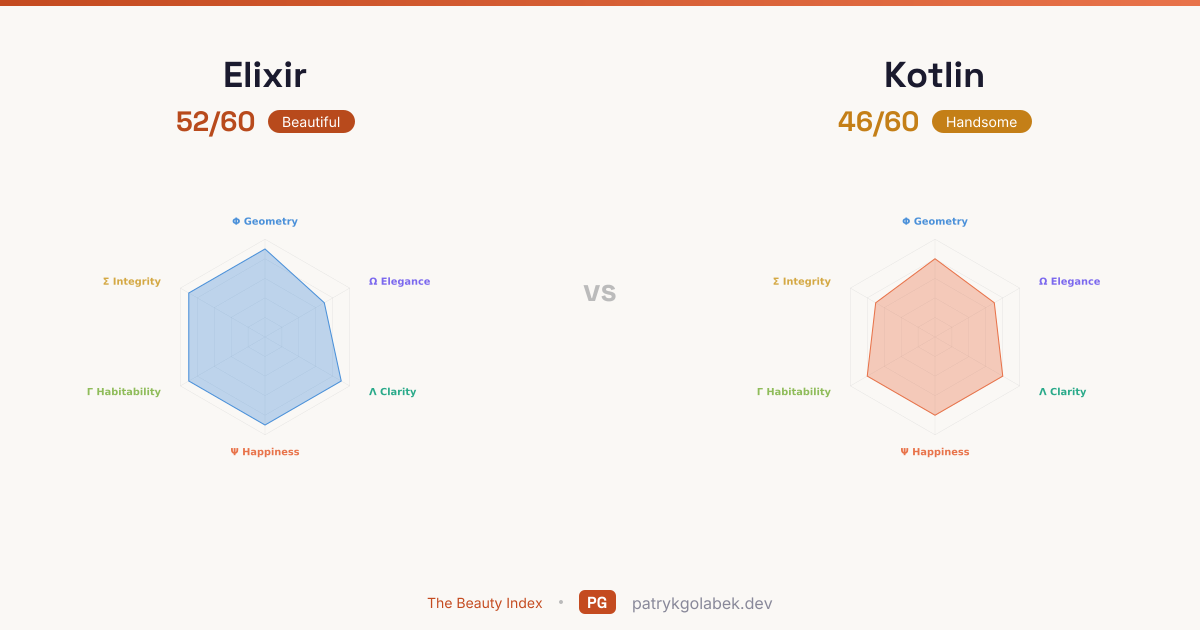
Elixir scores 52/60 against Kotlin's 46/60, leading in 5 of 6 dimensions. Elixir dominates the aesthetic, human, and design axes. The widest gap sits on Conceptual Integrity, where Elixir's 2-point lead over Kotlin shapes most of the pair's character.
See also: Elixir vs PHP , Elixir .
Dimension-by-dimension analysis
Σ Conceptual Integrity
Elixir wins Conceptual Integrity by 2 points — a genuine lead in design coherence. "Erlang's power with modern syntax." José Valim had a clear vision: bring functional programming and fault-tolerant concurrency to a wider audience. The language feels designed by one mind with a singular purpose. The design philosophy of Elixir feels inevitable, each feature a consequence of one idea — Kotlin feels assembled from several good ideas instead of from one great one. "What if Java, but good?" is a clear mission, but it's defined in opposition to something else rather than from first principles. The pragmatic "fix everything" approach is coherent but doesn't have the singular philosophical punch of Rust or Clojure. In high-level work a coherent philosophy is the frame that holds the language's features together.
Γ Organic Habitability
Elixir edges Kotlin by a single point on Organic Habitability; the practical difference is slim but real. Pipelines are growth-point idioms, insert a transformation step anywhere without restructuring. OTP's supervision trees are the embodiment of habitable architecture: systems designed to fail gracefully and be extended incrementally. The habitability edge is slim and often dominated by team culture rather than language choice. Interoperability with Java means Kotlin codebases can grow incrementally. Null-safety, sealed classes, and coroutines provide guardrails that help code age well without over-constraining structure. For application codebases the habitability edge determines whether a project survives its second rewrite.
Λ Linguistic Clarity
Elixir edges Kotlin by a single point on Linguistic Clarity; the practical difference is slim but real. The pipe operator (|>) turns data transformation into a readable narrative. "hello" |> String.split() |> Enum.map(&String.capitalize/1) reads as a clear sequence of intentions. Among the most literate functional languages. Both Elixir and Kotlin communicate their intent without heroic effort; Elixir is only a little more forgiving. Kotlin reads clearly, listOf, when, ?.let { } communicate intent without requiring deep language knowledge. Scope functions (let, run, apply) can slightly obscure control flow when overused, preventing a 9. For application code the clarity advantage is the whole point of the language category.
Φ Aesthetic Geometry
Elixir edges Kotlin by a single point on Aesthetic Geometry; the practical difference is slim but real. Pipeline operators, pattern-matching clauses, and module structure create a visual flow that scans beautifully. Elixir code looks like a series of clean, evenly weighted transformation steps. Elixir edges ahead on visual rhythm, but Kotlin is comfortably readable in its own right. Data classes, named arguments, and concise lambda syntax produce clean, well-proportioned code. The visual improvement over Java is immediately obvious, less ceremony, more signal. In a language where expressiveness is the selling point, visual calm amplifies the advantage.
Ψ Practitioner Happiness
Elixir edges Kotlin by a single point on Practitioner Happiness; the practical difference is slim but real. Stack Overflow admiration at 66%. The Phoenix framework, LiveView, and OTP give practitioners a feeling of building something that "just works." The community is small but deeply enthusiastic and welcoming. On developer happiness the edge is modest — the two communities are both thriving. Strong admiration in the Android community and growing JVM adoption. JetBrains' tooling (IntelliJ integration) is best-in-class. Developers who switch from Java rarely want to go back. In application languages the community culture compounds the language advantage.
Ω Mathematical Elegance
Both score 7 — this is one dimension where Elixir and Kotlin genuinely agree. Pattern matching, recursion, and immutable data structures support elegant algorithm expression. Not as abstract as Haskell or OCaml, but the BEAM VM's concurrency primitives give certain distributed algorithms an inevitable quality. Algorithmically the two meet on equal ground; elegance is not what separates them. Extension functions, sealed classes, and functional collection operations (map, filter, fold) support elegant algorithm expression within a pragmatic framework. Not pushing mathematical frontiers, but consistently economical. For high-level work, the gap compounds: fewer lines per algorithm means fewer bugs per feature.
Code comparison
Exception handling via try/catch or Result/Either patterns.
with {:ok, user} <- fetch_user(id), {:ok, posts} <- fetch_posts(user.id), {:ok, _} <- validate(posts) do {:ok, format_response(user, posts)}else {:error, :not_found} -> {:error, "User not found"} {:error, reason} -> {:error, reason}endfun parseNumber(s: String): Result<Int> = runCatching { s.toInt() }
val result = parseNumber("42") .map { it * 2 } .getOrElse { -1 }
val value = try { riskyOperation()} catch (e: IOException) { fallbackValue}Basic variable syntax, type annotations, and initialization patterns.
name = "Elixir"age = 12{status, message} = {:ok, "Connected"}
[head | tail] = [1, 2, 3, 4]%{name: lang} = %{name: "Elixir", year: 2011}val name = "Kotlin"var count: Int = 0val languages = listOf("Kotlin", "Java", "Scala")
count += 1
val (x, y) = Pair(10, 20)val nullable: String? = nullFor/while iteration patterns and loop constructs.
Frequently asked questions
- Which is easier to learn, Elixir or Kotlin?
- Elixir scores 9 on Practitioner Happiness versus Kotlin's 8. Stack Overflow admiration at 66%. The Phoenix framework, LiveView, and OTP give practitioners a feeling of building something that "just works." The community is small but deeply enthusiastic and welcoming. For classroom or self-directed study, the practitioner-happiness winner almost always has better learning materials and kinder error messages.
- Is Elixir or Kotlin better for principled design?
- For principled design, Elixir has a clear edge — it scores 9/10 on Conceptual Integrity against Kotlin's 7/10. "Erlang's power with modern syntax." José Valim had a clear vision: bring functional programming and fault-tolerant concurrency to a wider audience. The language feels designed by one mind with a singular purpose.
- Should I pick Elixir or Kotlin in 2026?
- Elixir lands in the beautiful tier at 52/60; Kotlin in the handsome tier at 46/60. The score gap is real; the higher-scoring language has a measurable edge. Go the other way only if a concrete ecosystem need pulls you there.