
Elixir vs PHP
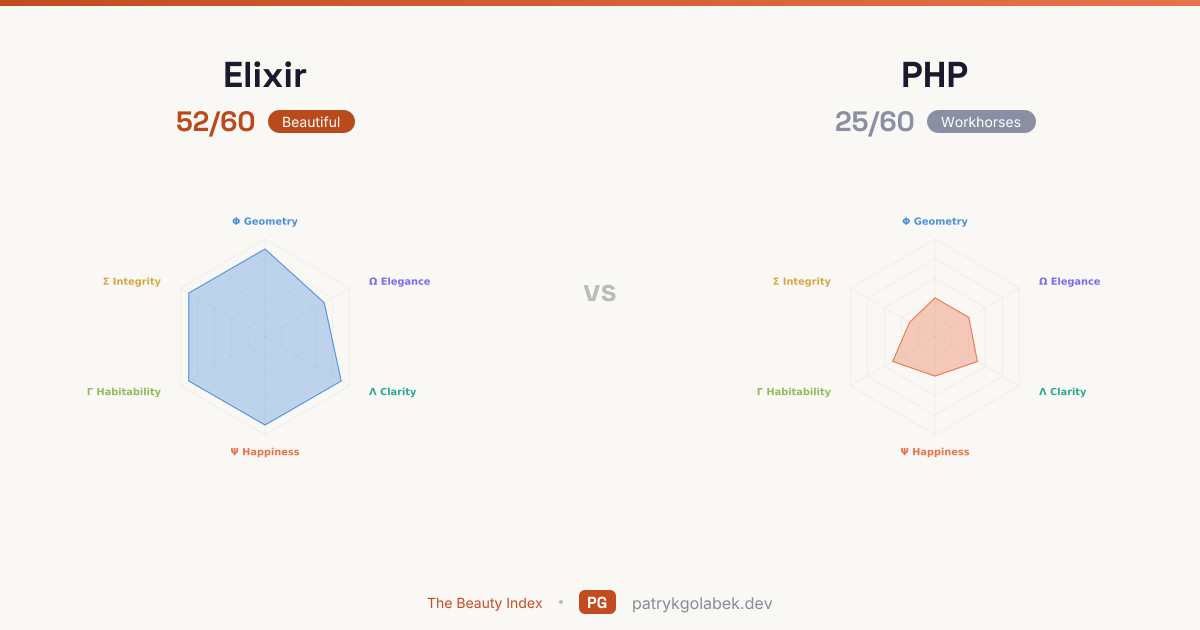
Elixir
The jazz musician who studied classical. Elixir takes Erlang's battle-tested concurrency and wraps it in syntax so pleasant you forget you're building distributed systems that never go down.
PHP
The duct tape that holds 40% of the web together while everyone pretends it doesn't exist. PHP is the cockroach of programming: ugly, everywhere, and absolutely unkillable.
Elixir scores 52/60 against PHP's 25/60, leading in 6 of 6 dimensions. Elixir dominates the aesthetic, mathematical, human, and design axes. The widest gap sits on Conceptual Integrity, where Elixir's 6-point lead over PHP shapes most of the pair's character.
See also: Elixir vs Python , Elixir .
Dimension-by-dimension analysis
Σ Conceptual Integrity
Elixir wins Conceptual Integrity by 6 points — a clear integrity advantage. "Erlang's power with modern syntax." José Valim had a clear vision: bring functional programming and fault-tolerant concurrency to a wider audience. The language feels designed by one mind with a singular purpose. The design philosophy of Elixir feels inevitable, each feature a consequence of one idea — PHP feels assembled from several good ideas instead of from one great one. PHP was not designed; it was accumulated. Rasmus Lerdorf's personal homepage tools grew into a language without a coherent philosophy. Each version has improved quality, but there is no "soul", no single idea that all features follow from. The quintessential committee language. In high-level work a coherent philosophy is the frame that holds the language's features together.
Φ Aesthetic Geometry
Elixir wins Aesthetic Geometry by 5 points — a clear geometric edge. Pipeline operators, pattern-matching clauses, and module structure create a visual flow that scans beautifully. Elixir code looks like a series of clean, evenly weighted transformation steps. PHP, by contrast, accepts visual density in exchange for other priorities. $ on every variable, -> for method calls, inconsistent brace styles across frameworks, and <?php tags create visual clutter. Modern PHP (8.x) with named arguments and match expressions is cleaner, but the legacy visual debt remains. For application code the geometry translates directly into readability for new contributors.
Ψ Practitioner Happiness
Elixir wins Practitioner Happiness by 5 points — a decisive cultural edge. Stack Overflow admiration at 66%. The Phoenix framework, LiveView, and OTP give practitioners a feeling of building something that "just works." The community is small but deeply enthusiastic and welcoming. Where Elixir feels designed for the human, PHP feels designed for the machine first — the human catches up second. PHP developers themselves joke about PHP. The community is large and productive, but "most admired" it is not. Modern PHP (8.x with Laravel) has improved the experience significantly, but the reputation, and the daily reality of legacy code, weighs on happiness. The winner here invites the next generation of contributors without asking them to earn it first.
Γ Organic Habitability
Elixir wins Organic Habitability by 4 points — an unmistakable lead in how well code ages. Pipelines are growth-point idioms, insert a transformation step anywhere without restructuring. OTP's supervision trees are the embodiment of habitable architecture: systems designed to fail gracefully and be extended incrementally. Where Elixir accommodates change gracefully, PHP makes you earn each new direction. PHP codebases survive, 77% of the web runs on PHP, and that code keeps working. The language is pragmatically habitable. But the inconsistent standard library and multiple paradigm shifts (procedural → OOP → modern PHP) make long-term evolution uneven. In high-level work, the language that welcomes modification wins the decade, not the quarter.
Λ Linguistic Clarity
Elixir wins Linguistic Clarity by 4 points — a clear signal-to-noise edge. The pipe operator (|>) turns data transformation into a readable narrative. "hello" |> String.split() |> Enum.map(&String.capitalize/1) reads as a clear sequence of intentions. Among the most literate functional languages. Elixir reads like a well-edited paragraph; PHP reads like a sentence that is still being translated. PHP can be readable in modern frameworks (Laravel's fluent syntax reads well). But str_replace vs. strpos vs. substr, inconsistent parameter ordering, and the legacy API are the antithesis of linguistic clarity. Two PHPs coexist: modern and legacy. For application code the clarity advantage is the whole point of the language category.
Ω Mathematical Elegance
Elixir wins Mathematical Elegance by 3 points — a genuine expressive lead. Pattern matching, recursion, and immutable data structures support elegant algorithm expression. Not as abstract as Haskell or OCaml, but the BEAM VM's concurrency primitives give certain distributed algorithms an inevitable quality. Elixir lets algorithms approach mathematical statement, while PHP asks more of the programmer when elegance is the goal. PHP is a templating language that grew into a general-purpose one. Array functions exist but lack the composability of functional languages. Mathematical elegance is not the design space PHP occupies. The winner lets the author think in algorithms rather than in ceremony.
Code comparison
Exception handling via try/catch or Result/Either patterns.
with {:ok, user} <- fetch_user(id), {:ok, posts} <- fetch_posts(user.id), {:ok, _} <- validate(posts) do {:ok, format_response(user, posts)}else {:error, :not_found} -> {:error, "User not found"} {:error, reason} -> {:error, reason}endfunction parseNumber(string $s): int { if (!is_numeric($s)) { throw new InvalidArgumentException("Invalid: $s"); } return (int) $s;}
try { $result = parseNumber('42');} catch (InvalidArgumentException $e) { echo "Error: " . $e->getMessage();} finally { cleanup();}Basic variable syntax, type annotations, and initialization patterns.
The characteristic code snippet that best represents each language.
def process_order(%Order{items: items, user: user}) do items |> Enum.filter(&(&1.in_stock)) |> Enum.map(&apply_discount(&1, user.tier)) |> Enum.reduce(0, &(&1.price + &2)) |> apply_tax(user.region) |> format_total()end$results = array_map( fn($user) => [ 'name' => $user['name'], 'email' => strtolower($user['email']), 'score' => array_sum($user['grades']) / count($user['grades']), ], array_filter( $users, fn($u) => $u['active'] && count($u['grades']) > 0 ));Frequently asked questions
- Which is easier to learn, Elixir or PHP?
- Elixir scores 9 on Practitioner Happiness versus PHP's 4. Stack Overflow admiration at 66%. The Phoenix framework, LiveView, and OTP give practitioners a feeling of building something that "just works." The community is small but deeply enthusiastic and welcoming. For a newcomer picking up their first serious language in 2026, the happiness-score winner is the more forgiving starting point.
- Is Elixir or PHP better for principled design?
- For principled design, Elixir has a clear edge — it scores 9/10 on Conceptual Integrity against PHP's 3/10. "Erlang's power with modern syntax." José Valim had a clear vision: bring functional programming and fault-tolerant concurrency to a wider audience. The language feels designed by one mind with a singular purpose.
- Should I pick Elixir or PHP in 2026?
- Elixir lands in the beautiful tier at 52/60; PHP in the workhorses tier at 25/60. With this much daylight between them, the higher scorer is the default and the lower scorer needs a business case. The score difference reflects years of community use, tooling maturity, and the editorial judgment of the Beauty Index rubric.