
Dart vs TypeScript
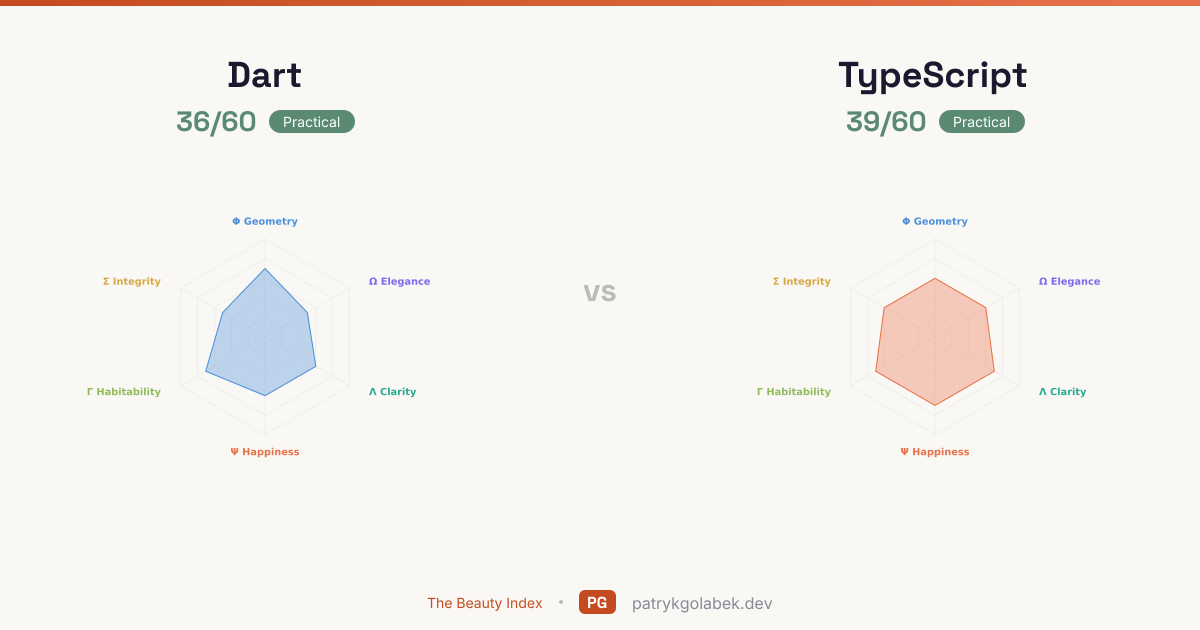
Dart
The second-chance kid who found their calling in Flutter. Dart was nearly forgotten until mobile development gave it a purpose, and now it's living its best life painting pixels.
TypeScript
The responsible older sibling who cleans up JavaScript's messes. TypeScript proves that the best way to fix a language is to build a better one on top and pretend the old one doesn't exist.
TypeScript scores 39/60 against Dart's 36/60, leading in 4 of 6 dimensions. TypeScript dominates the mathematical, human, and design axes. The widest gap sits on Linguistic Clarity, where TypeScript's 1-point lead over Dart shapes most of the pair's character.
See also: Dart vs Elixir , Dart .
Dimension-by-dimension analysis
Λ Linguistic Clarity
TypeScript edges Dart by a single point on Linguistic Clarity; the practical difference is slim but real. TypeScript improves on JavaScript's readability significantly, type annotations as documentation, discriminated unions for intent, and strong IDE support make code self-explanatory. A clear upgrade in linguistic clarity. On readability the edge is slim and disappears quickly as idioms are learned. Readable and predictable. Named parameters, cascade notation (..), and clear class syntax make intent visible. Not particularly literary, but consistently clear. The winner here treats readability as a core feature rather than a style preference.
Ω Mathematical Elegance
TypeScript edges Dart by a single point on Mathematical Elegance; the practical difference is slim but real. Conditional types, mapped types, and template literal types are genuinely innovative, the type system is more expressive than most mainstream languages. But the underlying JS runtime prevents the mathematical "economy" that Omega measures. TypeScript nudges ahead, but Dart is capable of the same expressive heights in the hands of a confident user. Dart is a pragmatic language without strong mathematical abstractions. It does what it needs to for UI programming. Generics and async/await are useful but not mathematically elegant. The winner lets the author think in algorithms rather than in ceremony.
Φ Aesthetic Geometry
Dart edges TypeScript by a single point on Aesthetic Geometry; the practical difference is slim but real. Dart's syntax is clean and visually familiar to Java/JavaScript developers. Flutter's widget tree syntax, with its trailing commas and nested constructors, has a structured, tree-like visual geometry. Both Dart and TypeScript care about how code looks — they simply draw the line in slightly different places. Inherits JavaScript's visual structure, which is functional but unremarkable. Generic type annotations and complex union types can create visual density. Not ugly, but not architecturally striking. Designers of high-level code feel this difference the moment they open an unfamiliar module.
Ψ Practitioner Happiness
TypeScript edges Dart by a single point on Practitioner Happiness; the practical difference is slim but real. Consistently scores ~73% admired in Stack Overflow surveys. The VS Code integration is best-in-class, and catching bugs at compile time is genuinely satisfying. Developers actively choose TypeScript over JavaScript. Both Dart and TypeScript are broadly loved; TypeScript is loved a little harder, a little more loudly. Flutter developers generally enjoy the experience. Hot reload is a genuine joy. The language itself is pleasant enough, but Dart's identity is inseparable from Flutter, outside that context, enthusiasm drops significantly. The winner here invites the next generation of contributors without asking them to earn it first.
Σ Conceptual Integrity
TypeScript edges Dart by a single point on Conceptual Integrity; the practical difference is slim but real. TypeScript has evolved beyond "typed JavaScript" into its own identity. The type system is a language-within-a-language with a coherent mission: add sound typing to JS without breaking compatibility. Still inherits some of JavaScript's conceptual chaos, but the mission itself is clear and focused. On conceptual unity the two are close enough that the decision turns on other factors. Dart's identity crisis, initially a web language, then reborn as a Flutter companion, weakens its conceptual integrity. It's a good language in service of a framework, not a language with its own philosophical center. In high-level work a coherent philosophy is the frame that holds the language's features together.
Γ Organic Habitability
Both score 7 — this is one dimension where Dart and TypeScript genuinely agree. Dart codebases grow well within the Flutter paradigm. The widget composition model encourages incremental, modular extension. Sound null safety (added retroactively) improved long-term maintainability. For long-lived codebases the two languages sit on roughly equal ground. Gradual typing means you can introduce TypeScript incrementally. Codebases grow naturally from loose to strict. The any escape hatch is ugly but pragmatically habitable, you can always tighten later. In high-level work, the language that welcomes modification wins the decade, not the quarter.
Code comparison
Native pattern matching constructs for destructuring and control flow.
String describe(Object obj) => switch (obj) { int n when n > 0 => 'positive: $n', String s => 'string: $s', (int x, int y) => 'point: $x, $y', _ => 'unknown',};type Shape = | { kind: "circle"; radius: number } | { kind: "rect"; w: number; h: number };
function area(shape: Shape): number { switch (shape.kind) { case "circle": return Math.PI * shape.radius ** 2; case "rect": return shape.w * shape.h; }}The characteristic code snippet that best represents each language.
final paint = Paint()  ..color = Colors.blue  ..strokeWidth = 4.0  ..style = PaintingStyle.stroke;
final path = Path()  ..moveTo(0, 0)  ..lineTo(100, 0)  ..lineTo(100, 100)  ..close();
canvas.drawPath(path, paint);type Result<T, E = Error> = | { ok: true; value: T } | { ok: false; error: E };
function parse(input: string): Result<number> { const n = Number(input); return isNaN(n) ? { ok: false, error: new Error(`Invalid: ${input}`) } : { ok: true, value: n };}Exception handling via try/catch or Result/Either patterns.
int parseNumber(String s) {  try {    return int.parse(s);  } on FormatException catch (e) {    throw ArgumentError('Invalid: $s');  }}
try { final result = parseNumber('42'); print(result);} catch (e) { print('Error: $e');}type Result<T> = { ok: true; value: T } | { ok: false; error: Error };
function safeParse(s: string): Result<number> { const n = Number(s); return isNaN(n) ? { ok: false, error: new Error(`Invalid: ${s}`) } : { ok: true, value: n };}
const result = safeParse("42");if (result.ok) console.log(result.value);Frequently asked questions
- Which is easier to learn, Dart or TypeScript?
- TypeScript scores 7 on Practitioner Happiness versus Dart's 6. Consistently scores ~73% admired in Stack Overflow surveys. The VS Code integration is best-in-class, and catching bugs at compile time is genuinely satisfying. Developers actively choose TypeScript over JavaScript. For classroom or self-directed study, the practitioner-happiness winner almost always has better learning materials and kinder error messages.
- Is Dart or TypeScript better for readable code?
- For readable code, TypeScript has a clear edge — it scores 7/10 on Linguistic Clarity against Dart's 6/10. TypeScript improves on JavaScript's readability significantly, type annotations as documentation, discriminated unions for intent, and strong IDE support make code self-explanatory. A clear upgrade in linguistic clarity.
- Should I pick Dart or TypeScript in 2026?
- Dart lands in the practical tier at 36/60; TypeScript in the practical tier at 39/60. At this score gap the choice turns on context. Evaluate the two against the specific project rather than in the abstract. The score difference reflects years of community use, tooling maturity, and the editorial judgment of the Beauty Index rubric.