
C# vs Clojure
C#
The corporate executive who secretly writes poetry. C# started as a Java clone in a suit, then quietly evolved into one of the most feature-complete languages ever designed.
Clojure
The Zen master who sees through your abstractions. Clojure distills programming to data, functions, and immutability, then watches smugly as your mutable-state codebase catches fire.
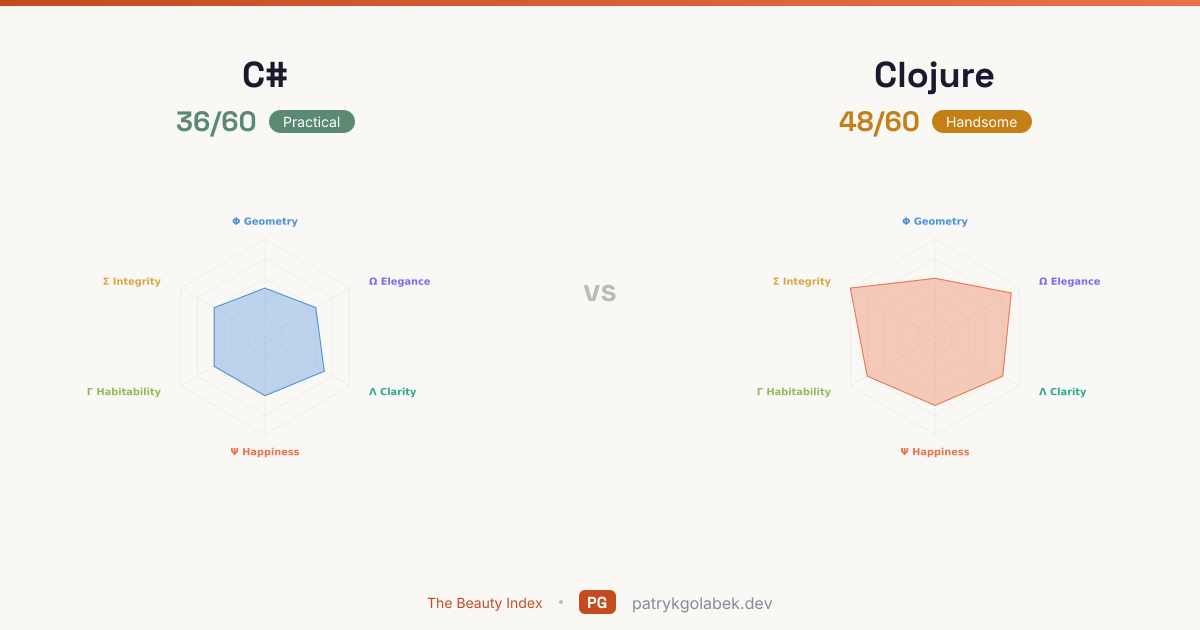
Clojure scores 48/60 against C#'s 36/60, leading in 6 of 6 dimensions. Clojure dominates the aesthetic, mathematical, human, and design axes. Read the comparison through Conceptual Integrity first: Clojure wins that axis by 4 points over C#, and it is the single best lens on the pair.
See also: C# vs Dart , C# .
Dimension-by-dimension analysis
Σ Conceptual Integrity
Clojure wins Conceptual Integrity by 4 points — a clear integrity advantage. "Code is data. Data is code. Everything is immutable." Clojure is distilled philosophy, every design choice follows from a handful of axioms. Rich Hickey's talks are effectively the language's specification, and the language is the talks made concrete. Where Clojure holds a line, C# has negotiated with history, ecosystems, and legacy users. Anders Hejlsberg has maintained a clearer vision than most credit, async/await, LINQ, and pattern matching feel designed rather than patched on. But the steady feature accumulation over 25 years does dilute the singular "language soul." C# is coherent, not focused. For application code the integrity edge means fewer "wait, why does it behave that way?" moments per week.
Ω Mathematical Elegance
Clojure wins Mathematical Elegance by 3 points — a genuine expressive lead. Homoiconicity (code is data) enables metaprogramming that feels mathematical. Persistent data structures, lazy sequences, and transducers let you express algorithms with remarkable economy. Among the most "Book", like in practice. The gap on Elegance is real: Clojure rewards precise thought, C# rewards precise bookkeeping. LINQ is genuinely elegant, embedding query algebra into the type system is a real achievement. Pattern matching in C# 11+ is increasingly expressive. But the OOP substrate limits how close algorithms can get to mathematical notation. The winner lets the author think in algorithms rather than in ceremony.
Γ Organic Habitability
Clojure wins Organic Habitability by 2 points — an unmistakable lead in how well code ages. Immutable data and pure functions produce code that is inherently easy to extend and modify, no hidden state to trip over. Rich Hickey's "simple made easy" philosophy is the definition of habitable design. The habitability gap shows in long-lived codebases — Clojure ages, C# calcifies without careful discipline. C#'s backward compatibility and incremental feature additions mean codebases can adopt new patterns gradually. The ecosystem is mature and battle-tested. Docked because the language's breadth (OOP + FP + async + LINQ + dynamic) means codebases vary widely in style. The winner here is the language you will still enjoy reading in five years.
Λ Linguistic Clarity
Clojure edges C# by a single point on Linguistic Clarity; the practical difference is slim but real. Threading macros (->, ->>) transform nested Lisp into readable pipelines. The data-oriented philosophy, plain maps and vectors over custom types, makes intent transparent. Prefix notation is a barrier for newcomers, but the idioms are clear once learned. The difference is real but modest — pick either and a team will read fluently within weeks. Modern C# reads well, async/await patterns are clear, LINQ chains communicate intent, and named arguments help. The language has steadily improved its Knuthian "wit" with each version. For application code the clarity advantage is the whole point of the language category.
Φ Aesthetic Geometry
Clojure edges C# by a single point on Aesthetic Geometry; the practical difference is slim but real. Clojure's parentheses-heavy syntax is unconventional, but it's regular and tree-like. The uniform (verb noun noun) structure has its own geometric coherence once you internalize the visual grammar. Not chaotic, just non-traditional. Both C# and Clojure care about how code looks — they simply draw the line in slightly different places. C# has reduced ceremony significantly with top-level statements, records, and file-scoped namespaces. But the language's Java-era heritage still shows in verbose patterns, property accessors, attribute decorations, and using blocks add visual weight. Improving, but not yet clean. In a language where expressiveness is the selling point, visual calm amplifies the advantage.
Ψ Practitioner Happiness
Clojure edges C# by a single point on Practitioner Happiness; the practical difference is slim but real. A devoted, intellectually engaged community. The REPL-driven workflow induces genuine flow states. The ecosystem is mature (for its size). Docked because the community is small and Lisp-family syntax creates a real adoption barrier. Clojure noses ahead in surveys, but C# retains a devoted following of its own. Modern .NET is a pleasure to use, excellent tooling (Rider, VS Code, hot reload), rapid language evolution, and an engaged community. Stack Overflow admiration is solid and improving. The "corporate Java clone" reputation is outdated but sticky, and the developer experience has genuinely earned a higher mark than the old perception suggests. For high-level work, developer happiness is the main driver of long-term retention.
Code comparison
For/while iteration patterns and loop constructs.
The characteristic code snippet that best represents each language.
var summary = from order in orders where order.Date.Year == 2024 group order by order.Category into g orderby g.Sum(o => o.Total) descending select new { Category = g.Key, Revenue = g.Sum(o => o.Total), Count = g.Count() };(defn process-users [users] (->> users (filter :active) (map :email) (map clojure.string/lower-case) (sort) (dedupe) (into [])))Native pattern matching constructs for destructuring and control flow.
string Describe(object obj) => obj switch{ int n when n > 0 => $"positive: {n}", string s => $"string: {s}", (int x, int y) => $"point: {x},{y}", null => "null", _ => "unknown"};(require '[clojure.core.match :refer [match]])
(match [x y] [_ 0] "y is zero" [0 _] "x is zero" [a b] (str "both non-zero: " a ", " b))
(let [{:keys [name age]} person] (str name " is " age))Frequently asked questions
- Which is easier to learn, C# or Clojure?
- Clojure scores 7 on Practitioner Happiness versus C#'s 6. A devoted, intellectually engaged community. The REPL-driven workflow induces genuine flow states. The ecosystem is mature (for its size). Docked because the community is small and Lisp-family syntax creates a real adoption barrier. For a newcomer picking up their first serious language in 2026, the happiness-score winner is the more forgiving starting point.
- Is C# or Clojure better for principled design?
- For principled design, Clojure has a clear edge — it scores 10/10 on Conceptual Integrity against C#'s 6/10. "Code is data. Data is code. Everything is immutable." Clojure is distilled philosophy, every design choice follows from a handful of axioms. Rich Hickey's talks are effectively the language's specification, and the language is the talks made concrete.
- Should I pick C# or Clojure in 2026?
- C# lands in the practical tier at 36/60; Clojure in the handsome tier at 48/60. With this much daylight between them, the higher scorer is the default and the lower scorer needs a business case. The score difference reflects years of community use, tooling maturity, and the editorial judgment of the Beauty Index rubric.