
C++ vs C#
C++
The gothic cathedral — ornate, imposing, awe-inspiring, occasionally terrifying. Fifty years of features layered onto a C foundation. Template metaprogramming is many things, but visually clean isn't one of them.
C#
The corporate executive who secretly writes poetry. C# started as a Java clone in a suit, then quietly evolved into one of the most feature-complete languages ever designed.
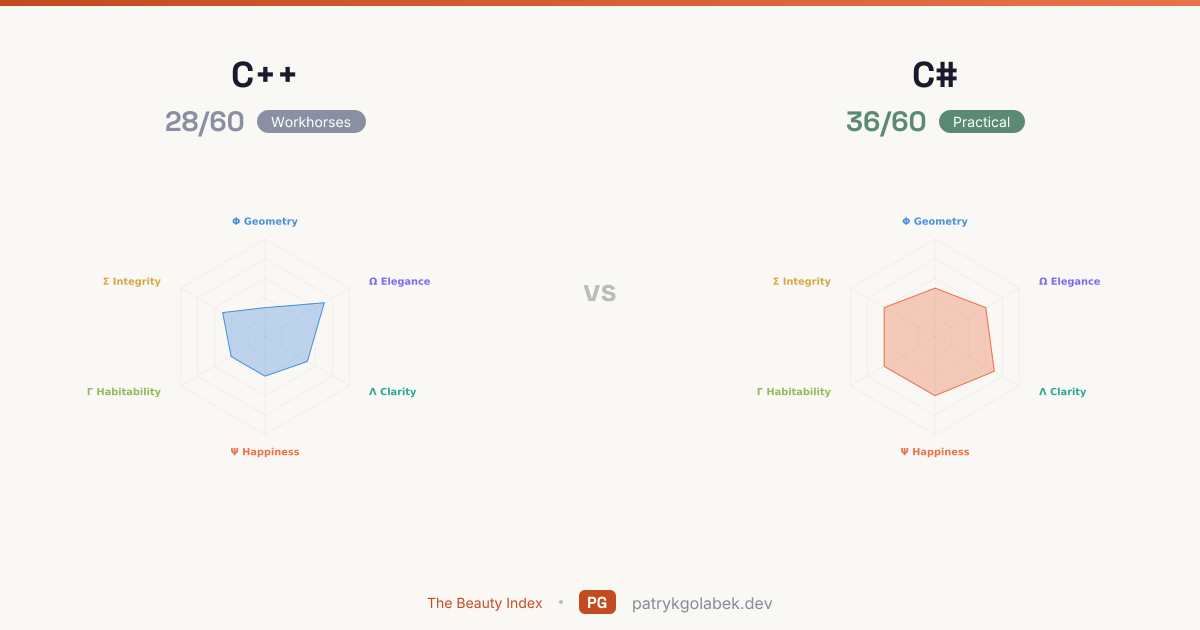
C# scores 36/60 against C++'s 28/60, leading in 5 of 6 dimensions. C# dominates the aesthetic, human, and design axes. The widest gap sits on Organic Habitability, where C#'s 2-point lead over C++ shapes most of the pair's character.
See also: C++ vs Elixir , C++ .
Dimension-by-dimension analysis
Γ Organic Habitability
C# wins Organic Habitability by 2 points — a meaningful extensibility gap. C#'s backward compatibility and incremental feature additions mean codebases can adopt new patterns gradually. The ecosystem is mature and battle-tested. Docked because the language's breadth (OOP + FP + async + LINQ + dynamic) means codebases vary widely in style. C# invites modification; C++ rewards planning more than adjustment. Adding a feature to a C++ codebase can require understanding templates, RAII, move semantics, and exception safety simultaneously. The language's complexity makes modification risky. Codebases tend to become more brittle over time as layers of C++ eras accumulate. For application codebases the habitability edge determines whether a project survives its second rewrite.
Λ Linguistic Clarity
C# wins Linguistic Clarity by 2 points — a meaningful clarity gap. Modern C# reads well, async/await patterns are clear, LINQ chains communicate intent, and named arguments help. The language has steadily improved its Knuthian "wit" with each version. The clarity gap is felt on first contact — C# invites, C++ introduces friction before trust is earned. Modern C++ is more readable than legacy C++, but the language's accumulated complexity means any line might require knowing 10 different features. Range-based for loops and structured bindings help, but the cognitive load of "which C++ era is this?" persists. For application code the clarity advantage is the whole point of the language category.
Φ Aesthetic Geometry
C# wins Aesthetic Geometry by 2 points — a decisive visual advantage. C# has reduced ceremony significantly with top-level statements, records, and file-scoped namespaces. But the language's Java-era heritage still shows in verbose patterns, property accessors, attribute decorations, and using blocks add visual weight. Improving, but not yet clean. The visual gap between the two is not subtle — where C# prizes geometric calm, C++ trades that serenity for other commitments. Template metaprogramming, #include chains, and nested angle brackets (std::vector<std::pair<int, std::string>>) create some of the most visually dense code in any language. Modern C++ is cleaner, but the language's visual floor is very low. In a language where expressiveness is the selling point, visual calm amplifies the advantage.
Ψ Practitioner Happiness
C# wins Practitioner Happiness by 2 points — a real happiness advantage. Modern .NET is a pleasure to use, excellent tooling (Rider, VS Code, hot reload), rapid language evolution, and an engaged community. Stack Overflow admiration is solid and improving. The "corporate Java clone" reputation is outdated but sticky, and the developer experience has genuinely earned a higher mark than the old perception suggests. Where C# feels designed for the human, C++ feels designed for the machine first — the human catches up second. Respected for power, rarely enjoyed for developer experience. Build systems, header management, cryptic template error messages, and undefined behavior create constant friction. Developers use C++ because nothing else does what it does, not because they prefer it. In application languages the community culture compounds the language advantage.
Ω Mathematical Elegance
C++ edges C# by a single point on Mathematical Elegance; the practical difference is slim but real. C++ is Turing-complete at compile time. Template metaprogramming and concepts (C++20) enable powerful abstractions. The mathematical capability is real, but std::transform(v.begin(), v.end(), v.begin(), [](int x){ return x*x; }) vs. Haskell's map (^2) v tells the story, the machinery is always visible. Both C++ and C# can express algorithms cleanly; C++ merely gets there with slightly less ceremony. LINQ is genuinely elegant, embedding query algebra into the type system is a real achievement. Pattern matching in C# 11+ is increasingly expressive. But the OOP substrate limits how close algorithms can get to mathematical notation. At the systems level elegance is rare and valuable — the winner earns it under real constraints.
Σ Conceptual Integrity
C# edges C++ by a single point on Conceptual Integrity; the practical difference is slim but real. Anders Hejlsberg has maintained a clearer vision than most credit, async/await, LINQ, and pattern matching feel designed rather than patched on. But the steady feature accumulation over 25 years does dilute the singular "language soul." C# is coherent, not focused. The integrity gap is narrow and more visible in edge cases than in everyday code. "C with classes" was a clear idea, but 40+ years of committee additions have layered paradigms without full integration. C++11/14 brought more coherence (RAII, value semantics, move), but the language remains a cathedral built by many architects across many centuries. The winner's philosophical discipline is what keeps its idioms stable as the language evolves.
Code comparison
The characteristic code snippet that best represents each language.
class ResourcePool { std::vector<std::unique_ptr<Connection>> pool_;public: auto acquire() { if (pool_.empty()) pool_.push_back(std::make_unique<Connection>()); auto conn = std::move(pool_.back()); pool_.pop_back(); return std::shared_ptr<Connection>( conn.release(), [this](Connection* c) { pool_.emplace_back(c); } ); }};var summary = from order in orders where order.Date.Year == 2024 group order by order.Category into g orderby g.Sum(o => o.Total) descending select new { Category = g.Key, Revenue = g.Sum(o => o.Total), Count = g.Count() };Map, filter, reduce and functional collection transformations.
auto numbers = std::views::iota(1, 11) | std::ranges::to<std::vector>();
auto doubled = numbers | std::views::transform([](int n) { return n * 2; });auto evens = numbers | std::views::filter([](int n) { return n % 2 == 0; });auto total = std::accumulate(numbers.begin(), numbers.end(), 0);var numbers = Enumerable.Range(1, 10).ToList();
var doubled = numbers.Select(n => n * 2);var evens = numbers.Where(n => n % 2 == 0);var total = numbers.Sum();
var result = numbers .Where(n => n % 2 == 0) .Select(n => n * n) .Sum();Data structure definition using classes, structs, records, or equivalent.
struct User {    std::string name;    std::string email;    int age;
    User(std::string n, std::string e, int a)        : name(std::move(n)), email(std::move(e)), age(a) {}
std::string greeting() const { return std::format("Hello, {}!", name); }};public record User( string Name, string Email, int Age = 0) { public string Greeting() => $"Hello, {Name}!";}
var user = new User("Alice", "alice@ex.com", 30);var updated = user with { Age = 31 };Frequently asked questions
- Which is easier to learn, C++ or C#?
- C# scores 6 on Practitioner Happiness versus C++'s 4. Modern .NET is a pleasure to use, excellent tooling (Rider, VS Code, hot reload), rapid language evolution, and an engaged community. Stack Overflow admiration is solid and improving. The "corporate Java clone" reputation is outdated but sticky, and the developer experience has genuinely earned a higher mark than the old perception suggests. For a developer adding a new language to their toolbelt, the happier one is the one you will still.
- Is C++ or C# better for long-lived codebases?
- For long-lived codebases, C# has a clear edge — it scores 6/10 on Organic Habitability against C++'s 4/10. C#'s backward compatibility and incremental feature additions mean codebases can adopt new patterns gradually. The ecosystem is mature and battle-tested. Docked because the language's breadth (OOP + FP + async + LINQ + dynamic) means codebases vary widely in style.
- Should I pick C++ or C# in 2026?
- C++ lands in the workhorses tier at 28/60; C# in the practical tier at 36/60. The score gap is real; the higher-scoring language has a measurable edge. Go the other way only if a concrete ecosystem need pulls you there.