
C vs Kotlin
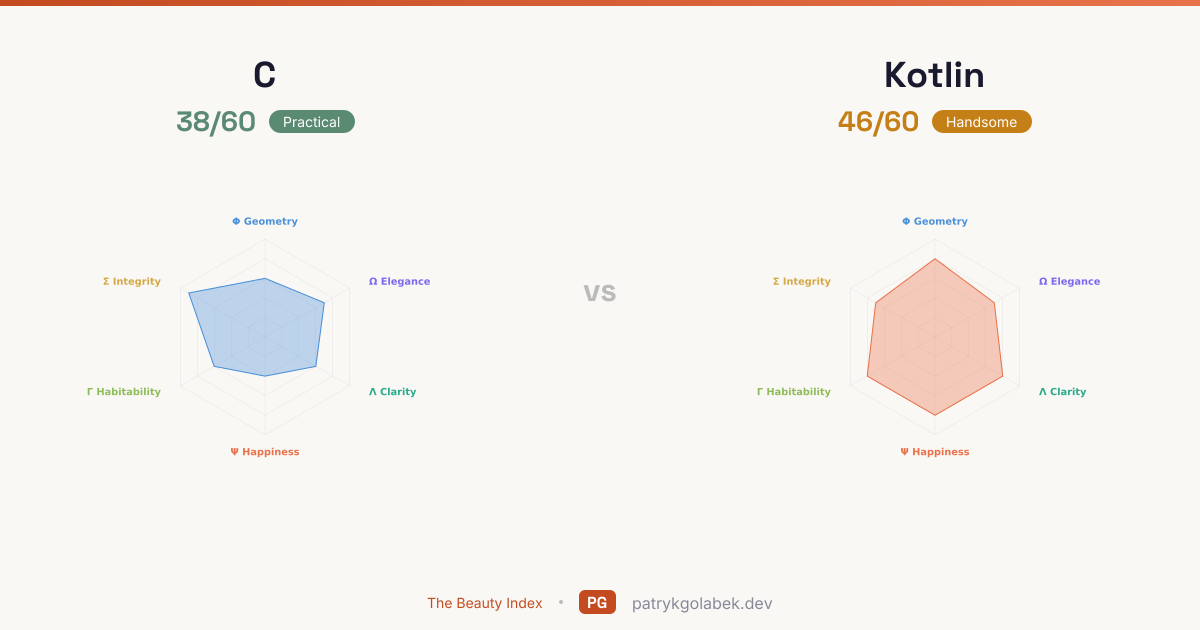
C
The grizzled veteran who built the foundations everyone else stands on. C gives you a knife, a piece of rope, and unlimited trust — the scars are your problem.
Kotlin
The diplomat who made peace between Java and good taste. Kotlin looked at decades of JVM pain and said 'what if we just... didn't do that?' and everyone agreed.
Kotlin scores 46/60 against C's 38/60, leading in 4 of 6 dimensions. C owns design while Kotlin leads in aesthetic and human. The widest gap sits on Practitioner Happiness, where Kotlin's 4-point lead over C shapes most of the pair's character.
See also: PHP vs Kotlin , C .
Dimension-by-dimension analysis
Ψ Practitioner Happiness
Kotlin wins Practitioner Happiness by 4 points — an unmistakable experiential gap. Strong admiration in the Android community and growing JVM adoption. JetBrains' tooling (IntelliJ integration) is best-in-class. Developers who switch from Java rarely want to go back. The practitioner experience on Kotlin is simply more fun, day in and day out, than on C. Respected but not loved. Debugging segfaults, managing memory manually, and undefined behavior create constant friction. The tooling ecosystem is mature but the developer experience is unforgiving. The winner here invites the next generation of contributors without asking them to earn it first.
Γ Organic Habitability
Kotlin wins Organic Habitability by 2 points — a real habitability advantage. Interoperability with Java means Kotlin codebases can grow incrementally. Null-safety, sealed classes, and coroutines provide guardrails that help code age well without over-constraining structure. Kotlin invites modification; C rewards planning more than adjustment. C's simplicity means codebases can age well, and many have (Linux kernel, SQLite). But the lack of safety guardrails makes modification risky, one wrong pointer and you're debugging memory corruption. Habitable for experts, hostile to newcomers. The winner here is the language you will still enjoy reading in five years.
Λ Linguistic Clarity
Kotlin wins Linguistic Clarity by 2 points — a real readability advantage. Kotlin reads clearly, listOf, when, ?.let { } communicate intent without requiring deep language knowledge. Scope functions (let, run, apply) can slightly obscure control flow when overused, preventing a 9. Where Kotlin favours plain intent, C trades clarity for control, capability, or history. C communicates what the machine is doing, not what the programmer intends. Skilled C programmers write beautifully clear code, but the language itself doesn't guide you toward Knuthian "wit." You earn clarity; it's not given. The winner here treats readability as a core feature rather than a style preference.
Φ Aesthetic Geometry
Kotlin wins Aesthetic Geometry by 2 points — a meaningful cleanliness gap. Data classes, named arguments, and concise lambda syntax produce clean, well-proportioned code. The visual improvement over Java is immediately obvious, less ceremony, more signal. The difference is not cosmetic: Kotlin rewards the eye, while C asks the reader to absorb more punctuation and more ceremony. C code can be visually clean, function signatures, struct definitions, and #define blocks have a spare, architectural quality. But pointer notation, preprocessor macros, and manual memory management create visual noise. Designers of high-level code feel this difference the moment they open an unfamiliar module.
Σ Conceptual Integrity
C wins Conceptual Integrity by 2 points — a genuine lead in design coherence. "Trust the programmer." Dennis Ritchie's design philosophy is one of the clearest and most consistent in computing history. Every C feature follows from the idea that the programmer should have direct, unsupervised access to the machine. C speaks with a single design voice; Kotlin speaks with a committee. "What if Java, but good?" is a clear mission, but it's defined in opposition to something else rather than from first principles. The pragmatic "fix everything" approach is coherent but doesn't have the singular philosophical punch of Rust or Clojure. The winner's design discipline pays off most under the extreme constraints systems work imposes.
Ω Mathematical Elegance
Both score 7 — this is one dimension where C and Kotlin genuinely agree. Algorithms in C are explicit and transparent, you can see every machine operation. This clarity has its own elegance, but the manual machinery (malloc, sizeof, void* casts) obscures the mathematical intent. Power, not economy. Both C and Kotlin support the same class of elegant patterns — the decision lives on another axis. Extension functions, sealed classes, and functional collection operations (map, filter, fold) support elegant algorithm expression within a pragmatic framework. Not pushing mathematical frontiers, but consistently economical. Elegance under tight constraints is the hardest kind; the winner here does not take it for granted.
Code comparison
The characteristic code snippet that best represents each language.
void reverse(char *str) {    char *end = str;    while (*end) end++;    end--;
while (str < end) { char tmp = *str; *str++ = *end; *end-- = tmp; }}data class User(val name: String, val email: String?)
fun greet(users: List<User>): List<String> = users .filter { it.email != null } .sortedBy { it.name } .map { user -> "Hello, ${user.name} (${user.email!!})" }Map, filter, reduce and functional collection transformations.
int numbers[] = {1, 2, 3, 4, 5, 6, 7, 8, 9, 10};int len = sizeof(numbers) / sizeof(numbers[0]);
int sum = 0;for (int i = 0; i < len; i++) sum += numbers[i];
int evens[10], count = 0;for (int i = 0; i < len; i++) if (numbers[i] % 2 == 0) evens[count++] = numbers[i];val numbers = (1..10).toList()
val doubled = numbers.map { it * 2 }val evens = numbers.filter { it % 2 == 0 }val total = numbers.reduce { acc, n -> acc + n }
val result = numbers .filter { it % 2 == 0 } .map { it * it } .sum()Exception handling via try/catch or Result/Either patterns.
#include <errno.h>
int parse_number(const char *s, int *out) {    char *end;    errno = 0;    long val = strtol(s, &end, 10);    if (errno != 0 || *end != '\0') return -1;    *out = (int)val;    return 0;}
int result;if (parse_number("42", &result) != 0) fprintf(stderr, "Invalid input\n");fun parseNumber(s: String): Result<Int> = runCatching { s.toInt() }
val result = parseNumber("42") .map { it * 2 } .getOrElse { -1 }
val value = try { riskyOperation()} catch (e: IOException) { fallbackValue}Frequently asked questions
- Which is easier to learn, C or Kotlin?
- Kotlin scores 8 on Practitioner Happiness versus C's 4. Strong admiration in the Android community and growing JVM adoption. JetBrains' tooling (IntelliJ integration) is best-in-class. Developers who switch from Java rarely want to go back. For classroom or self-directed study, the practitioner-happiness winner almost always has better learning materials and kinder error messages.
- Is C or Kotlin better for developer happiness?
- For developer happiness, Kotlin has a clear edge — it scores 8/10 on Practitioner Happiness against C's 4/10. Strong admiration in the Android community and growing JVM adoption. JetBrains' tooling (IntelliJ integration) is best-in-class. Developers who switch from Java rarely want to go back.
- Should I pick C or Kotlin in 2026?
- C lands in the practical tier at 38/60; Kotlin in the handsome tier at 46/60. With this spread, default to the higher-ranked language and reserve the other for projects where its specific strengths matter. The score difference reflects years of community use, tooling maturity, and the editorial judgment of the Beauty Index rubric.