
Python vs Zig
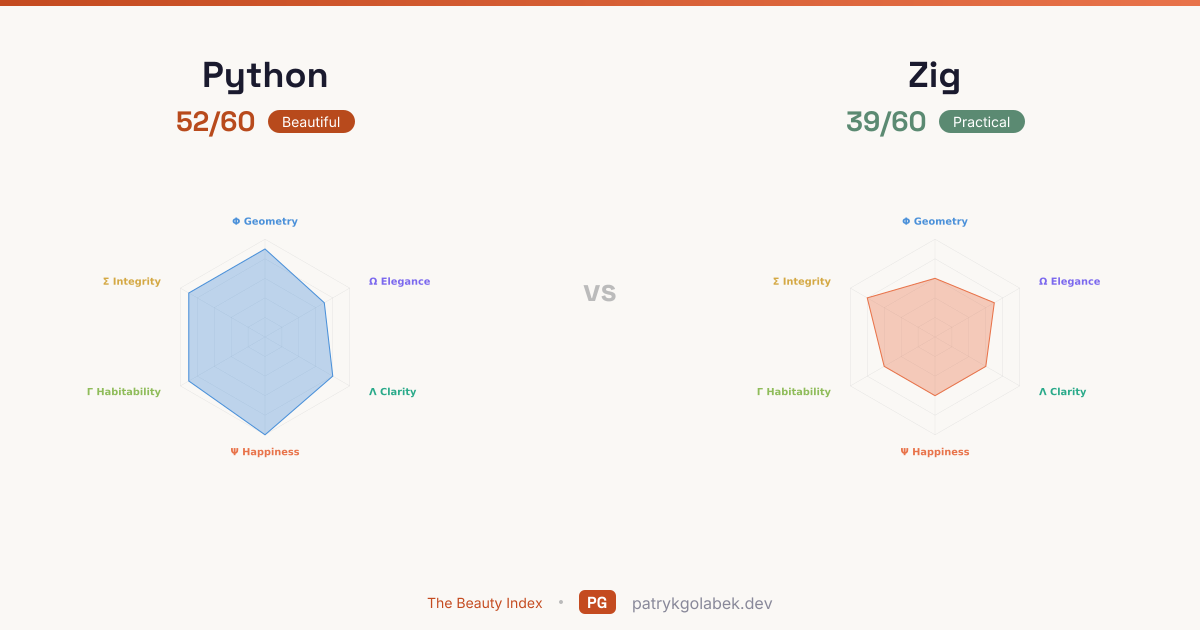
Python
Everyone's first love and nobody's last. Python's beauty is the beauty of clarity, indentation is structure, the most readable way is the correct way, and a newcomer can read someone else's code without a tutorial.
Zig
The systems programmer who looked at C and said 'I can fix this without adding complexity.' Zig is the rare language that removes footguns by making the right thing the easy thing.
Python scores 52/60 against Zig's 39/60, leading in 5 of 6 dimensions. Python dominates the aesthetic, human, and design axes. Practitioner Happiness is where the pair separates most cleanly — Python leads Zig by 4 points and that gap colours everything else on the page.
See also: Python vs PHP , Python .
Dimension-by-dimension analysis
Ψ Practitioner Happiness
Python wins Practitioner Happiness by 4 points — a real happiness advantage. Universally liked, beginner-friendly, and the default choice across data science, web, scripting, and education. The community is enormous, warm, and productive. Packaging friction (pip vs. poetry vs. uv) is a real blemish, but the read-write experience remains unmatched in reach. Python has done the harder cultural work: tooling that delights, a community that welcomes, documentation that explains. Growing admiration in the systems programming community. The compiler's error messages are good, and the community is enthusiastic. Still young enough that tooling and ecosystem maturity lag behind established languages. In application languages the community culture compounds the language advantage.
Γ Organic Habitability
Python wins Organic Habitability by 3 points — a meaningful extensibility gap. Python codebases age well. Duck typing, simple module structure, and a culture of readability make modification and extension feel natural. The language bends to the domain rather than imposing rigid abstractions. Where Python accommodates change gracefully, Zig makes you earn each new direction. Zig's explicitness makes code predictable to modify but also verbose to evolve. The language removes footguns but doesn't actively create growth-point idioms. Habitable by being unsurprising rather than by being inviting. In high-level work, the language that welcomes modification wins the decade, not the quarter.
Φ Aesthetic Geometry
Python wins Aesthetic Geometry by 3 points — a decisive visual advantage. Indentation is syntax. Python enforces geometric structure at the grammar level. A screenful of Python has natural visual rhythm with minimal punctuation noise. The visual gap between the two is not subtle — where Python prizes geometric calm, Zig trades that serenity for other commitments. Clean and minimal but not visually distinctive. Zig code is functional and well-structured, but the syntax doesn't create the kind of visual rhythm that scores above 7. Workmanlike layout. For application code the geometry translates directly into readability for new contributors.
Λ Linguistic Clarity
Python wins Linguistic Clarity by 2 points — a meaningful clarity gap. The closest any general-purpose language gets to executable pseudocode. Variable naming conventions, keyword arguments, and minimal ceremony make intent self-evident to readers at nearly any experience level. Where Python favours plain intent, Zig trades clarity for control, capability, or history. Explicit by design, no hidden control flow, no hidden allocators. This makes code predictable but verbose. You always know what's happening, but you're reading more to know it. The winner here treats readability as a core feature rather than a style preference.
Σ Conceptual Integrity
Python edges Zig by a single point on Conceptual Integrity; the practical difference is slim but real. "There should be one, and preferably only one, obvious way to do it." The Zen of Python is a genuine design philosophy, not a marketing tagline. Guido's benevolent-dictator era gave the language a coherent soul that has mostly survived committee evolution. On conceptual unity the two are close enough that the decision turns on other factors. "No hidden control flow, no hidden memory allocators." Andrew Kelley's vision is sharp and consistent. Every design choice follows from the principle that implicit behavior is the enemy. A focused, opinionated systems language. The winner's philosophical discipline is what keeps its idioms stable as the language evolves.
Ω Mathematical Elegance
Both score 7 — this is one dimension where Python and Zig genuinely agree. List comprehensions, generators, and first-class functions bring Python closer to mathematical notation than most dynamic languages. sum(x**2 for x in range(10)) reads like a formula. Not Haskell-tier, but a clear step above "workhorse" expressiveness. Algorithmically the two meet on equal ground; elegance is not what separates them. comptime is genuinely clever, compile-time code generation without metaprogramming complexity. The approach to generics and allocators is elegant in a systems-programming context, though not mathematically abstract. For high-level work, the gap compounds: fewer lines per algorithm means fewer bugs per feature.
Code comparison
Map, filter, reduce and functional collection transformations.
numbers = list(range(1, 11))
doubled = [n * 2 for n in numbers]evens = [n for n in numbers if n % 2 == 0]total = sum(numbers)
squares = list(map(lambda n: n * n, filter(lambda n: n % 2 == 0, numbers)))const numbers = [_]i32{ 1, 2, 3, 4, 5, 6, 7, 8, 9, 10 };
var sum: i32 = 0;for (numbers) |n| { sum += n;}
var evens: [5]i32 = undefined;var idx: usize = 0;for (numbers) |n| { if (@rem(n, 2) == 0) { evens[idx] = n; idx += 1; }}Function definition, parameters, return types, and closures.
def greet(name: str) -> str:    return f"Hello, {name}!"
def apply(f, x):    return f(x)
double = lambda x: x * 2
def make_adder(n): return lambda x: x + nfn greet(name: []const u8) void { std.debug.print("Hello, {s}!\n", .{name});}
fn apply(comptime T: type, f: fn (T) T, x: T) T { return f(x);}Embedding expressions and variables within string literals.
name = "Python"version = 3.12
msg = f"Hello, {name}! Version: {version}"expr = f"Length: {len(name)}, Upper: {name.upper()}"aligned = f"{name:<10} | {version:>5.1f}"debug = f"{name!r} has {len(name)} chars"const name = "Zig";const version: f32 = 0.12;
std.debug.print("Hello, {s}! Version: {d:.2}\n", .{ name, version });
var buf: [256]u8 = undefined;const msg = std.fmt.bufPrint(&buf, "Welcome to {s}", .{name}) catch unreachable;Frequently asked questions
- Which is easier to learn, Python or Zig?
- Python scores 10 on Practitioner Happiness versus Zig's 6. Universally liked, beginner-friendly, and the default choice across data science, web, scripting, and education. The community is enormous, warm, and productive. Packaging friction (pip vs. poetry vs. uv) is a real blemish, but the read-write experience remains unmatched in reach. For a developer adding a new language to their toolbelt, the happier one is the one you will still be writing in six months.
- Is Python or Zig better for developer happiness?
- For developer happiness, Python has a clear edge — it scores 10/10 on Practitioner Happiness against Zig's 6/10. Universally liked, beginner-friendly, and the default choice across data science, web, scripting, and education. The community is enormous, warm, and productive. Packaging friction (pip vs. poetry vs. uv) is a real blemish, but the read-write experience remains unmatched in reach.
- Should I pick Python or Zig in 2026?
- Python lands in the beautiful tier at 52/60; Zig in the practical tier at 39/60. The gap is wide. Unless a specific platform or ecosystem constraint forces the other choice, go with the higher-scoring language. The score difference reflects years of community use, tooling maturity, and the editorial judgment of the Beauty Index rubric.