
Python vs Swift
Python
Everyone's first love and nobody's last. Python's beauty is the beauty of clarity, indentation is structure, the most readable way is the correct way, and a newcomer can read someone else's code without a tutorial.
Swift
The architect who redesigned the entire house because the kitchen drawer was 2mm off. Swift pursues perfection with Apple-level obsession, and the result is a language that feels inevitable.
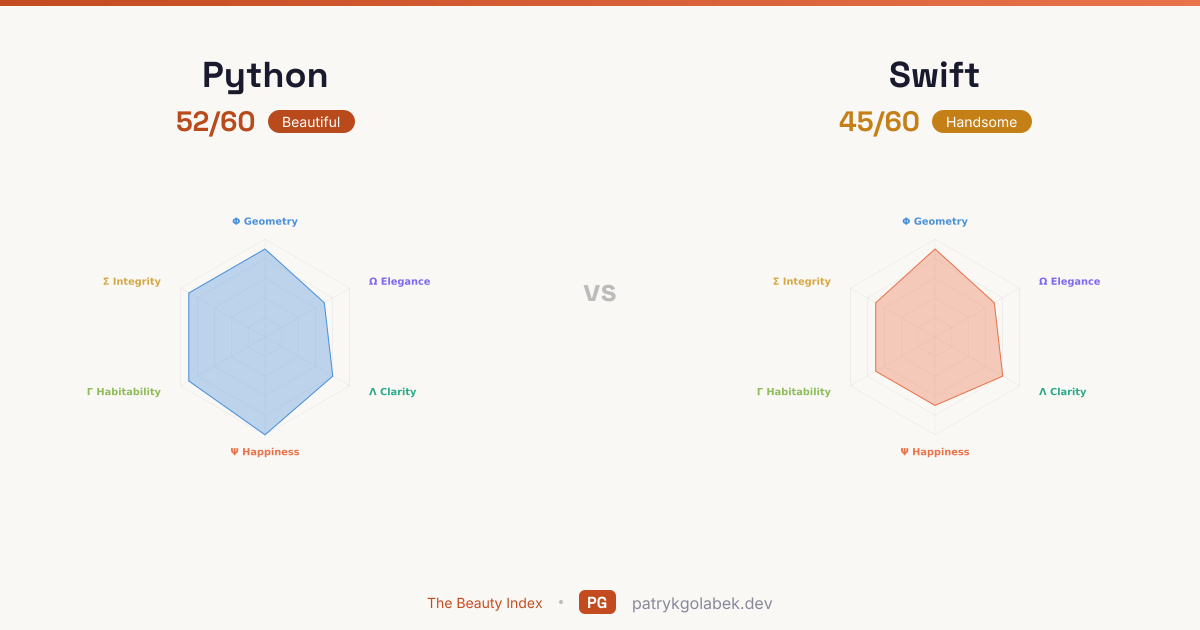
Python scores 52/60 against Swift's 45/60, leading in 3 of 6 dimensions. Python and Swift share the four axis clusters evenly, trading leads without either side claiming the frame. Read the comparison through Practitioner Happiness first: Python wins that axis by 3 points over Swift, and it is the single best lens on the pair.
See also: Python vs PHP , Python .
Dimension-by-dimension analysis
Ψ Practitioner Happiness
Python wins Practitioner Happiness by 3 points — a genuine community lead. Universally liked, beginner-friendly, and the default choice across data science, web, scripting, and education. The community is enormous, warm, and productive. Packaging friction (pip vs. poetry vs. uv) is a real blemish, but the read-write experience remains unmatched in reach. Python has done the harder cultural work: tooling that delights, a community that welcomes, documentation that explains. Strong satisfaction among iOS/macOS developers. Swift Playgrounds and Xcode integration create pleasant workflows. Docked because the ecosystem is Apple-locked, and build times plus ABI stability issues have caused real friction. In application languages the community culture compounds the language advantage.
Γ Organic Habitability
Python wins Organic Habitability by 2 points — a clear edge for long-lived code. Python codebases age well. Duck typing, simple module structure, and a culture of readability make modification and extension feel natural. The language bends to the domain rather than imposing rigid abstractions. Where Python accommodates change gracefully, Swift makes you earn each new direction. Protocol-oriented design encourages extensible architecture. Codebases can grow along protocol boundaries. Docked because Apple's rapid language evolution (Swift 1→6) has imposed migration costs, and the tight platform coupling limits organic growth beyond Apple's garden. In high-level work, the language that welcomes modification wins the decade, not the quarter.
Σ Conceptual Integrity
Python wins Conceptual Integrity by 2 points — an unmistakable unity of purpose. "There should be one, and preferably only one, obvious way to do it." The Zen of Python is a genuine design philosophy, not a marketing tagline. Guido's benevolent-dictator era gave the language a coherent soul that has mostly survived committee evolution. Where Python holds a line, Swift has negotiated with history, ecosystems, and legacy users. "Safe, fast, expressive" with protocol-oriented programming as a distinctive paradigm. The design is opinionated, but Apple's commercial interests and platform-specific priorities dilute the pure language-design vision. The winner's philosophical discipline is what keeps its idioms stable as the language evolves.
Λ Linguistic Clarity
Both score 8 — this is one dimension where Python and Swift genuinely agree. The closest any general-purpose language gets to executable pseudocode. Variable naming conventions, keyword arguments, and minimal ceremony make intent self-evident to readers at nearly any experience level. Both Python and Swift aim for the same high bar on readability, and both reach it. Named parameters, guard clauses, and descriptive API naming conventions (inherited from Objective-C culture) make Swift code read clearly. array.filter { $0.isValid }.map { $0.name } communicates intent directly. For application code the clarity advantage is the whole point of the language category.
Ω Mathematical Elegance
Both score 7 — this is one dimension where Python and Swift genuinely agree. List comprehensions, generators, and first-class functions bring Python closer to mathematical notation than most dynamic languages. sum(x**2 for x in range(10)) reads like a formula. Not Haskell-tier, but a clear step above "workhorse" expressiveness. When it comes to reaching "The Book," these two arrive together. Generics, protocol extensions, and enum-associated values support expressive algorithm design. Not in the functional-language Omega tier, but protocol-oriented programming enables elegant domain modeling. In application code the elegance edge shows up as less boilerplate per idea.
Φ Aesthetic Geometry
Both score 9 — this is one dimension where Python and Swift genuinely agree. Indentation is syntax. Python enforces geometric structure at the grammar level. A screenful of Python has natural visual rhythm with minimal punctuation noise. When both languages look this clean, the decision moves elsewhere entirely. Swift's syntax is visually clean and well-proportioned, closures, guard statements, and trailing closure syntax create a natural reading flow. Apple's design obsession shows in the visual weight of the code. In a language where expressiveness is the selling point, visual calm amplifies the advantage.
Code comparison
Native pattern matching constructs for destructuring and control flow.
match command: case ["quit"]: quit() case ["go", direction]: move(direction) case ["get", item] if item in inventory: pick_up(item) case _: print("Unknown command")func describe(_ value: Any) -> String { switch value { case let n as Int where n > 0: return "positive int: \(n)" case let s as String: return "string: \(s)" case let (x, y) as (Int, Int): return "pair: \(x), \(y)" default: return "unknown" }}The characteristic code snippet that best represents each language.
from itertools import takewhile
def fibonacci():    a, b = 0, 1    while True:        yield a        a, b = b, a + b
squares = { n: n**2 for n in takewhile(lambda x: x < 100, fibonacci()) if n > 0}protocol Drawable { func draw() -> String}
extension Drawable { func debugDraw() -> String { "[(draw())]" }}
struct Circle: Drawable { let radius: Double func draw() -> String { "Circle(r=(radius))" }}Embedding expressions and variables within string literals.
name = "Python"version = 3.12
msg = f"Hello, {name}! Version: {version}"expr = f"Length: {len(name)}, Upper: {name.upper()}"aligned = f"{name:<10} | {version:>5.1f}"debug = f"{name!r} has {len(name)} chars"let name = "Swift"let version = 5.10
let msg = "Hello, \(name)! Version: \(version)"let expr = "Length: \(name.count), Upper: \(name.uppercased())"let multi = """Welcome to \(name).Version: \(version)"""Frequently asked questions
- Which is easier to learn, Python or Swift?
- Python scores 10 on Practitioner Happiness versus Swift's 7. Universally liked, beginner-friendly, and the default choice across data science, web, scripting, and education. The community is enormous, warm, and productive. Packaging friction (pip vs. poetry vs. uv) is a real blemish, but the read-write experience remains unmatched in reach. When ease of learning is the deciding factor, the happier community wins every time — mentors, docs, and examples are simply more abundant.
- Is Python or Swift better for developer happiness?
- For developer happiness, Python has a clear edge — it scores 10/10 on Practitioner Happiness against Swift's 7/10. Universally liked, beginner-friendly, and the default choice across data science, web, scripting, and education. The community is enormous, warm, and productive. Packaging friction (pip vs. poetry vs. uv) is a real blemish, but the read-write experience remains unmatched in reach.
- Should I pick Python or Swift in 2026?
- Python lands in the beautiful tier at 52/60; Swift in the handsome tier at 45/60. The score gap is real; the higher-scoring language has a measurable edge. Go the other way only if a concrete ecosystem need pulls you there.