
Python vs OCaml
Python
Everyone's first love and nobody's last. Python's beauty is the beauty of clarity, indentation is structure, the most readable way is the correct way, and a newcomer can read someone else's code without a tutorial.
OCaml
The quiet genius in the corner who invented half of modern type theory and never got credit. OCaml's type system is a masterpiece; its ecosystem is an archaeology dig.
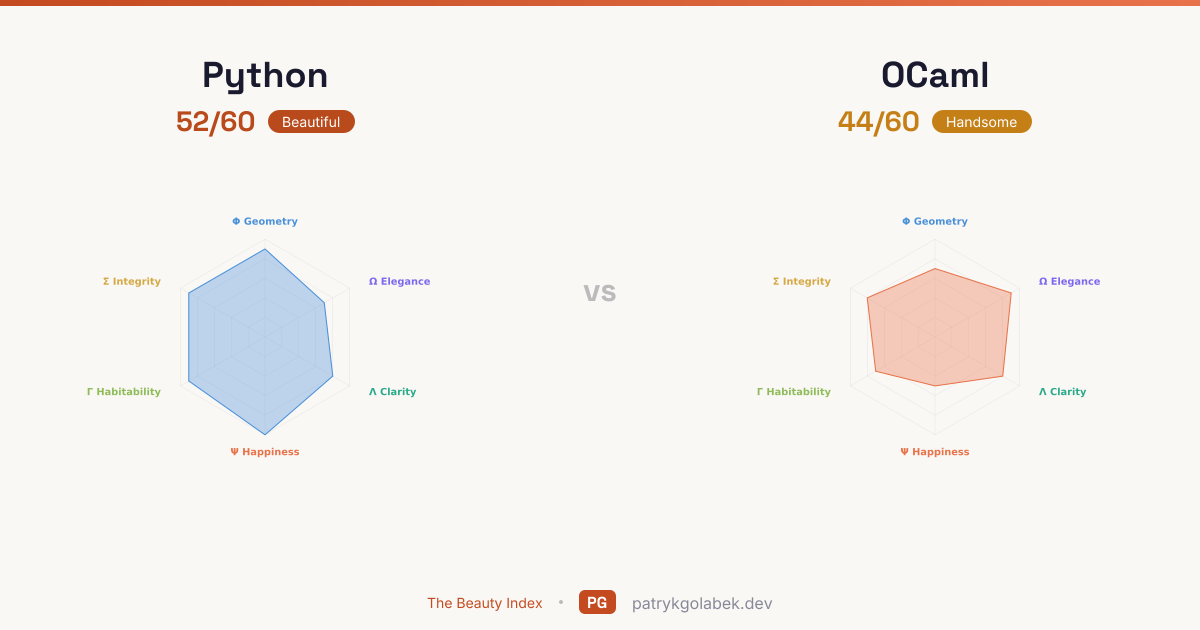
Python scores 52/60 against OCaml's 44/60, leading in 4 of 6 dimensions. Python dominates the aesthetic, human, and design axes. The widest gap sits on Practitioner Happiness, where Python's 5-point lead over OCaml shapes most of the pair's character.
See also: Python vs PHP , Python .
Dimension-by-dimension analysis
Ψ Practitioner Happiness
Python wins Practitioner Happiness by 5 points — an unmistakable experiential gap. Universally liked, beginner-friendly, and the default choice across data science, web, scripting, and education. The community is enormous, warm, and productive. Packaging friction (pip vs. poetry vs. uv) is a real blemish, but the read-write experience remains unmatched in reach. The practitioner experience on Python is simply more fun, day in and day out, than on OCaml. A small community with niche adoption. Tooling has improved dramatically (opam, dune, Merlin), but the ecosystem remains thin compared to mainstream languages. Practitioners love it deeply, but they are few. For high-level work, developer happiness is the main driver of long-term retention.
Γ Organic Habitability
Python wins Organic Habitability by 2 points — a real habitability advantage. Python codebases age well. Duck typing, simple module structure, and a culture of readability make modification and extension feel natural. The language bends to the domain rather than imposing rigid abstractions. Python invites modification; OCaml rewards planning more than adjustment. Strong types and module boundaries help code age well. The functors system enables reusable, extensible abstractions. Docked because the ecosystem's small size means fewer established patterns for common problems. In high-level work, the language that welcomes modification wins the decade, not the quarter.
Ω Mathematical Elegance
OCaml wins Mathematical Elegance by 2 points — a clear algorithmic edge. MetaLanguage-family heritage gives OCaml one of the most expressive type systems in existence. GADTs, functors, and first-class modules enable algorithm expression that approaches mathematical proof. Type theory pioneers use OCaml for a reason. OCaml lets algorithms approach mathematical statement, while Python asks more of the programmer when elegance is the goal. List comprehensions, generators, and first-class functions bring Python closer to mathematical notation than most dynamic languages. sum(x**2 for x in range(10)) reads like a formula. Not Haskell-tier, but a clear step above "workhorse" expressiveness. The winner lets the author think in algorithms rather than in ceremony.
Φ Aesthetic Geometry
Python wins Aesthetic Geometry by 2 points — a meaningful cleanliness gap. Indentation is syntax. Python enforces geometric structure at the grammar level. A screenful of Python has natural visual rhythm with minimal punctuation noise. The difference is not cosmetic: Python rewards the eye, while OCaml asks the reader to absorb more punctuation and more ceremony. Pattern matching, let bindings, and module signatures create a structured visual feel. Clean but not striking, the syntax is functional without being visually adventurous. In a language where expressiveness is the selling point, visual calm amplifies the advantage.
Σ Conceptual Integrity
Python edges OCaml by a single point on Conceptual Integrity; the practical difference is slim but real. "There should be one, and preferably only one, obvious way to do it." The Zen of Python is a genuine design philosophy, not a marketing tagline. Guido's benevolent-dictator era gave the language a coherent soul that has mostly survived committee evolution. On conceptual unity the two are close enough that the decision turns on other factors. OCaml has always known what it is: a practical functional language with an exceptional type system. The design is focused and coherent, types as the organizing principle, everything else in service of that. For application code the integrity edge means fewer "wait, why does it behave that way?" moments per week.
Λ Linguistic Clarity
Both score 8 — this is one dimension where Python and OCaml genuinely agree. The closest any general-purpose language gets to executable pseudocode. Variable naming conventions, keyword arguments, and minimal ceremony make intent self-evident to readers at nearly any experience level. Both Python and OCaml aim for the same high bar on readability, and both reach it. The |> operator, descriptive module paths, and pattern matching make OCaml code readable to anyone familiar with ML conventions. The language communicates structure and intent through types rather than comments. For application code the clarity advantage is the whole point of the language category.
Code comparison
The characteristic code snippet that best represents each language.
from itertools import takewhile
def fibonacci():    a, b = 0, 1    while True:        yield a        a, b = b, a + b
squares = { n: n**2 for n in takewhile(lambda x: x < 100, fibonacci()) if n > 0}type 'a tree = | Leaf | Node of 'a tree * 'a * 'a tree
let rec fold f acc = function | Leaf -> acc | Node (left, value, right) -> let acc = fold f acc left in let acc = f acc value in fold f acc rightFor/while iteration patterns and loop constructs.
Exception handling via try/catch or Result/Either patterns.
def parse_number(s: str) -> int:    try:        return int(s)    except ValueError as e:        raise ValueError(f"Invalid: {s}") from e
try: result = parse_number(input_str)except ValueError: result = -1finally: cleanup()let safe_divide a b = if b = 0.0 then Error "Division by zero" else Ok (a /. b)
let compute = Result.bind (safe_divide 10.0 2.0) (fun x -> safe_divide x 3.0)
match compute with| Ok v -> Printf.printf "Got: %f\n" v| Error e -> Printf.printf "Error: %s\n" eFrequently asked questions
- Which is easier to learn, Python or OCaml?
- Python scores 10 on Practitioner Happiness versus OCaml's 5. Universally liked, beginner-friendly, and the default choice across data science, web, scripting, and education. The community is enormous, warm, and productive. Packaging friction (pip vs. poetry vs. uv) is a real blemish, but the read-write experience remains unmatched in reach. For classroom or self-directed study, the practitioner-happiness winner almost always has better learning materials and kinder error messages.
- Is Python or OCaml better for developer happiness?
- For developer happiness, Python has a clear edge — it scores 10/10 on Practitioner Happiness against OCaml's 5/10. Universally liked, beginner-friendly, and the default choice across data science, web, scripting, and education. The community is enormous, warm, and productive. Packaging friction (pip vs. poetry vs. uv) is a real blemish, but the read-write experience remains unmatched in reach.
- Should I pick Python or OCaml in 2026?
- Python lands in the beautiful tier at 52/60; OCaml in the handsome tier at 44/60. The gap is wide enough to matter in day-to-day experience. Pick the higher scorer unless a hard constraint pushes otherwise. The score difference reflects years of community use, tooling maturity, and the editorial judgment of the Beauty Index rubric.