
Python vs Lua
Python
Everyone's first love and nobody's last. Python's beauty is the beauty of clarity, indentation is structure, the most readable way is the correct way, and a newcomer can read someone else's code without a tutorial.
Lua
The compact Swiss army knife that fits in any pocket. Lua is so small and embeddable that it powers everything from World of Warcraft to nginx configs without anyone noticing.
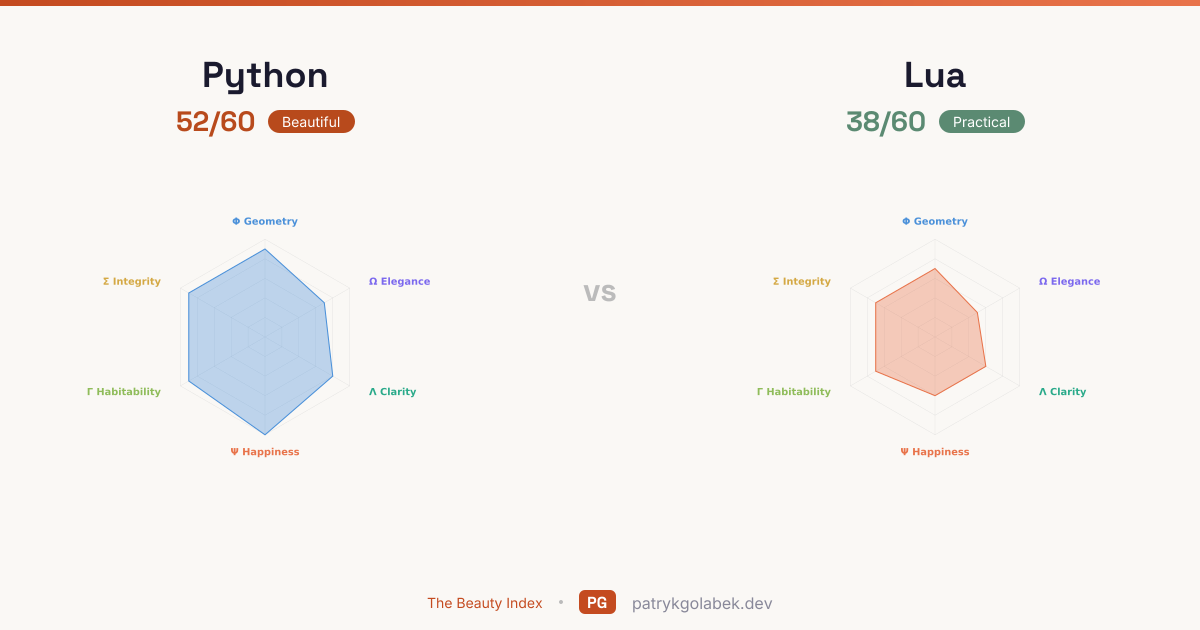
Python scores 52/60 against Lua's 38/60, leading in 6 of 6 dimensions. Python dominates the aesthetic, mathematical, human, and design axes. Practitioner Happiness is where the pair separates most cleanly — Python leads Lua by 4 points and that gap colours everything else on the page.
Dimension-by-dimension analysis
Ψ Practitioner Happiness
Python wins Practitioner Happiness by 4 points — a real happiness advantage. Universally liked, beginner-friendly, and the default choice across data science, web, scripting, and education. The community is enormous, warm, and productive. Packaging friction (pip vs. poetry vs. uv) is a real blemish, but the read-write experience remains unmatched in reach. Where Python feels designed for the human, Lua feels designed for the machine first — the human catches up second. Appreciated by game developers and embedded systems programmers. The embedding experience is seamless. But as a standalone language, the ecosystem is thin and the community is niche. For high-level work, developer happiness is the main driver of long-term retention.
Γ Organic Habitability
Python wins Organic Habitability by 2 points — a meaningful extensibility gap. Python codebases age well. Duck typing, simple module structure, and a culture of readability make modification and extension feel natural. The language bends to the domain rather than imposing rigid abstractions. The habitability gap shows in long-lived codebases — Python ages, Lua calcifies without careful discipline. Lua's tiny footprint and simple embedding API make it exceptionally habitable in its niche, you can drop it into any C/C++ project. Metatables allow organic extension. Code accommodates change well within its scope. The winner here is the language you will still enjoy reading in five years.
Λ Linguistic Clarity
Python wins Linguistic Clarity by 2 points — a meaningful clarity gap. The closest any general-purpose language gets to executable pseudocode. Variable naming conventions, keyword arguments, and minimal ceremony make intent self-evident to readers at nearly any experience level. Where Python favours plain intent, Lua trades clarity for control, capability, or history. Lua reads simply and directly for small scripts. The table-as-everything paradigm is clear once understood. Docked because the lack of distinct data structures (no arrays, no classes, just tables) can make larger codebases harder to read. For application code the clarity advantage is the whole point of the language category.
Ω Mathematical Elegance
Python wins Mathematical Elegance by 2 points — a decisive elegance advantage. List comprehensions, generators, and first-class functions bring Python closer to mathematical notation than most dynamic languages. sum(x**2 for x in range(10)) reads like a formula. Not Haskell-tier, but a clear step above "workhorse" expressiveness. The gap on Elegance is real: Python rewards precise thought, Lua rewards precise bookkeeping. Lua is deliberately simple. Tables as the single data structure are elegant in concept, but the language doesn't provide tools for abstract mathematical expression. Practical economy rather than mathematical economy. In application code the elegance edge shows up as less boilerplate per idea.
Φ Aesthetic Geometry
Python wins Aesthetic Geometry by 2 points — a decisive visual advantage. Indentation is syntax. Python enforces geometric structure at the grammar level. A screenful of Python has natural visual rhythm with minimal punctuation noise. The visual gap between the two is not subtle — where Python prizes geometric calm, Lua trades that serenity for other commitments. Lua's minimal syntax, function, end, local, tables, creates clean, visually proportional code. The lack of punctuation noise gives it a quiet, uncluttered feel. Small but well-composed. In a language where expressiveness is the selling point, visual calm amplifies the advantage.
Σ Conceptual Integrity
Python wins Conceptual Integrity by 2 points — a decisive philosophical edge. "There should be one, and preferably only one, obvious way to do it." The Zen of Python is a genuine design philosophy, not a marketing tagline. Guido's benevolent-dictator era gave the language a coherent soul that has mostly survived committee evolution. The design philosophy of Python feels inevitable, each feature a consequence of one idea — Lua feels assembled from several good ideas instead of from one great one. "Small, fast, embeddable." Lua knows exactly what it is and stays in its lane. The design is coherent and focused. Docked slightly because the minimalism is more pragmatic than philosophical — it's simple because it needs to be small, not because simplicity is the point. For application code the integrity edge means fewer "wait, why does it behave that way?" moments per week.
Code comparison
Map, filter, reduce and functional collection transformations.
numbers = list(range(1, 11))
doubled = [n * 2 for n in numbers]evens = [n for n in numbers if n % 2 == 0]total = sum(numbers)
squares = list(map(lambda n: n * n, filter(lambda n: n % 2 == 0, numbers)))local numbers = {1, 2, 3, 4, 5, 6, 7, 8, 9, 10}
local evens = {}for _, n in ipairs(numbers) do if n % 2 == 0 then evens[#evens + 1] = n endend
local sum = 0for _, n in ipairs(numbers) do sum = sum + n endThe characteristic code snippet that best represents each language.
from itertools import takewhile
def fibonacci():    a, b = 0, 1    while True:        yield a        a, b = b, a + b
squares = { n: n**2 for n in takewhile(lambda x: x < 100, fibonacci()) if n > 0}local Vector = {}Vector.__index = Vector
function Vector.new(x, y) return setmetatable({x = x, y = y}, Vector)end
function Vector:length() return math.sqrt(self.x^2 + self.y^2)end
function Vector.__add(a, b) return Vector.new(a.x + b.x, a.y + b.y)endData structure definition using classes, structs, records, or equivalent.
from dataclasses import dataclass
@dataclassclass User:    name: str    email: str    age: int = 0
def greeting(self) -> str: return f"Hello, {self.name}!"local User = {}User.__index = User
function User.new(name, email, age) return setmetatable({ name = name, email = email, age = age }, User)end
function User:greeting() return "Hello, " .. self.name .. "!"endFrequently asked questions
- Which is easier to learn, Python or Lua?
- Python scores 10 on Practitioner Happiness versus Lua's 6. Universally liked, beginner-friendly, and the default choice across data science, web, scripting, and education. The community is enormous, warm, and productive. Packaging friction (pip vs. poetry vs. uv) is a real blemish, but the read-write experience remains unmatched in reach. For a developer adding a new language to their toolbelt, the happier one is the one you will still be writing in six months.
- Is Python or Lua better for developer happiness?
- For developer happiness, Python has a clear edge — it scores 10/10 on Practitioner Happiness against Lua's 6/10. Universally liked, beginner-friendly, and the default choice across data science, web, scripting, and education. The community is enormous, warm, and productive. Packaging friction (pip vs. poetry vs. uv) is a real blemish, but the read-write experience remains unmatched in reach.
- Should I pick Python or Lua in 2026?
- Python lands in the beautiful tier at 52/60; Lua in the practical tier at 38/60. On this score difference the answer is clear: the higher-ranked language wins unless you have an explicit reason to pay the cost of the other.