
Python vs Julia
Python
Everyone's first love and nobody's last. Python's beauty is the beauty of clarity, indentation is structure, the most readable way is the correct way, and a newcomer can read someone else's code without a tutorial.
Julia
The prodigy who wants to be Python, R, and Fortran simultaneously. Julia solves the two-language problem by being fast enough for C programmers and readable enough for scientists.
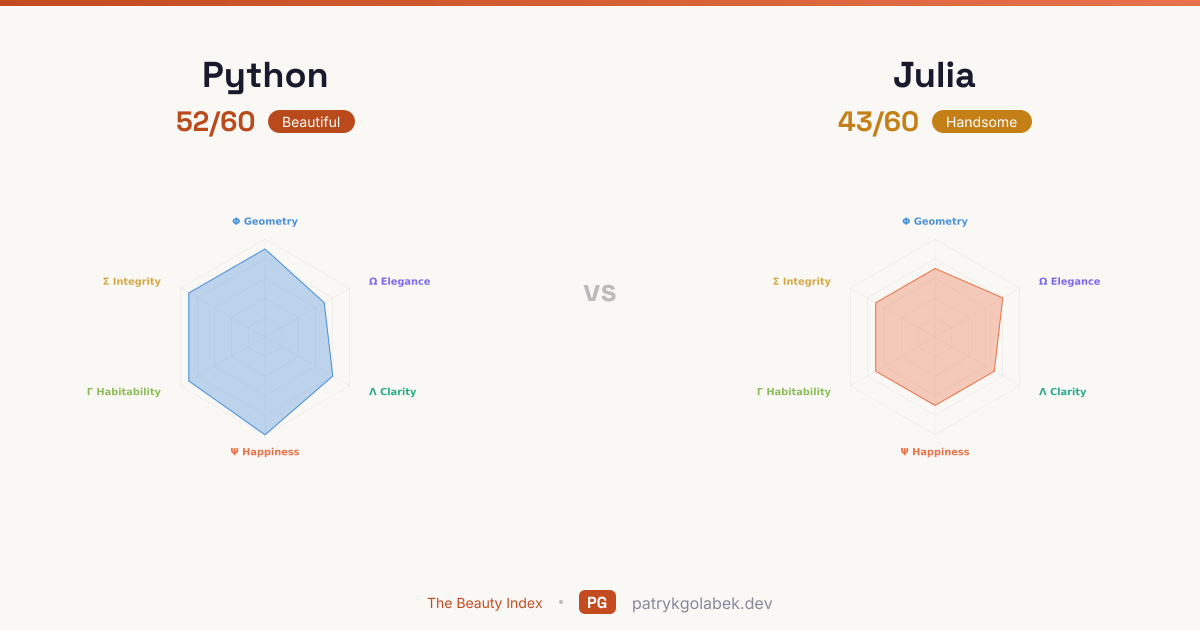
Python scores 52/60 against Julia's 43/60, leading in 5 of 6 dimensions. Python dominates the aesthetic, human, and design axes. The widest gap sits on Practitioner Happiness, where Python's 3-point lead over Julia shapes most of the pair's character.
See also: Python vs PHP , Python .
Dimension-by-dimension analysis
Ψ Practitioner Happiness
Python wins Practitioner Happiness by 3 points — a decisive cultural edge. Universally liked, beginner-friendly, and the default choice across data science, web, scripting, and education. The community is enormous, warm, and productive. Packaging friction (pip vs. poetry vs. uv) is a real blemish, but the read-write experience remains unmatched in reach. The practitioner experience on Python is simply more fun, day in and day out, than on Julia. Loved by its scientific computing community. The "two-language problem" solution is real and appreciated. Docked because time-to-first-plot latency, package precompilation times, and ecosystem maturity create friction. The winner here invites the next generation of contributors without asking them to earn it first.
Γ Organic Habitability
Python wins Organic Habitability by 2 points — an unmistakable lead in how well code ages. Python codebases age well. Duck typing, simple module structure, and a culture of readability make modification and extension feel natural. The language bends to the domain rather than imposing rigid abstractions. Python invites modification; Julia rewards planning more than adjustment. Multiple dispatch and scientific workflow patterns age more gracefully than originally credited. Julia codebases tend to grow organically along domain boundaries — new methods extend existing types naturally without modification. In high-level work, the language that welcomes modification wins the decade, not the quarter.
Φ Aesthetic Geometry
Python wins Aesthetic Geometry by 2 points — a clear geometric edge. Indentation is syntax. Python enforces geometric structure at the grammar level. A screenful of Python has natural visual rhythm with minimal punctuation noise. Julia, by contrast, accepts visual density in exchange for other priorities. Unicode operators, mathematical notation support, and clean function definitions give Julia a visual feel closer to mathematics than most languages. Matrix operations look like textbook equations. In a language where expressiveness is the selling point, visual calm amplifies the advantage.
Σ Conceptual Integrity
Python wins Conceptual Integrity by 2 points — a clear integrity advantage. "There should be one, and preferably only one, obvious way to do it." The Zen of Python is a genuine design philosophy, not a marketing tagline. Guido's benevolent-dictator era gave the language a coherent soul that has mostly survived committee evolution. Python speaks with a single design voice; Julia speaks with a committee. "Solve the two-language problem" is a clear mission, and multiple dispatch as the unifying principle is distinctive. Docked because the "be Python, R, and Fortran simultaneously" ambition stretches the conceptual focus. For application code the integrity edge means fewer "wait, why does it behave that way?" moments per week.
Λ Linguistic Clarity
Python edges Julia by a single point on Linguistic Clarity; the practical difference is slim but real. The closest any general-purpose language gets to executable pseudocode. Variable naming conventions, keyword arguments, and minimal ceremony make intent self-evident to readers at nearly any experience level. The difference is real but modest — pick either and a team will read fluently within weeks. Julia reads clearly for scientific audiences, broadcasting syntax, comprehensions, and mathematical operators make domain intent visible. Less clear for general-purpose tasks outside its scientific home turf. In high-level work, readable code is the difference between a 6-month onboarding and a 6-week one.
Ω Mathematical Elegance
Julia edges Python by a single point on Mathematical Elegance; the practical difference is slim but real. Multiple dispatch as the core paradigm enables elegant mathematical abstractions. Julia's type system lets you write generic algorithms that specialize naturally. Scientific algorithms can approach "Book" elegance. Julia nudges ahead, but Python is capable of the same expressive heights in the hands of a confident user. List comprehensions, generators, and first-class functions bring Python closer to mathematical notation than most dynamic languages. sum(x**2 for x in range(10)) reads like a formula. Not Haskell-tier, but a clear step above "workhorse" expressiveness. For high-level work, the gap compounds: fewer lines per algorithm means fewer bugs per feature.
Code comparison
Native pattern matching constructs for destructuring and control flow.
match command: case ["quit"]: quit() case ["go", direction]: move(direction) case ["get", item] if item in inventory: pick_up(item) case _: print("Unknown command")describe(::Nothing) = "nothing"describe(x::Int) = x > 0 ? "positive" : "non-positive"describe(s::String) = "string: $s"describe(v::Vector) = isempty(v) ? "empty" : "list"describe(_) = "unknown"The characteristic code snippet that best represents each language.
from itertools import takewhile
def fibonacci():    a, b = 0, 1    while True:        yield a        a, b = b, a + b
squares = { n: n**2 for n in takewhile(lambda x: x < 100, fibonacci()) if n > 0}abstract type Shape endstruct Circle <: Shape; r::Float64 endstruct Rect <: Shape; w::Float64; h::Float64 end
area(c::Circle) = pi * c.r^2area(r::Rect) = r.w * r.h
combine(a::Circle, b::Circle) = Circle(sqrt(a.r^2 + b.r^2))combine(a::Rect, b::Rect) = Rect(a.w + b.w, max(a.h, b.h))combine(a::Shape, b::Shape) = area(a) + area(b)Exception handling via try/catch or Result/Either patterns.
def parse_number(s: str) -> int:    try:        return int(s)    except ValueError as e:        raise ValueError(f"Invalid: {s}") from e
try: result = parse_number(input_str)except ValueError: result = -1finally: cleanup()function parse_number(s::String) try parse(Int, s) catch e if isa(e, ArgumentError) error("Invalid input: $s") end rethrow() endend
result = try parse_number("42")catch e -1endFrequently asked questions
- Which is easier to learn, Python or Julia?
- Python scores 10 on Practitioner Happiness versus Julia's 7. Universally liked, beginner-friendly, and the default choice across data science, web, scripting, and education. The community is enormous, warm, and productive. Packaging friction (pip vs. poetry vs. uv) is a real blemish, but the read-write experience remains unmatched in reach. For a newcomer picking up their first serious language in 2026, the happiness-score winner is the more forgiving starting point.
- Is Python or Julia better for developer happiness?
- For developer happiness, Python has a clear edge — it scores 10/10 on Practitioner Happiness against Julia's 7/10. Universally liked, beginner-friendly, and the default choice across data science, web, scripting, and education. The community is enormous, warm, and productive. Packaging friction (pip vs. poetry vs. uv) is a real blemish, but the read-write experience remains unmatched in reach.
- Should I pick Python or Julia in 2026?
- Python lands in the beautiful tier at 52/60; Julia in the handsome tier at 43/60. The gap is wide. Unless a specific platform or ecosystem constraint forces the other choice, go with the higher-scoring language. The score difference reflects years of community use, tooling maturity, and the editorial judgment of the Beauty Index rubric.