
Python vs Gleam
Python
Everyone's first love and nobody's last. Python's beauty is the beauty of clarity, indentation is structure, the most readable way is the correct way, and a newcomer can read someone else's code without a tutorial.
Gleam
The new kid who showed up and immediately made the honor roll. Still young — hit 1.0 in 2024 — but already the number-two most admired language. No null, no exceptions, no implicit behavior. Radical simplicity as philosophy.
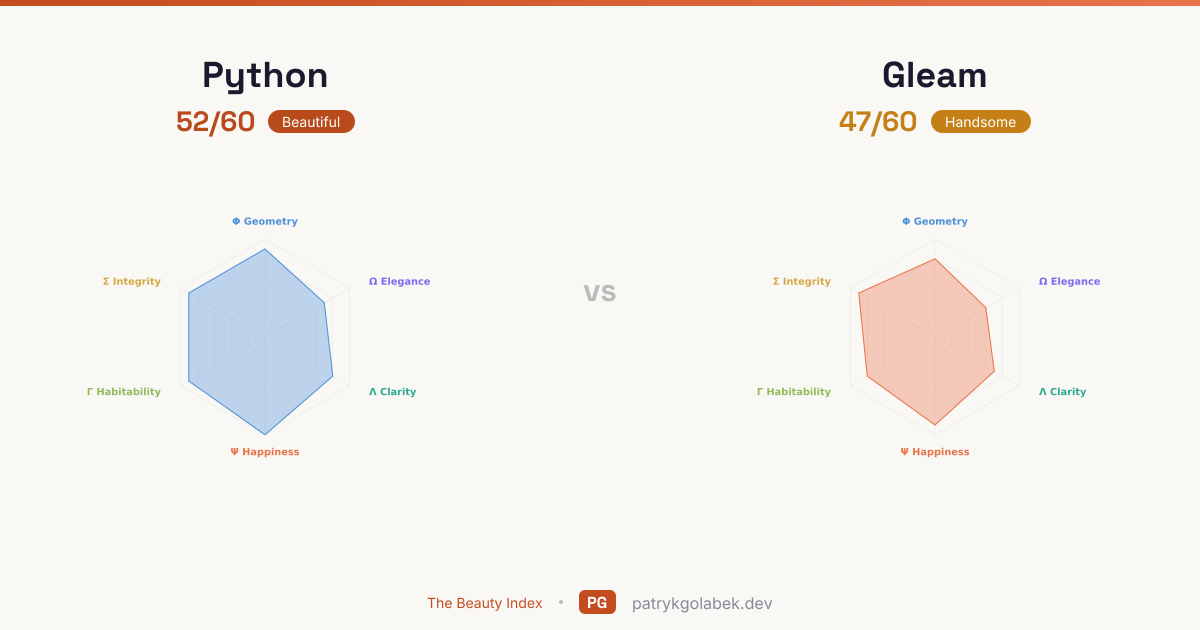
Python scores 52/60 against Gleam's 47/60, leading in 5 of 6 dimensions. Python dominates the aesthetic, mathematical, and human axes. Organic Habitability is where the pair separates most cleanly — Python leads Gleam by 1 points and that gap colours everything else on the page.
See also: Python vs PHP , Python .
Dimension-by-dimension analysis
Γ Organic Habitability
Python edges Gleam by a single point on Organic Habitability; the practical difference is slim but real. Python codebases age well. Duck typing, simple module structure, and a culture of readability make modification and extension feel natural. The language bends to the domain rather than imposing rigid abstractions. On extensibility the two are close enough that the decision rarely hinges on this axis alone. No null, no exceptions, no implicit behavior means fewer surprises as codebases grow. The radical simplicity is itself a growth-point philosophy, less to go wrong, more room to extend. In high-level work, the language that welcomes modification wins the decade, not the quarter.
Λ Linguistic Clarity
Python edges Gleam by a single point on Linguistic Clarity; the practical difference is slim but real. The closest any general-purpose language gets to executable pseudocode. Variable naming conventions, keyword arguments, and minimal ceremony make intent self-evident to readers at nearly any experience level. The difference is real but modest — pick either and a team will read fluently within weeks. Explicit, predictable, and readable. Every value is named, every path is visible. Not as fluent as Ruby or Elixir in "reads-like-prose" terms, but the absence of magic makes intent self-evident. For application code the clarity advantage is the whole point of the language category.
Ω Mathematical Elegance
Python edges Gleam by a single point on Mathematical Elegance; the practical difference is slim but real. List comprehensions, generators, and first-class functions bring Python closer to mathematical notation than most dynamic languages. sum(x**2 for x in range(10)) reads like a formula. Not Haskell-tier, but a clear step above "workhorse" expressiveness. Python nudges ahead, but Gleam is capable of the same expressive heights in the hands of a confident user. Deliberately simple, no higher-kinded types, no advanced abstractions. Gleam trades mathematical power for clarity. The design is intentional, but it limits the ceiling for algorithmic elegance compared to Haskell or OCaml. The winner lets the author think in algorithms rather than in ceremony.
Φ Aesthetic Geometry
Python edges Gleam by a single point on Aesthetic Geometry; the practical difference is slim but real. Indentation is syntax. Python enforces geometric structure at the grammar level. A screenful of Python has natural visual rhythm with minimal punctuation noise. The edge here is thin; a seasoned reader might prefer one strictly on personal taste. Clean syntax with no semicolons, no null, no exceptions. The visual layout is consistent and uncluttered. Gleam code has the proportional clarity of a well-organized document. In a language where expressiveness is the selling point, visual calm amplifies the advantage.
Ψ Practitioner Happiness
Python edges Gleam by a single point on Practitioner Happiness; the practical difference is slim but real. Universally liked, beginner-friendly, and the default choice across data science, web, scripting, and education. The community is enormous, warm, and productive. Packaging friction (pip vs. poetry vs. uv) is a real blemish, but the read-write experience remains unmatched in reach. On developer happiness the edge is modest — the two communities are both thriving. Stack Overflow's #2 "Most Admired" at 70%. For a language that hit 1.0 in 2024, the community love is extraordinary. The compiler's error messages are famously friendly. For high-level work, developer happiness is the main driver of long-term retention.
Σ Conceptual Integrity
Both score 9 — this is one dimension where Python and Gleam genuinely agree. "There should be one, and preferably only one, obvious way to do it." The Zen of Python is a genuine design philosophy, not a marketing tagline. Guido's benevolent-dictator era gave the language a coherent soul that has mostly survived committee evolution. Both Python and Gleam feel designed by a single mind, even when they are not; on integrity they meet as equals. "Radical simplicity." Every feature omission is a deliberate design statement. Louis Pilfold's vision is crystal clear: a language where the right thing is the only thing. Few languages this young have this much conceptual integrity. In high-level work a coherent philosophy is the frame that holds the language's features together.
Code comparison
The characteristic code snippet that best represents each language.
Native pattern matching constructs for destructuring and control flow.
match command: case ["quit"]: quit() case ["go", direction]: move(direction) case ["get", item] if item in inventory: pick_up(item) case _: print("Unknown command")pub fn describe(items: List(Int)) -> String { case items { [] -> "empty" [x] -> "singleton" [x, ..] if x > 0 -> "starts positive" _ -> "other" }}
pub fn unwrap(result: Result(a, b), default: a) -> a { case result { Ok(value) -> value Error(_) -> default }}Embedding expressions and variables within string literals.
name = "Python"version = 3.12
msg = f"Hello, {name}! Version: {version}"expr = f"Length: {len(name)}, Upper: {name.upper()}"aligned = f"{name:<10} | {version:>5.1f}"debug = f"{name!r} has {len(name)} chars"import gleam/intimport gleam/string
let name = "Gleam"let version = 1
let msg = "Hello, " <> name <> "! Version: " <> int.to_string(version)
let multi = string.concat([ "Welcome to ", name, ".\n", "Version: ", int.to_string(version),])Frequently asked questions
- Which is easier to learn, Python or Gleam?
- Python scores 10 on Practitioner Happiness versus Gleam's 9. Universally liked, beginner-friendly, and the default choice across data science, web, scripting, and education. The community is enormous, warm, and productive. Packaging friction (pip vs. poetry vs. uv) is a real blemish, but the read-write experience remains unmatched in reach. For classroom or self-directed study, the practitioner-happiness winner almost always has better learning materials and kinder error messages.
- Is Python or Gleam better for long-lived codebases?
- For long-lived codebases, Python has a clear edge — it scores 9/10 on Organic Habitability against Gleam's 8/10. Python codebases age well. Duck typing, simple module structure, and a culture of readability make modification and extension feel natural. The language bends to the domain rather than imposing rigid abstractions.
- Should I pick Python or Gleam in 2026?
- Python lands in the beautiful tier at 52/60; Gleam in the handsome tier at 47/60. The gap is wide enough to matter in day-to-day experience. Pick the higher scorer unless a hard constraint pushes otherwise. The score difference reflects years of community use, tooling maturity, and the editorial judgment of the Beauty Index rubric.