
Python vs F#
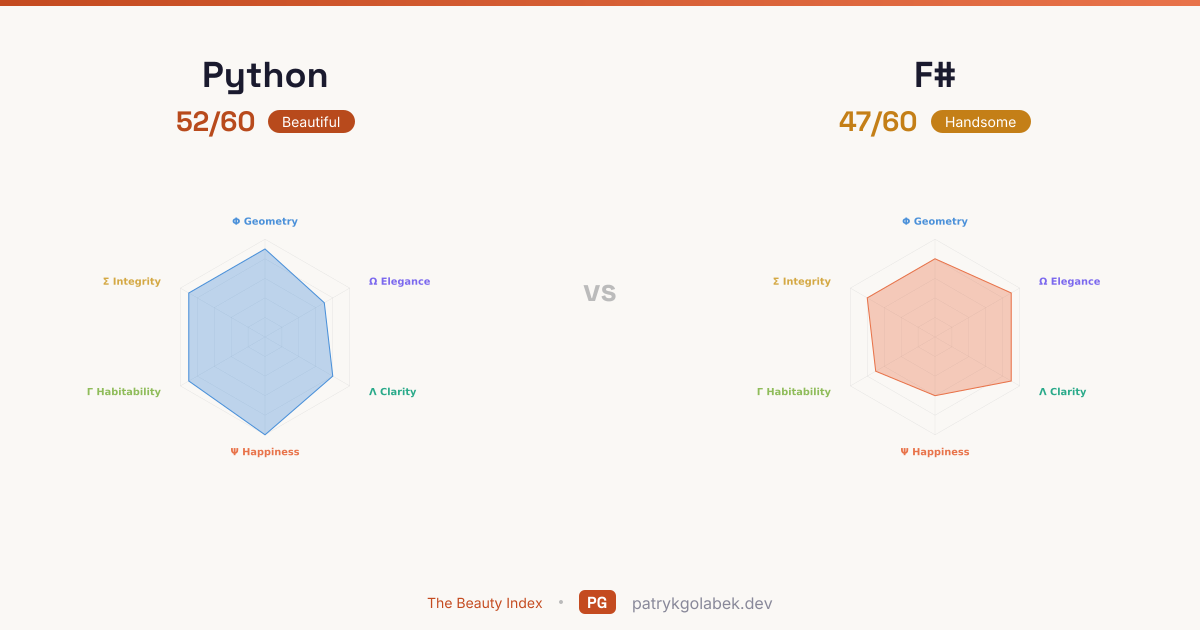
Python
Everyone's first love and nobody's last. Python's beauty is the beauty of clarity, indentation is structure, the most readable way is the correct way, and a newcomer can read someone else's code without a tutorial.
F#
The brilliant cousin nobody invites to parties. F# does everything right on the .NET platform, writes more elegant code than C# ever could, and wonders why nobody's paying attention.
Python scores 52/60 against F#'s 47/60, leading in 4 of 6 dimensions. Python owns human and design while F# leads in mathematical. Practitioner Happiness is where the pair separates most cleanly — Python leads F# by 4 points and that gap colours everything else on the page.
See also: Python vs PHP , Python .
Dimension-by-dimension analysis
Ψ Practitioner Happiness
Python wins Practitioner Happiness by 4 points — an unmistakable experiential gap. Universally liked, beginner-friendly, and the default choice across data science, web, scripting, and education. The community is enormous, warm, and productive. Packaging friction (pip vs. poetry vs. uv) is a real blemish, but the read-write experience remains unmatched in reach. Python has done the harder cultural work: tooling that delights, a community that welcomes, documentation that explains. A small, devoted community, but limited industry adoption creates friction, fewer libraries, fewer tutorials, fewer jobs. The .NET ecosystem helps, but F# often feels like a second-class citizen behind C#. The winner here invites the next generation of contributors without asking them to earn it first.
Γ Organic Habitability
Python wins Organic Habitability by 2 points — a real habitability advantage. Python codebases age well. Duck typing, simple module structure, and a culture of readability make modification and extension feel natural. The language bends to the domain rather than imposing rigid abstractions. Where Python accommodates change gracefully, F# makes you earn each new direction. Type inference and immutability-by-default produce code that ages reasonably well. The .NET interop story is good. Docked because the ecosystem's size means patterns and libraries are less battle-tested than in larger communities. In high-level work, the language that welcomes modification wins the decade, not the quarter.
Ω Mathematical Elegance
F# wins Mathematical Elegance by 2 points — a clear algorithmic edge. MetaLanguage-family heritage gives F# deep mathematical roots. Computation expressions, active patterns, and type providers enable algorithm expression that approaches Hardy's "economy" criterion. Where F# compresses an idea into a line or two, Python tends to spread the same idea across a paragraph. List comprehensions, generators, and first-class functions bring Python closer to mathematical notation than most dynamic languages. sum(x**2 for x in range(10)) reads like a formula. Not Haskell-tier, but a clear step above "workhorse" expressiveness. For high-level work, the gap compounds: fewer lines per algorithm means fewer bugs per feature.
Λ Linguistic Clarity
F# edges Python by a single point on Linguistic Clarity; the practical difference is slim but real. The pipeline operator, discriminated unions, and lack of ceremony make F# remarkably readable. items |> List.filter isValid |> List.map transform reads as a clear chain of intent. One of the most literate typed languages. On readability the edge is slim and disappears quickly as idioms are learned. The closest any general-purpose language gets to executable pseudocode. Variable naming conventions, keyword arguments, and minimal ceremony make intent self-evident to readers at nearly any experience level. For application code the clarity advantage is the whole point of the language category.
Φ Aesthetic Geometry
Python edges F# by a single point on Aesthetic Geometry; the practical difference is slim but real. Indentation is syntax. Python enforces geometric structure at the grammar level. A screenful of Python has natural visual rhythm with minimal punctuation noise. The edge here is thin; a seasoned reader might prefer one strictly on personal taste. Significant whitespace, pipeline operators, and concise type definitions give F# a clean, proportional visual feel. Pattern matching arms align naturally. Less visual noise than C# by a wide margin. For application code the geometry translates directly into readability for new contributors.
Σ Conceptual Integrity
Python edges F# by a single point on Conceptual Integrity; the practical difference is slim but real. "There should be one, and preferably only one, obvious way to do it." The Zen of Python is a genuine design philosophy, not a marketing tagline. Guido's benevolent-dictator era gave the language a coherent soul that has mostly survived committee evolution. On conceptual unity the two are close enough that the decision turns on other factors. "Functional-first on .NET" is a clear, focused vision that Don Syme has maintained consistently. F# knows what it is and doesn't try to be everything. The design is opinionated in the right ways. In high-level work a coherent philosophy is the frame that holds the language's features together.
Code comparison
The characteristic code snippet that best represents each language.
from itertools import takewhile
def fibonacci():    a, b = 0, 1    while True:        yield a        a, b = b, a + b
squares = { n: n**2 for n in takewhile(lambda x: x < 100, fibonacci()) if n > 0}type Shape = | Circle of radius: float | Rect of width: float * height: float
let area = function | Circle r -> System.Math.PI * r * r | Rect (w, h) -> w * h
let totalArea shapes = shapes |> List.map area |> List.sumData structure definition using classes, structs, records, or equivalent.
from dataclasses import dataclass
@dataclassclass User:    name: str    email: str    age: int = 0
def greeting(self) -> str: return f"Hello, {self.name}!"type User = { Name: string Email: string Age: int } member this.Greeting = sprintf "Hello, %s!" this.Name
let user = { Name = "Alice"; Email = "a@b.c"; Age = 30 }let updated = { user with Age = 31 }Native pattern matching constructs for destructuring and control flow.
match command: case ["quit"]: quit() case ["go", direction]: move(direction) case ["get", item] if item in inventory: pick_up(item) case _: print("Unknown command")let describe = function | [] -> "empty" | [x] -> sprintf "singleton: %A" x | x :: _ when x > 0 -> "starts positive" | _ -> "other"
let area = function | Circle r -> System.Math.PI * r * r | Rect (w, h) -> w * hFrequently asked questions
- Which is easier to learn, Python or F#?
- Python scores 10 on Practitioner Happiness versus F#'s 6. Universally liked, beginner-friendly, and the default choice across data science, web, scripting, and education. The community is enormous, warm, and productive. Packaging friction (pip vs. poetry vs. uv) is a real blemish, but the read-write experience remains unmatched in reach. For classroom or self-directed study, the practitioner-happiness winner almost always has better learning materials and kinder error messages.
- Is Python or F# better for developer happiness?
- For developer happiness, Python has a clear edge — it scores 10/10 on Practitioner Happiness against F#'s 6/10. Universally liked, beginner-friendly, and the default choice across data science, web, scripting, and education. The community is enormous, warm, and productive. Packaging friction (pip vs. poetry vs. uv) is a real blemish, but the read-write experience remains unmatched in reach.
- Should I pick Python or F# in 2026?
- Python lands in the beautiful tier at 52/60; F# in the handsome tier at 47/60. The gap is wide enough to matter in day-to-day experience. Pick the higher scorer unless a hard constraint pushes otherwise. The score difference reflects years of community use, tooling maturity, and the editorial judgment of the Beauty Index rubric.