
Python vs Dart
Python
Everyone's first love and nobody's last. Python's beauty is the beauty of clarity, indentation is structure, the most readable way is the correct way, and a newcomer can read someone else's code without a tutorial.
Dart
The second-chance kid who found their calling in Flutter. Dart was nearly forgotten until mobile development gave it a purpose, and now it's living its best life painting pixels.
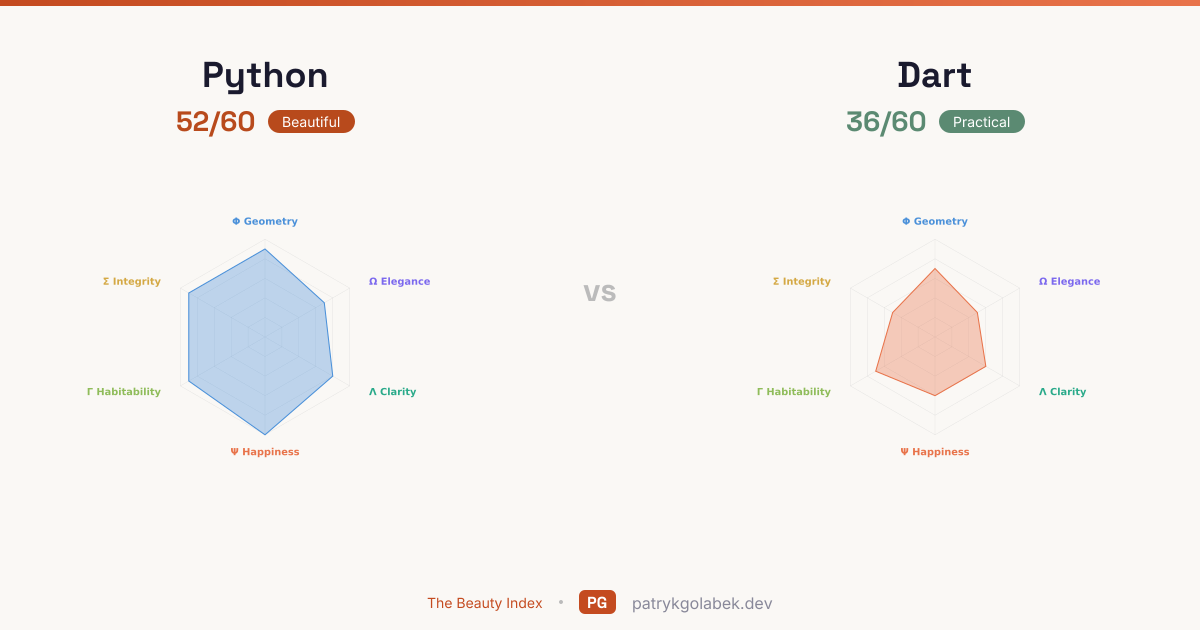
Python scores 52/60 against Dart's 36/60, leading in 6 of 6 dimensions. Python dominates the aesthetic, mathematical, human, and design axes. The widest gap sits on Practitioner Happiness, where Python's 4-point lead over Dart shapes most of the pair's character.
See also: C# vs Dart , Python .
Dimension-by-dimension analysis
Ψ Practitioner Happiness
Python wins Practitioner Happiness by 4 points — a genuine community lead. Universally liked, beginner-friendly, and the default choice across data science, web, scripting, and education. The community is enormous, warm, and productive. Packaging friction (pip vs. poetry vs. uv) is a real blemish, but the read-write experience remains unmatched in reach. Python has done the harder cultural work: tooling that delights, a community that welcomes, documentation that explains. Flutter developers generally enjoy the experience. Hot reload is a genuine joy. The language itself is pleasant enough, but Dart's identity is inseparable from Flutter, outside that context, enthusiasm drops significantly. For high-level work, developer happiness is the main driver of long-term retention.
Σ Conceptual Integrity
Python wins Conceptual Integrity by 4 points — an unmistakable unity of purpose. "There should be one, and preferably only one, obvious way to do it." The Zen of Python is a genuine design philosophy, not a marketing tagline. Guido's benevolent-dictator era gave the language a coherent soul that has mostly survived committee evolution. Python speaks with a single design voice; Dart speaks with a committee. Dart's identity crisis, initially a web language, then reborn as a Flutter companion, weakens its conceptual integrity. It's a good language in service of a framework, not a language with its own philosophical center. In high-level work a coherent philosophy is the frame that holds the language's features together.
Γ Organic Habitability
Python wins Organic Habitability by 2 points — a clear edge for long-lived code. Python codebases age well. Duck typing, simple module structure, and a culture of readability make modification and extension feel natural. The language bends to the domain rather than imposing rigid abstractions. The habitability gap shows in long-lived codebases — Python ages, Dart calcifies without careful discipline. Dart codebases grow well within the Flutter paradigm. The widget composition model encourages incremental, modular extension. Sound null safety (added retroactively) improved long-term maintainability. The winner here is the language you will still enjoy reading in five years.
Λ Linguistic Clarity
Python wins Linguistic Clarity by 2 points — an unmistakable prose-like flow. The closest any general-purpose language gets to executable pseudocode. Variable naming conventions, keyword arguments, and minimal ceremony make intent self-evident to readers at nearly any experience level. The clarity gap is felt on first contact — Python invites, Dart introduces friction before trust is earned. Readable and predictable. Named parameters, cascade notation (..), and clear class syntax make intent visible. Not particularly literary, but consistently clear. In high-level work, readable code is the difference between a 6-month onboarding and a 6-week one.
Ω Mathematical Elegance
Python wins Mathematical Elegance by 2 points — a substantive reach beyond idiom. List comprehensions, generators, and first-class functions bring Python closer to mathematical notation than most dynamic languages. sum(x**2 for x in range(10)) reads like a formula. Not Haskell-tier, but a clear step above "workhorse" expressiveness. Python lets algorithms approach mathematical statement, while Dart asks more of the programmer when elegance is the goal. Dart is a pragmatic language without strong mathematical abstractions. It does what it needs to for UI programming. Generics and async/await are useful but not mathematically elegant. For high-level work, the gap compounds: fewer lines per algorithm means fewer bugs per feature.
Φ Aesthetic Geometry
Python wins Aesthetic Geometry by 2 points — an unmistakable aesthetic lead. Indentation is syntax. Python enforces geometric structure at the grammar level. A screenful of Python has natural visual rhythm with minimal punctuation noise. Set the two side by side and the shape of each language announces itself before you read a single identifier. Dart's syntax is clean and visually familiar to Java/JavaScript developers. Flutter's widget tree syntax, with its trailing commas and nested constructors, has a structured, tree-like visual geometry. In a language where expressiveness is the selling point, visual calm amplifies the advantage.
Code comparison
Native pattern matching constructs for destructuring and control flow.
match command: case ["quit"]: quit() case ["go", direction]: move(direction) case ["get", item] if item in inventory: pick_up(item) case _: print("Unknown command")String describe(Object obj) => switch (obj) { int n when n > 0 => 'positive: $n', String s => 'string: $s', (int x, int y) => 'point: $x, $y', _ => 'unknown',};The characteristic code snippet that best represents each language.
from itertools import takewhile
def fibonacci():    a, b = 0, 1    while True:        yield a        a, b = b, a + b
squares = { n: n**2 for n in takewhile(lambda x: x < 100, fibonacci()) if n > 0}final paint = Paint() ..color = Colors.blue ..strokeWidth = 4.0 ..style = PaintingStyle.stroke;
final path = Path() ..moveTo(0, 0) ..lineTo(100, 0) ..lineTo(100, 100) ..close();
canvas.drawPath(path, paint);Basic variable syntax, type annotations, and initialization patterns.
Frequently asked questions
- Which is easier to learn, Python or Dart?
- Python scores 10 on Practitioner Happiness versus Dart's 6. Universally liked, beginner-friendly, and the default choice across data science, web, scripting, and education. The community is enormous, warm, and productive. Packaging friction (pip vs. poetry vs. uv) is a real blemish, but the read-write experience remains unmatched in reach. When ease of learning is the deciding factor, the happier community wins every time — mentors, docs, and examples are simply more abundant.
- Is Python or Dart better for developer happiness?
- For developer happiness, Python has a clear edge — it scores 10/10 on Practitioner Happiness against Dart's 6/10. Universally liked, beginner-friendly, and the default choice across data science, web, scripting, and education. The community is enormous, warm, and productive. Packaging friction (pip vs. poetry vs. uv) is a real blemish, but the read-write experience remains unmatched in reach.
- Should I pick Python or Dart in 2026?
- Python lands in the beautiful tier at 52/60; Dart in the practical tier at 36/60. With this much daylight between them, the higher scorer is the default and the lower scorer needs a business case. The score difference reflects years of community use, tooling maturity, and the editorial judgment of the Beauty Index rubric.