
Python vs Clojure
Python
Everyone's first love and nobody's last. Python's beauty is the beauty of clarity, indentation is structure, the most readable way is the correct way, and a newcomer can read someone else's code without a tutorial.
Clojure
The Zen master who sees through your abstractions. Clojure distills programming to data, functions, and immutability, then watches smugly as your mutable-state codebase catches fire.
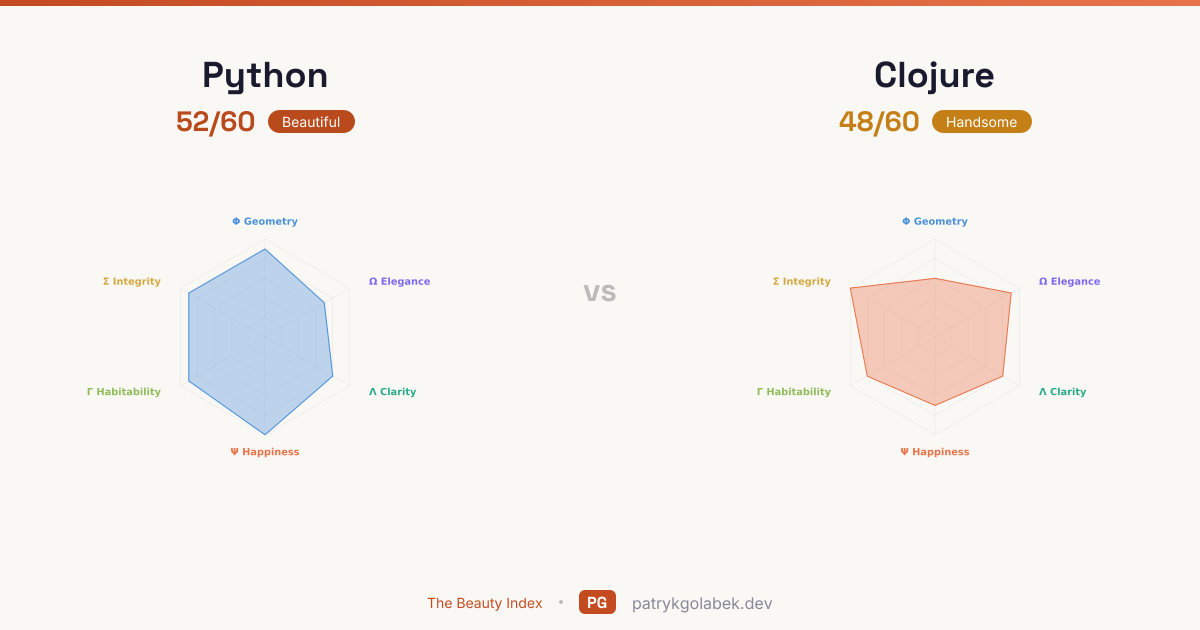
Python scores 52/60 against Clojure's 48/60, leading in 3 of 6 dimensions. Python owns aesthetic and human while Clojure leads in mathematical and design. Aesthetic Geometry is where the pair separates most cleanly — Python leads Clojure by 3 points and that gap colours everything else on the page.
See also: Python vs PHP , Python .
Dimension-by-dimension analysis
Φ Aesthetic Geometry
Python wins Aesthetic Geometry by 3 points — a meaningful cleanliness gap. Indentation is syntax. Python enforces geometric structure at the grammar level. A screenful of Python has natural visual rhythm with minimal punctuation noise. The difference is not cosmetic: Python rewards the eye, while Clojure asks the reader to absorb more punctuation and more ceremony. Clojure's parentheses-heavy syntax is unconventional, but it's regular and tree-like. The uniform (verb noun noun) structure has its own geometric coherence once you internalize the visual grammar. Not chaotic, just non-traditional. In a language where expressiveness is the selling point, visual calm amplifies the advantage.
Ψ Practitioner Happiness
Python wins Practitioner Happiness by 3 points — an unmistakable experiential gap. Universally liked, beginner-friendly, and the default choice across data science, web, scripting, and education. The community is enormous, warm, and productive. Packaging friction (pip vs. poetry vs. uv) is a real blemish, but the read-write experience remains unmatched in reach. The practitioner experience on Python is simply more fun, day in and day out, than on Clojure. A devoted, intellectually engaged community. The REPL-driven workflow induces genuine flow states. The ecosystem is mature (for its size). Docked because the community is small and Lisp-family syntax creates a real adoption barrier. The winner here invites the next generation of contributors without asking them to earn it first.
Ω Mathematical Elegance
Clojure wins Mathematical Elegance by 2 points — a clear algorithmic edge. Homoiconicity (code is data) enables metaprogramming that feels mathematical. Persistent data structures, lazy sequences, and transducers let you express algorithms with remarkable economy. Among the most "Book", like in practice. Where Clojure compresses an idea into a line or two, Python tends to spread the same idea across a paragraph. List comprehensions, generators, and first-class functions bring Python closer to mathematical notation than most dynamic languages. sum(x**2 for x in range(10)) reads like a formula. Not Haskell-tier, but a clear step above "workhorse" expressiveness. For high-level work, the gap compounds: fewer lines per algorithm means fewer bugs per feature.
Γ Organic Habitability
Python edges Clojure by a single point on Organic Habitability; the practical difference is slim but real. Python codebases age well. Duck typing, simple module structure, and a culture of readability make modification and extension feel natural. The language bends to the domain rather than imposing rigid abstractions. Both Python and Clojure age reasonably well; Python is merely a little kinder to the future reader. Immutable data and pure functions produce code that is inherently easy to extend and modify, no hidden state to trip over. Rich Hickey's "simple made easy" philosophy is the definition of habitable design. The winner here is the language you will still enjoy reading in five years.
Σ Conceptual Integrity
Clojure edges Python by a single point on Conceptual Integrity; the practical difference is slim but real. "Code is data. Data is code. Everything is immutable." Clojure is distilled philosophy, every design choice follows from a handful of axioms. Rich Hickey's talks are effectively the language's specification, and the language is the talks made concrete. Both Python and Clojure have coherent design philosophies; Clojure merely holds to its centre with a firmer grip. "There should be one, and preferably only one, obvious way to do it." The Zen of Python is a genuine design philosophy, not a marketing tagline. Guido's benevolent-dictator era gave the language a coherent soul that has mostly survived committee evolution. The winner's philosophical discipline is what keeps its idioms stable as the language evolves.
Λ Linguistic Clarity
Both score 8 — this is one dimension where Python and Clojure genuinely agree. The closest any general-purpose language gets to executable pseudocode. Variable naming conventions, keyword arguments, and minimal ceremony make intent self-evident to readers at nearly any experience level. On linguistic clarity the two converge; what separates them is elsewhere. Threading macros (->, ->>) transform nested Lisp into readable pipelines. The data-oriented philosophy, plain maps and vectors over custom types, makes intent transparent. Prefix notation is a barrier for newcomers, but the idioms are clear once learned. In high-level work, readable code is the difference between a 6-month onboarding and a 6-week one.
Code comparison
The characteristic code snippet that best represents each language.
from itertools import takewhile
def fibonacci():    a, b = 0, 1    while True:        yield a        a, b = b, a + b
squares = { n: n**2 for n in takewhile(lambda x: x < 100, fibonacci()) if n > 0}(defn process-users [users] (->> users (filter :active) (map :email) (map clojure.string/lower-case) (sort) (dedupe) (into [])))For/while iteration patterns and loop constructs.
Native pattern matching constructs for destructuring and control flow.
match command: case ["quit"]: quit() case ["go", direction]: move(direction) case ["get", item] if item in inventory: pick_up(item) case _: print("Unknown command")(require '[clojure.core.match :refer [match]])
(match [x y] [_ 0] "y is zero" [0 _] "x is zero" [a b] (str "both non-zero: " a ", " b))
(let [{:keys [name age]} person] (str name " is " age))Frequently asked questions
- Which is easier to learn, Python or Clojure?
- Python scores 10 on Practitioner Happiness versus Clojure's 7. Universally liked, beginner-friendly, and the default choice across data science, web, scripting, and education. The community is enormous, warm, and productive. Packaging friction (pip vs. poetry vs. uv) is a real blemish, but the read-write experience remains unmatched in reach. For classroom or self-directed study, the practitioner-happiness winner almost always has better learning materials and kinder error messages.
- Is Python or Clojure better for visually clean syntax?
- For visually clean syntax, Python has a clear edge — it scores 9/10 on Aesthetic Geometry against Clojure's 6/10. Indentation is syntax. Python enforces geometric structure at the grammar level. A screenful of Python has natural visual rhythm with minimal punctuation noise.
- Should I pick Python or Clojure in 2026?
- Python lands in the beautiful tier at 52/60; Clojure in the handsome tier at 48/60. With this spread, default to the higher-ranked language and reserve the other for projects where its specific strengths matter. The score difference reflects years of community use, tooling maturity, and the editorial judgment of the Beauty Index rubric.