
Python vs C
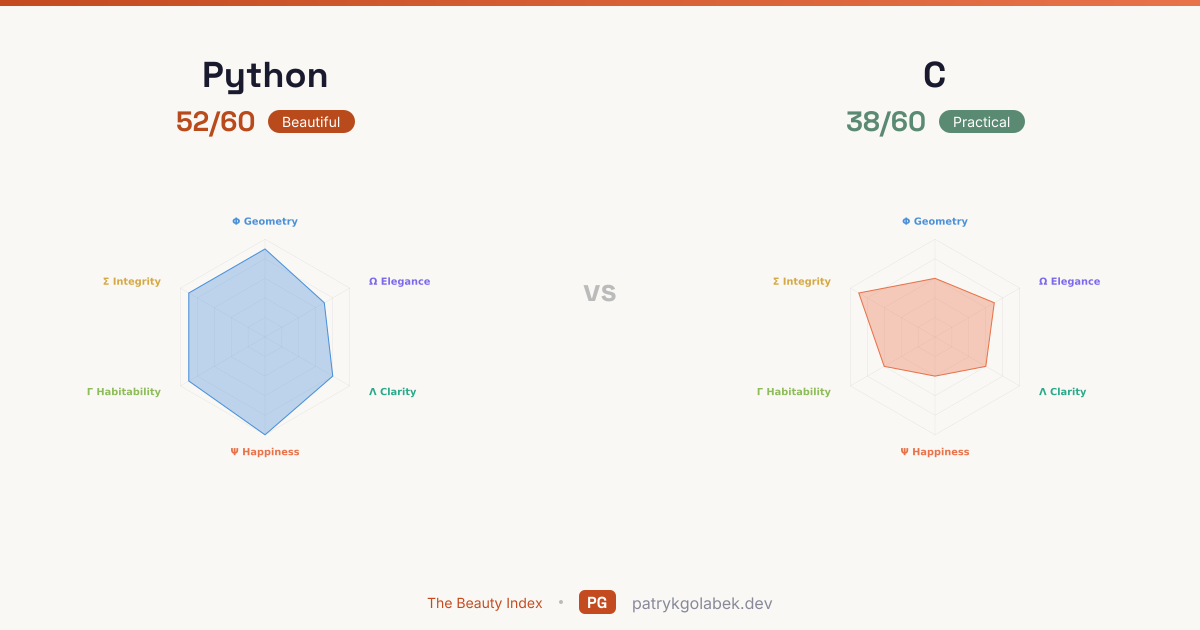
Python
Everyone's first love and nobody's last. Python's beauty is the beauty of clarity, indentation is structure, the most readable way is the correct way, and a newcomer can read someone else's code without a tutorial.
C
The grizzled veteran who built the foundations everyone else stands on. C gives you a knife, a piece of rope, and unlimited trust — the scars are your problem.
Python scores 52/60 against C's 38/60, leading in 4 of 6 dimensions. Python and C share the four axis clusters evenly, trading leads without either side claiming the frame. Read the comparison through Practitioner Happiness first: Python wins that axis by 6 points over C, and it is the single best lens on the pair.
Dimension-by-dimension analysis
Ψ Practitioner Happiness
Python wins Practitioner Happiness by 6 points — a decisive cultural edge. Universally liked, beginner-friendly, and the default choice across data science, web, scripting, and education. The community is enormous, warm, and productive. Packaging friction (pip vs. poetry vs. uv) is a real blemish, but the read-write experience remains unmatched in reach. Python has done the harder cultural work: tooling that delights, a community that welcomes, documentation that explains. Respected but not loved. Debugging segfaults, managing memory manually, and undefined behavior create constant friction. The tooling ecosystem is mature but the developer experience is unforgiving. The winner here invites the next generation of contributors without asking them to earn it first.
Γ Organic Habitability
Python wins Organic Habitability by 3 points — an unmistakable lead in how well code ages. Python codebases age well. Duck typing, simple module structure, and a culture of readability make modification and extension feel natural. The language bends to the domain rather than imposing rigid abstractions. The habitability gap shows in long-lived codebases — Python ages, C calcifies without careful discipline. C's simplicity means codebases can age well, and many have (Linux kernel, SQLite). But the lack of safety guardrails makes modification risky, one wrong pointer and you're debugging memory corruption. Habitable for experts, hostile to newcomers. For application codebases the habitability edge determines whether a project survives its second rewrite.
Φ Aesthetic Geometry
Python wins Aesthetic Geometry by 3 points — a clear geometric edge. Indentation is syntax. Python enforces geometric structure at the grammar level. A screenful of Python has natural visual rhythm with minimal punctuation noise. C, by contrast, accepts visual density in exchange for other priorities. C code can be visually clean, function signatures, struct definitions, and #define blocks have a spare, architectural quality. But pointer notation, preprocessor macros, and manual memory management create visual noise. In a language where expressiveness is the selling point, visual calm amplifies the advantage.
Λ Linguistic Clarity
Python wins Linguistic Clarity by 2 points — a clear signal-to-noise edge. The closest any general-purpose language gets to executable pseudocode. Variable naming conventions, keyword arguments, and minimal ceremony make intent self-evident to readers at nearly any experience level. Where Python favours plain intent, C trades clarity for control, capability, or history. C communicates what the machine is doing, not what the programmer intends. Skilled C programmers write beautifully clear code, but the language itself doesn't guide you toward Knuthian "wit." You earn clarity; it's not given. The winner here treats readability as a core feature rather than a style preference.
Ω Mathematical Elegance
Both score 7 — this is one dimension where Python and C genuinely agree. List comprehensions, generators, and first-class functions bring Python closer to mathematical notation than most dynamic languages. sum(x**2 for x in range(10)) reads like a formula. Not Haskell-tier, but a clear step above "workhorse" expressiveness. Algorithmically the two meet on equal ground; elegance is not what separates them. Algorithms in C are explicit and transparent, you can see every machine operation. This clarity has its own elegance, but the manual machinery (malloc, sizeof, void* casts) obscures the mathematical intent. Power, not economy. For high-level work, the gap compounds: fewer lines per algorithm means fewer bugs per feature.
Σ Conceptual Integrity
Both score 9 — this is one dimension where Python and C genuinely agree. "There should be one, and preferably only one, obvious way to do it." The Zen of Python is a genuine design philosophy, not a marketing tagline. Guido's benevolent-dictator era gave the language a coherent soul that has mostly survived committee evolution. Both Python and C feel designed by a single mind, even when they are not; on integrity they meet as equals. "Trust the programmer." Dennis Ritchie's design philosophy is one of the clearest and most consistent in computing history. Every C feature follows from the idea that the programmer should have direct, unsupervised access to the machine. For application code the integrity edge means fewer "wait, why does it behave that way?" moments per week.
Code comparison
The characteristic code snippet that best represents each language.
from itertools import takewhile
def fibonacci():    a, b = 0, 1    while True:        yield a        a, b = b, a + b
squares = { n: n**2 for n in takewhile(lambda x: x < 100, fibonacci()) if n > 0}void reverse(char *str) { char *end = str; while (*end) end++; end--;
while (str < end) { char tmp = *str; *str++ = *end; *end-- = tmp; }}For/while iteration patterns and loop constructs.
Data structure definition using classes, structs, records, or equivalent.
from dataclasses import dataclass
@dataclassclass User:    name: str    email: str    age: int = 0
def greeting(self) -> str: return f"Hello, {self.name}!"typedef struct { char name[64]; char email[128]; int age;} User;
void user_greeting(const User *u) { printf("Hello, %s!\n", u->name);}
User user = { .name = "Alice", .email = "a@b.c", .age = 30 };Frequently asked questions
- Which is easier to learn, Python or C?
- Python scores 10 on Practitioner Happiness versus C's 4. Universally liked, beginner-friendly, and the default choice across data science, web, scripting, and education. The community is enormous, warm, and productive. Packaging friction (pip vs. poetry vs. uv) is a real blemish, but the read-write experience remains unmatched in reach. For a newcomer picking up their first serious language in 2026, the happiness-score winner is the more forgiving starting point.
- Is Python or C better for developer happiness?
- For developer happiness, Python has a clear edge — it scores 10/10 on Practitioner Happiness against C's 4/10. Universally liked, beginner-friendly, and the default choice across data science, web, scripting, and education. The community is enormous, warm, and productive. Packaging friction (pip vs. poetry vs. uv) is a real blemish, but the read-write experience remains unmatched in reach.
- Should I pick Python or C in 2026?
- Python lands in the beautiful tier at 52/60; C in the practical tier at 38/60. On this score difference the answer is clear: the higher-ranked language wins unless you have an explicit reason to pay the cost of the other.