
Java vs Rust
Java
The enterprise middle manager who requires a meeting to schedule a meeting. Java turned verbosity into a virtue and AbstractSingletonProxyFactoryBean into a punchline.
Rust
The overprotective friend who's always right. Rust won't let you make mistakes, and you'll resent it until you realize every error it caught would have been a 3am production incident.
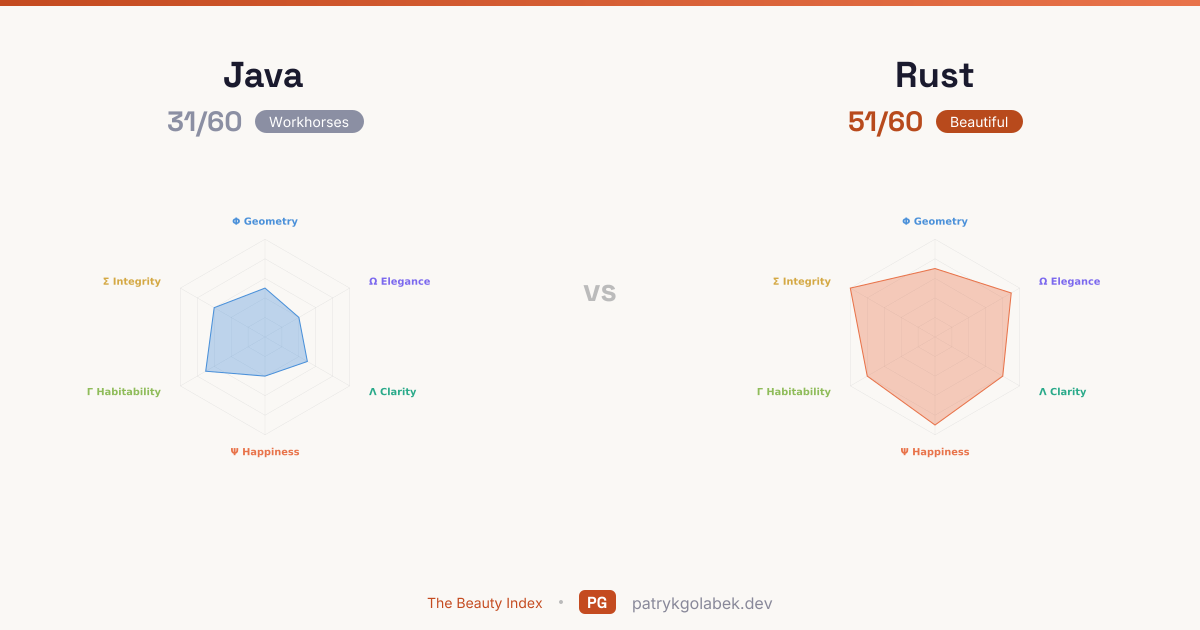
Rust scores 51/60 against Java's 31/60, leading in 6 of 6 dimensions. Rust dominates the aesthetic, mathematical, human, and design axes. The widest gap sits on Mathematical Elegance, where Rust's 5-point lead over Java shapes most of the pair's character.
See also: Elixir vs Rust , Java .
Dimension-by-dimension analysis
Ω Mathematical Elegance
Rust wins Mathematical Elegance by 5 points — a decisive elegance advantage. Algebraic data types, pattern matching, and zero-cost abstractions let you write algorithms that feel close to mathematical proofs. Ownership annotations interrupt the flow slightly — the ceremony is justified but still ceremony. Rust lets algorithms approach mathematical statement, while Java asks more of the programmer when elegance is the goal. Java's OOP-first design resists mathematical abstraction. Expressing algorithms requires ceremony, AbstractFactory, Iterator, Consumer<T>. The patterns are powerful but the opposite of Hardy's "economy." When performance and precision matter, the language that expresses the algorithm most directly wins twice.
Ψ Practitioner Happiness
Rust wins Practitioner Happiness by 5 points — a real happiness advantage. Topped Stack Overflow's "Most Admired" for 7+ consecutive years at 72%. The community is evangelical in its love. Compiler error messages are genuinely helpful. The "fighting the borrow checker" phase gives way to deep satisfaction. The practitioner experience on Rust is simply more fun, day in and day out, than on Java. Widely used, rarely loved. Stack Overflow admiration is moderate. The ecosystem is massive and mature, but developer experience surveys consistently place Java in the "tolerated" category. The JVM is respected; the language syntax is endured. Even in low-level work the human experience matters — the winner proves systems code need not be joyless.
Σ Conceptual Integrity
Rust wins Conceptual Integrity by 4 points — a decisive philosophical edge. "Safety without sacrificing control." Every feature (ownership, borrowing, lifetimes, traits) follows from this single idea. Rust is the most opinionated systems language ever designed, and every opinion is justified by the core philosophy. Where Rust holds a line, Java has negotiated with history, ecosystems, and legacy users. "Write once, run anywhere" was a clear mission, and the JVM delivered. But decades of committee-driven feature additions (generics via erasure, streams, modules, records) have layered paradigms without fully integrating them. Coherent enough, not focused. Philosophical unity in a systems language is a rare and load-bearing virtue.
Λ Linguistic Clarity
Rust wins Linguistic Clarity by 3 points — a meaningful clarity gap. Trait-based design, expressive enums, and the ? operator make intent clear. Rust rewards you with readable code once you know the idioms. Lifetime annotations are information for the compiler rather than the human reader, which docks it from 9. Where Rust favours plain intent, Java trades clarity for control, capability, or history. Java communicates intent through names and types, but the signal is buried under ceremony. AbstractSingletonProxyFactoryBean communicates structure but not wit. Java code is precise, but reading it is work. At the systems level clarity is sometimes sacrificed for control; the winner here refuses that trade.
Φ Aesthetic Geometry
Rust wins Aesthetic Geometry by 2 points — a decisive visual advantage. rustfmt enforces strong visual consistency, and match arms, impl blocks, and module structure create clear visual architecture. Docked because lifetime annotations, turbofish (::<>), and trait bounds add visual noise that breaks geometric serenity. The visual gap between the two is not subtle — where Rust prizes geometric calm, Java trades that serenity for other commitments. Java code is visually heavy, class wrappers, access modifiers, type declarations, and boilerplate create dense blocks. Modern Java (records, sealed classes) helps, but the language's verbosity is structural, not stylistic. The geometric advantage is felt most on the hundredth line, not the tenth.
Γ Organic Habitability
Rust edges Java by a single point on Organic Habitability; the practical difference is slim but real. Ownership rules force you to think about structure upfront, which often produces code that ages well. Some modifications ("I just wanted to add a reference here") cascade more than expected, but the type system catches the fallout. The habitability edge is slim and often dominated by team culture rather than language choice. Java's greatest strength: codebases survive decades. Backward compatibility is nearly absolute. Enterprise patterns, for all their verbosity, create predictable structures that large teams can maintain. Java is habitable in the way a well-run office building is habitable. At the systems level, long-lived code is the exception; the winner makes it the rule.
Code comparison
The characteristic code snippet that best represents each language.
Map<String, Long> wordFrequency = Files.lines(Path.of("book.txt")) .flatMap(line -> Arrays.stream(line.split("\\s+"))) .map(String::toLowerCase) .filter(w -> w.length() > 3) .collect(Collectors.groupingBy( Function.identity(), Collectors.counting() ));enum Shape { Circle(f64), Rectangle(f64, f64), Triangle(f64, f64, f64),}
fn area(shape: &Shape) -> f64 { match shape { Shape::Circle(r) => std::f64::consts::PI * r * r, Shape::Rectangle(w, h) => w * h, Shape::Triangle(a, b, c) => { let s = (a + b + c) / 2.0; (s * (s - a) * (s - b) * (s - c)).sqrt() } }}Embedding expressions and variables within string literals.
String name = "Java";int version = 21;
String msg = "Hello, %s! Version: %d".formatted(name, version);
String multi = """    Welcome to %s.    Version: %d    """.formatted(name, version);
String concat = "Hello, " + name + "! Version: " + version;let name = "Rust";let version = 2024;
let msg = format!("Hello, {}! Version: {}", name, version);let aligned = format!("{:<10} | {:>5}", name, version);let debug = format!("Value: {:?}", some_struct);
println!("Welcome to {name} {version}!");Data structure definition using classes, structs, records, or equivalent.
public record User(    String name,    String email,    int age) {    public String greeting() {        return "Hello, " + name + "!";    }}
var user = new User("Alice", "alice@ex.com", 30);#[derive(Debug, Clone)]struct User { name: String, email: String, age: u32,}
impl User { fn new(name: &str, email: &str, age: u32) -> Self { Self { name: name.into(), email: email.into(), age } }}Frequently asked questions
- Which is easier to learn, Java or Rust?
- Rust scores 9 on Practitioner Happiness versus Java's 4. Topped Stack Overflow's "Most Admired" for 7+ consecutive years at 72%. The community is evangelical in its love. Compiler error messages are genuinely helpful. The "fighting the borrow checker" phase gives way to deep satisfaction. For a developer adding a new language to their toolbelt, the happier one is the one you will still be writing in six months.
- Is Java or Rust better for algorithm-heavy code?
- For algorithm-heavy code, Rust has a clear edge — it scores 9/10 on Mathematical Elegance against Java's 4/10. Algebraic data types, pattern matching, and zero-cost abstractions let you write algorithms that feel close to mathematical proofs. Ownership annotations interrupt the flow slightly — the ceremony is justified but still ceremony.
- Should I pick Java or Rust in 2026?
- Java lands in the workhorses tier at 31/60; Rust in the beautiful tier at 51/60. On this score difference the answer is clear: the higher-ranked language wins unless you have an explicit reason to pay the cost of the other.